A zodiac animal identifies the year branch, not the whole year pillar or birth chart. For Ding-Wei 2027, common tables list Goat as matching, Ox as clashing, Rat as harming and Dog as breaking. The Ox–Goat–Dog xing group needs conditions and school-specific explanation; overlapping labels are not cumulative disaster points.
1. Your animal is the year branch—even the year pillar contains more
The twelve animals correspond to twelve Earthly Branches: Wei is Goat, Chou is Ox. A year pillar combines a Heavenly Stem with an Earthly Branch. In Ding-Wei, both Ding and Wei belong to the pillar; the animal tells you only Wei. Goat years can be Yi-Wei, Ding-Wei, Ji-Wei, Xin-Wei or Gui-Wei. Sharing the animal does not mean sharing the whole pillar.
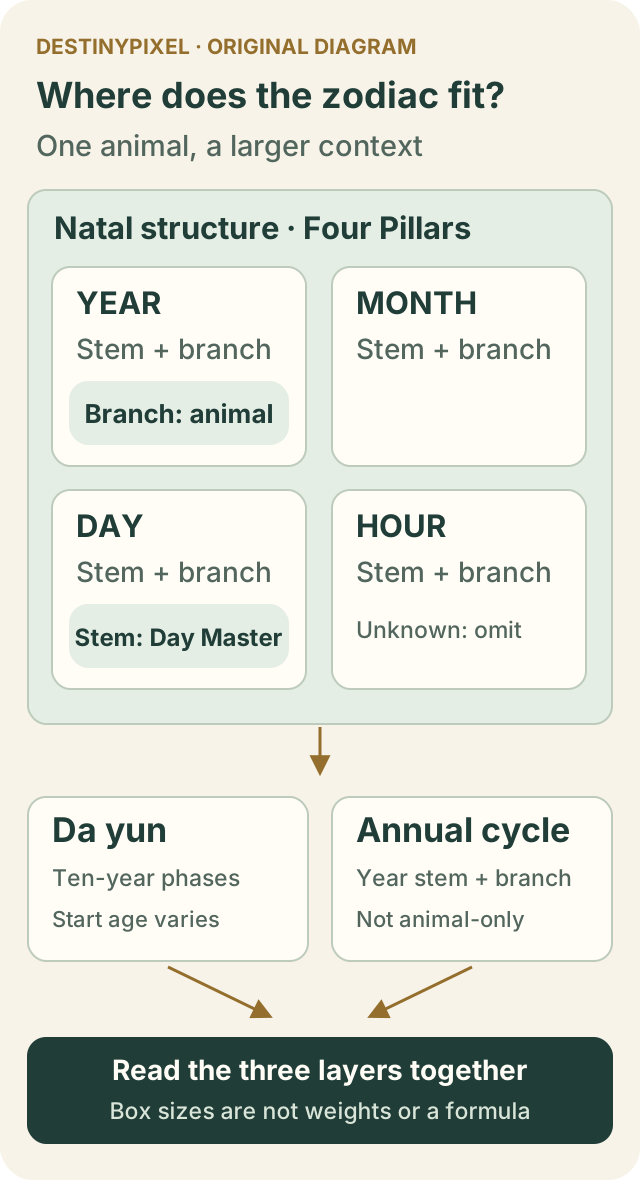
The Four Pillars pair stems and branches for the year, month, day and hour: eight characters in all. Traditional Zi Ping BaZi generally takes the day stem as its Day Master. A year animal is a narrow entry point, unable to replace the birth season, Day Master or other characters. There is no sound reason to turn that limitation into a fixed percentage. Reading a chart is not cutting eight equal slices of cake and handing the zodiac one slice.
2. Natal structure, major phases and the year: a joint reading
The natal structure is the Four Pillars at birth. Traditional readers consider the Day Master, season, relationships among stems and branches, hidden stems and other features before discussing strength, chart patterns and favourable or unfavourable influences. Schools differ in their methods. Da yun refers to traditionally derived major stem-branch phases, usually about ten years each; starting age and direction have their own conventions. Liu nian is the annual stem-branch pillar. These are not three independent report cards.
Here is a modern teaching metaphor: the natal structure is an existing stage set, a major phase is the wider setting of an act, and the annual pillar is a character entering the scene. The question is how they interact, not whether the newcomer has the word 'clash' on a badge. This metaphor is ours, not an ancient formula or evidence that the model controls events.
Volume Two of San Ming Tong Hui discusses major phases, the Day Master and Tai Sui together, with differing outcomes even when a stem-branch combination recurs. The source documents a traditional approach; its fortune statements are historical beliefs, not scientifically validated predictions. This article assigns no fixed percentages to year pillars or annual influences, and it does not derive a complete personal judgment from an animal.
3. Five Tai Sui terms do not mean five penalty notices
In everyday zodiac guides, fan Tai Sui often serves as an umbrella for certain relationships between a birth-year branch and the annual branch. That shorthand is less extensive than a full traditional discussion of Tai Sui. The table explains the common animal-based vocabulary. The English words 'punishment', 'harm' and 'break' name symbolic categories; they do not announce a court case, an injury or a broken possession.
| Term | Common meaning | What to check |
|---|---|---|
| Zhi · same branch | The birth-year branch repeats in the year; commonly called ben ming nian. | Matching branches need not mean matching whole pillars, or an adverse year. |
| Chong · clash | One of the six opposing branch pairs, such as Chou–Wei. | Traditional movement or opposition imagery cannot specify a job loss or breakup. |
| Xing · punishment | A particular xing relationship or group, including specified self-xing cases. | Name the group and conditions; readings do not all assign the same significance. |
| Hai · harm | One of the six hai pairs, such as Zi–Wei. | Symbolic friction is not proof that someone intends to harm you. |
| Po · break | A branch-breaking relationship under the chosen scheme, such as Wei–Xu. | Different systems give this category different emphasis. |
4. Which animals are involved in Ding-Wei 2027?
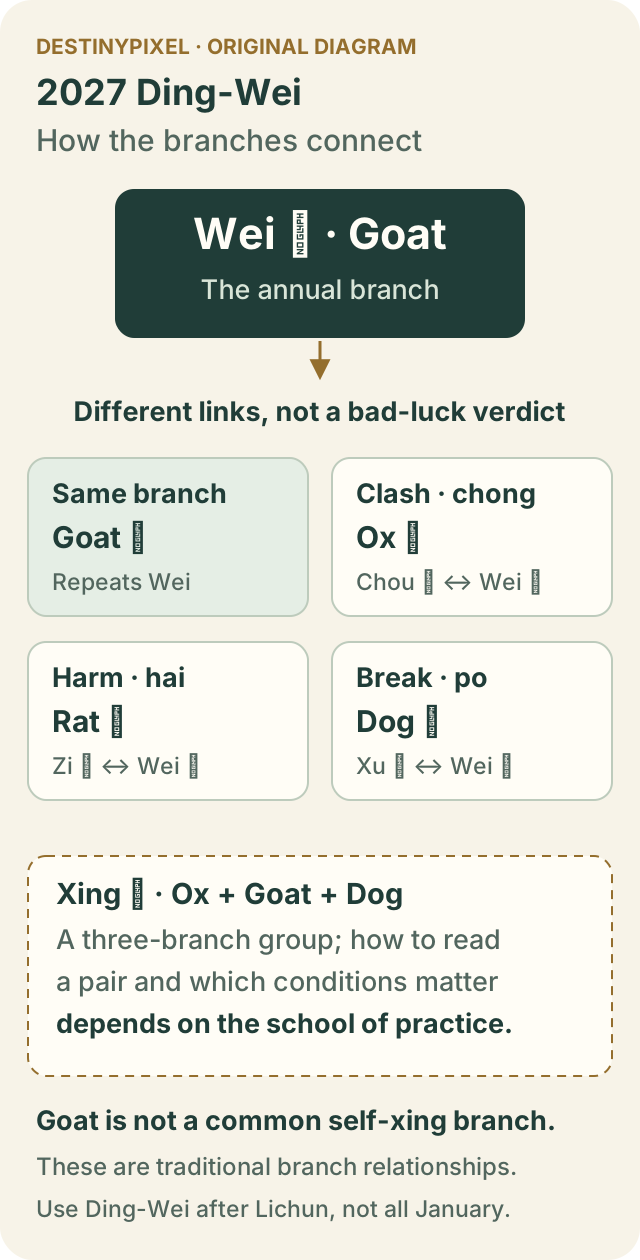
Start with Wei, the year's branch, and check each relationship. That is more informative than memorising a claim that a fixed number of animals 'offend Tai Sui'. This table follows a common zodiac-guide convention. The xing row keeps its qualifications visible rather than presenting one school's practice as universal.
| Relationship | 2027 animal / branch | Overlap and limits |
|---|---|---|
| Same branch | Goat / Wei | Wei meets Wei. This alone does not make it self-xing. |
| Clash | Ox / Chou | Chou–Wei is a clash pair. Ox can also appear in the xing discussion. |
| Ox–Chou, Goat–Wei, Dog–Xu group | Ox and Dog are often separately listed in animal guides. State whether a reading uses a pair, requires all three, or considers a particular direction and context. | |
| Harm | Rat / Zi | Zi–Wei is a hai pair. |
| Break | Dog / Xu | Wei–Xu is a po pair. Dog also belongs to the xing group. |
5. Why the Ox–Goat–Dog xing group needs a footnote
The xing chapter of San Ming Tong Hui lists Chou xing Xu, Xu xing Wei and Wei xing Chou, then discusses combinations and other chart conditions. It explicitly cautions against treating the appearance of xing as automatically adverse. Some readings discuss pairs; others emphasise the full three-branch group and its activation through phases or years. Knowing someone's year animal does not establish that the other branches occur in their natal chart or major phase. These approaches cannot all be presented as one unanimous rule.
Disagreement is not a footnote invented for the internet. The same chapter records different category names. A related Liu Ren text even disputes the Wei–Chou xing formulation. Liu Ren and BaZi are distinct divination systems; that source demonstrates disagreement in the literature, rather than settling a rule for every BaZi school.
One more useful distinction: the familiar self-xing list contains Chen, Wu, You and Hai—Dragon, Horse, Rooster and Pig. Wei, the Goat branch, is absent. In 2027 a Goat can be described as matching the annual branch; 'therefore it must also punish itself' does not follow.
6. Is it always three or four animals each year?
There is no fixed quota. First establish which relationships a list includes and how it treats xing; then remove repeated animals. Five categories do not mean five distinct signs. Two labels attached to one sign do not double a measured probability of trouble. Under the 2027 convention above, the commonly involved animals are Goat, Ox, Rat and Dog, with the xing qualifications from the previous section still attached.
In a different branch-year, the combinations and their overlaps change. Some guides list only matching and clashing signs; others add xing, hai and po, or include other symbolic markers. When two lists differ, compare their rules before assuming one has forgotten your animal. A zodiac table is an introduction, not an attendance register for future events.
7. Lunar New Year or Lichun? Say which boundary you mean
Popular New Year customs and the official lunar calendar usually refer to Lunar New Year's Day. The Hong Kong Observatory changes the lunar year's stem-branch designation at midnight Hong Kong time on the first day of the first lunar month. A common BaZi convention changes the year pillar at the precise Lichun, or Start of Spring, instant. DestinyPixel uses that BaZi convention. The two boundaries serve different purposes and should remain explicit.
The 2027 Hong Kong calendar places Lichun on 4 February and Lunar New Year's Day on 6 February. Lichun is an instant; converting it to another time zone can change its local date and time. It is not automatically midnight on 4 February everywhere. Our 2027 guide begins in January, so January and the period before Lichun retain the Bing-Wu year pillar; Ding-Wei begins at the boundary. Twelve Gregorian months are not forced into a single Goat-year label.
For a birth near a year boundary, check the recorded local date, time and birthplace, then the chosen convention. Subtracting one from the year on your phone does not resolve every boundary case.
8. Give 'be careful this year' an actual next step
Consider Lin, a fictional teaching example, not a user chart or a case from a classic. Lin is an Ox and already plans to change jobs in 2027. Reading 'clash' need not mean withdrawing an application or blaming every difficult interview on Tai Sui. Movement can become a prompt to check the probation clause, cash buffer and handover plan. Those checks are useful for every zodiac animal.
Another fictional person, Jo, is a Goat worried that a zodiac year will damage their relationship. A better question than 'Will we break up?' is 'What living arrangements matter most to each of us this year?' The answer comes from the partner. These are modern editorial exercises, not events calculated from an animal or instructions recovered from an ancient text.
If wearing red, visiting a temple or offering a blessing matters to you, it can remain a valued cultural practice. Participation should not be driven by threats. You do not need to buy a remedy package, and skipping a ritual is no reason to blame yourself when life is difficult. Actual health, financial or relationship concerns still call for evidence, practical action and appropriate help.
9. A star ranking, a personal guide and a small moment of peace
Our 2027 zodiac star ranking uses a disclosed modern editorial rubric to organise traditional imagery and everyday prompts. Ties are allowed, and your own zodiac year is not automatically ranked low. Its stars are not statistical probabilities, scientifically validated forecasts or a complete personal BaZi reading. Read the method before deciding which prompt to keep.
The free personal Year Ahead guide adds birth details for limited, separately explained BaZi and Western astrology perspectives. Its current BaZi section does not assess chart strength, favourable elements or major phases; it is not the full traditional synthesis discussed here. You may mark the birth time unknown: no noon is invented, no hour pillar is supplied, and unstable boundary items are omitted. The calendar still starts in January and changes its BaZi year pillar at Lichun.
Or visit Tai Sui Peace and light a small lamp for yourself. It is a cultural wish and a quiet personal moment, with no wishes collected and no promise to change fate. Understanding one term, clarifying one plan or taking a slower breath can leave you more room to meet the year.
Try it with a clear idea of what to expect.
Open your free 2027 guide · birth time optional