Read positions and images together
In Chapter 11 of Seventy-Eight Degrees of Wisdom, Rachel Pollack treats a spread as a relationship between images and positions. She also considers how cards support, constrain and develop one another. This guide draws on that approach and uses the ten positions currently shown in the DestinyPixel tarot tool. The grouping, questions and example below are our own teaching exercise.
Check which Celtic Cross you are using
Books and tools use different position names and dealing orders. Here, the positions are Present situation, Crossing influence, Underlying pattern, Recent past, Conscious focus, Possible direction, Your approach, Surroundings, Hopes and concerns, and Potential outcome. Keep those definitions consistent throughout the reading.
Position five deserves attention. Here, “conscious focus” concerns what occupies your attention or what you consciously seek. Pollack calls the upper position in her version “possible outcome” and discusses its relationship to the final outcome. Those roles are not interchangeable. We are not treating our fifth position as an additional prediction card.
If spreads are new to you, start with the three-card worked example, then return when you want to handle more information.
Start with facts you actually know
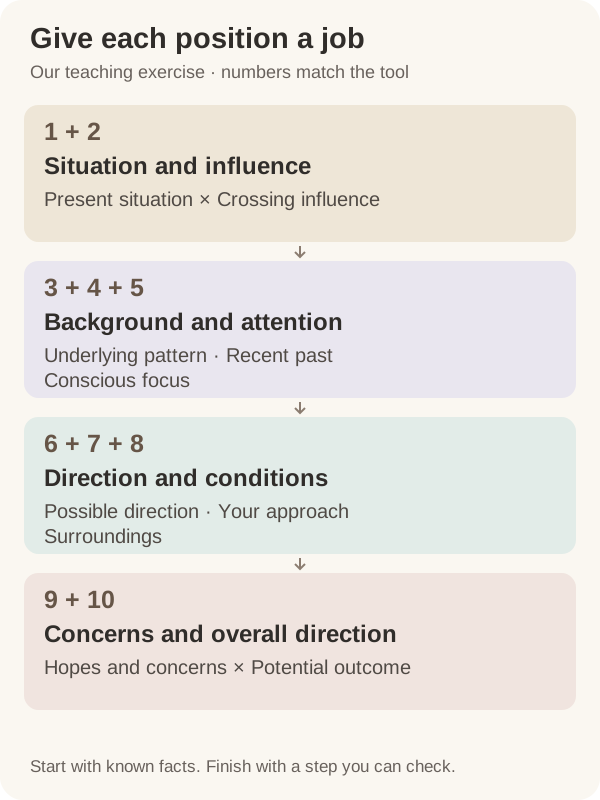
Imagine Lin wants to try running a weekend pottery class. A studio is available for one Saturday afternoon, and a friend with teaching experience has offered help. Several posts showing Lin's work received encouraging reactions, but nobody has confirmed a paid booking. The question is: “What should I do next to test whether this class is worth preparing further?”
The following cards are an invented teaching arrangement, all upright. This is neither a record of a real draw nor a case taken from Pollack's book.
| Position used here | First question | Hypothetical card |
|---|---|---|
| 1 Present situation | What needs coordinating now? | Two of Pentacles |
| 2 Crossing influence | What brings support or constraint? | Three of Pentacles |
| 3 Underlying pattern | Which known motive or habit still matters? | Four of Pentacles |
| 4 Recent past | What recent experience affects the present judgment? | Eight of Wands |
| 5 Conscious focus | What am I concentrating on or seeking? | Seven of Cups |
| 6 Possible direction | What deserves observation if current conditions continue? | Page of Pentacles |
| 7 Your approach | How can I participate and respond? | King of Swords |
| 8 Surroundings | What do other people and conditions actually provide? | Three of Cups |
| 9 Hopes and concerns | Which expectation or worry needs clarification? | The Tower |
| 10 Potential outcome | What overall direction can we describe and then check? | Temperance |
Read four relationships before ten separate speeches
These questions are learning prompts. Use the tool's own position labels, and consult the 78-card atlas when you need to check an image or a basic meaning.
Begin with positions one and two. The Two of Pentacles can prompt Lin to examine the coordination of time, materials and teaching. The Three of Pentacles brings collaboration into focus: what can the friend do, and does the studio permit a class? Cooperation may supply missing skills while adding coordination costs. Pollack explicitly allows the crossing card to support the first card. Whether this particular collaboration works requires an actual agreement.
Next, connect positions three, four and five. If Lin has already said that keeping costs manageable matters, the Four of Pentacles can bring that caution into the discussion. The Eight of Wands can connect with recent activity around sharing work. The Seven of Cups raises a question about the many classes Lin imagines offering: “Am I using encouraging feedback to justify developing too many options?” An “Underlying pattern” position does not give us permission to invent childhood experiences or hidden motives.
Then read six, seven and eight together. The Page of Pentacles can inspire a concrete learning experiment. The King of Swords suggests defining its terms: content, capacity and a booking deadline. The Three of Cups invites Lin to identify support from friends and community. Friends enjoying the pottery and people paying for a lesson remain separate facts to check. A short inquiry about interest is more useful than estimating bookings from a card.
Finally, connect nine and ten. In “hopes and concerns,” the Tower can help Lin clarify the worry: that the class may not happen, or that others may judge the public attempt? It cannot establish that something bad will happen to the studio. Temperance can bring the preceding conditions into a provisional plan: test a manageable class, adjust materials, timing and cooperation, then consider expansion. It does not guarantee market success.
These four groups are our exercise for this example. Pollack does not prescribe them as the single correct reading order.
Finish with something you can check
Lin's note might read: “The space and offer of help deserve confirmation. Positive reactions have not established paid demand. I will share a trial-class invitation with clear content, cost and timing, observe the actual response, and adjust its scale.”
Every card has contributed without taking over the conclusion. If the reading remains unclear, identify the missing fact, uncertain position definition or unresolved relationship first. The three-card connection guide offers practice with linking language and alternative interpretations. We use the spread to organize reflection, without presenting it as a scientifically validated prediction procedure.
After the reading, use our tarot journal guide to preserve the original interpretation and compare it with later information.
Versions and references
Pollack describes her own Celtic Cross variation. We draw on her treatment of images with positions, supportive crossing influences and outcomes read in context. We have not reproduced her case study. Reference: Rachel Pollack, Seventy-Eight Degrees of Wisdom, Chinese translation by Sun Meijun, Business Weekly Publications, December 2010 first edition, Chapter 11; consulted scan, PDF pages 331 (printed 333) and 336–348 (printed 338–350). These PDF page numbers apply only to the particular scan consulted for this article; other editions and scans may have different pagination.
Waite's The Pictorial Key to the Tarot, Part III, §7, 1911 online text uses a separate significator plus ten cards. In his dealing order, card three crowns, four is the foundation and five is the passing influence. The order here differs. His title, “An Ancient Celtic Method,” does not by itself establish an ancient Celtic origin. We do not adopt his significator rules based on age, gender or complexion.
Try it with a clear idea of what to expect.
Try the Celtic Cross