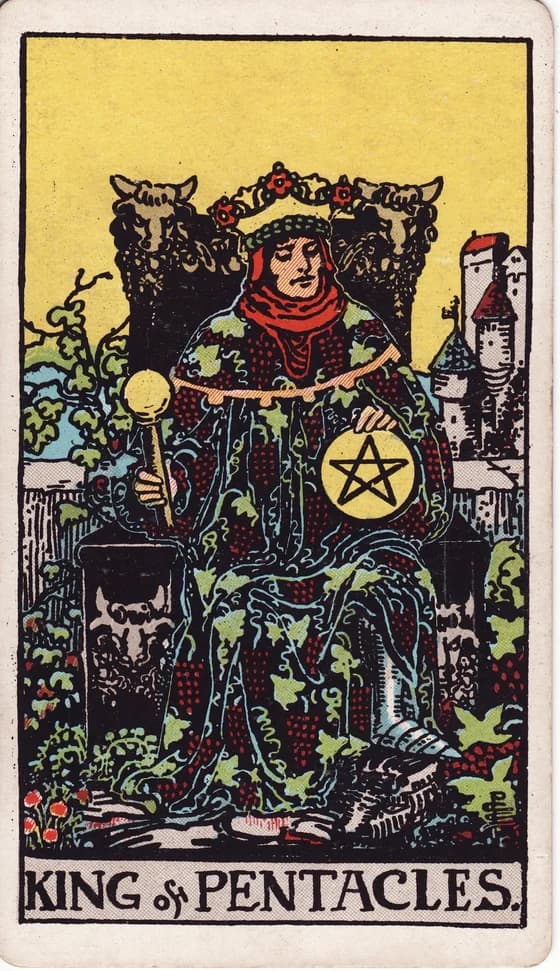
Bull heads recur on a heavy throne
The figure sits on a dark, high-backed throne, wearing a crown decorated with red flowers and red cloth around the neck. The dark robe is covered with green vine leaves and purple-red grape patterns. One hand holds a sceptre with a round finial; the other rests on a large pentacle. Bull heads appear at both upper corners and on both front sides of the throne.
An armoured foot emerges from the robe and rests against a carved base. Dense vines surround the figure, while a red-roofed castle stands behind on the right beneath a bright sky. The picture contains many things, yet the figure is not busy carrying them. Mature management is an interpretation drawn from the relation between possessions and surroundings, not a character trait proved by clothing. View the card image
Waite explicitly says Pentacles are not only about money
In the King of Pentacles entry, Waite draws attention to the recurring bull heads and explains the pentagram. He also explicitly says that the suit is not particularly confined to questions of money. The King's upright meanings emphasise courage, intelligence that brings things into effect, and aptitude in business and ordinary intellectual work.
The reversed list uses severe moral judgments. This article does not turn them into accusations against real people. Its modern approach concerns responsibility, the purposes resources serve and decisions that can be tested. The King is not restricted to a gender, and wealth is not proof of maturity. Check Waite’s text
Upright Put experience into dependable arrangements
The upright card can ask who is responsible for something continuing to work. That person needs to understand available resources, maintenance demands and manageable limits, and to know when another kind of expertise is needed. Experience is valuable when it brings judgment closer to reality, not when it exempts someone from explanation.
Resources may be tools, space, a team's time or accumulated knowledge. Clear rules for use can prevent repeated waiting and leave a way to handle exceptions. A sound arrangement can withstand questions and actual use by other people.
Reversed Notice when experience hardens into certainty
The reversal can ask whether status is replacing evidence: having succeeded before, you no longer listen to new constraints; controlling resources, you assume everyone should agree with every arrangement. Control may produce compliance while hiding information that belongs in the decision.
Another possibility is maintaining appearances while postponing necessary repairs. Return to observable operating conditions, listen to users and decide what needs changing. You can keep existing strengths while acknowledging that a method no longer fits.
Who maintains what has been built?
Running a shared studio requires more than buying equipment. It also needs maintenance, booking arrangements and instructions for newcomers. On a long-term project, regularly check actual progress and team workload rather than relying only on the pace of a previous success.
Major plans in a shared life also require everyone's participation. Providing more possessions or space may carry corresponding responsibilities, but does not automatically grant the final decision over everyone else.
Practice Check whether a resource is usable
Choose a shared resource you manage. Write down who uses it, how access is requested, who maintains it and whom to contact when something goes wrong. Ask a user to identify the most inconvenient part, then choose one concrete adjustment. Let actual use test your belief that things are arranged well.
Common misreading
The King of Pentacles is not a fixed label for a wealthy man, nor a guarantee of business success or safe returns. It can help discuss mature stewardship, but a title, wealth or one card cannot establish who is more moral or trustworthy.
Sources and image
The image was drawn by Pamela Colman Smith. The source manuscript was based on inspection of the standard 500px thumbnail listed on the file page; version details come from the Commons file page.
The historical discussion follows this card’s English entry in Part III, Section 2 of A. E. Waite’s The Pictorial Key to the Tarot. The source is the English transcription labelled [1911] by the Internet Sacred Text Archive. A physical 1910 first edition was not checked for this batch. The everyday situations, questions and exercises are original modern reflections, not direct translations of Waite’s book.