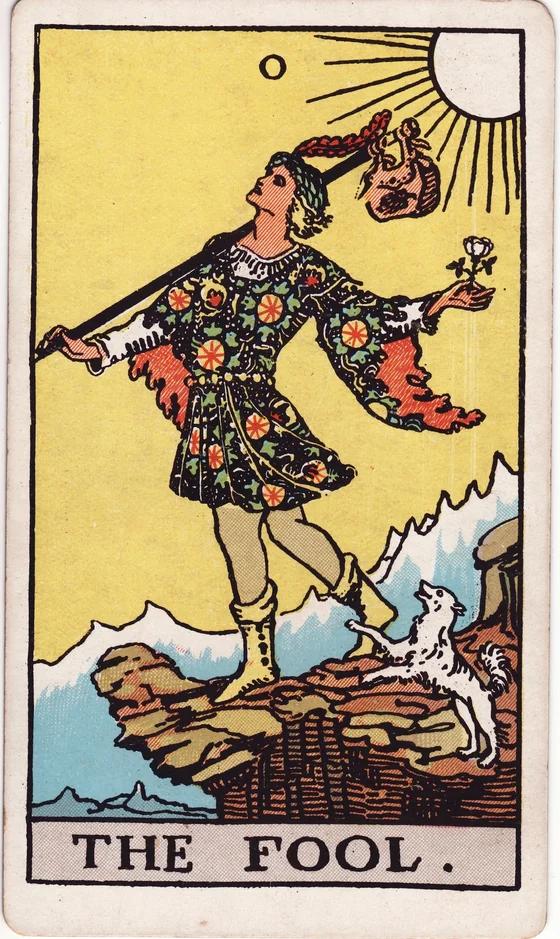
Looking into the Distance, Standing at the Edge
Yellow sky fills most of the picture, with a white sun appearing at the upper right. A young man wears a patterned tunic and a hat with a red feather. He looks upward toward the left of the picture. His right hand holds a long black staff across his shoulder, with a small bundle hanging behind it; his left hand lightly supports a white rose. His luggage is modest, and his posture relaxed and open.
Look lower down: one foot is close to the rocky edge, while the other is lifted behind him. A small white dog leaps at his feet, and blue-and-white mountains stand in the distance. The picture does show a cliff, but it shows neither a fall nor where his next step will land. Whether the dog is accompanying him, warning him, or following excitedly has no single answer in the image itself.
View the RWS artwork checked for this article
Now connect three details: the bundle shows that the traveler has not brought nothing; the rose leaves something delicate in his hand; the cliff means imagination alone cannot determine the next step. In a modern reading, these can prompt three questions: What experience can I take with me? What curiosity do I want to retain? Which risk must I check first? The white dog need not always mean a “benefactor” or an “obstacle.” A real-world warning may be incomplete and still deserve a hearing. If a redrawn deck puts a bridge or railing beneath the figure, the composition of risk has changed. Look again at the footing rather than reciting the cliff interpretation.
Waite's Traveler in Search of Experience
In his account of the card's symbolism, Waite describes the figure as a spiritual traveler seeking experience. He specifically notes that the figure is paused at this pictured moment, yet retains the eagerness of walking. This gives the Fool momentum while leaving room to choose the next step.
The familiar modern phrase “a new beginning” is a useful learning theme to develop from this picture. It should not be treated as a literal translation of all Waite's old divinatory entries. His separate entry for the Fool differs considerably from this description of a spiritual traveler.
Understanding the Upright Card
Upright, the card can suggest a willingness to encounter something unfamiliar. You may not yet have much experience, but you can ask questions, try things, and allow yourself to be unskilled for a while. You do not need an expert's identity before you begin learning.
In practice, the point is to give an experiment manageable limits: take one introductory class, attend one open event, or complete one small experiment. Knowing how much you will invest and when you will stop to review can help curiosity carry you further.
Understanding the Reversed Card
This article reads the reversed card as a prompt to check the pace of setting out. One possibility is that novelty has eclipsed the time, expense, or agreements involved. Another is that you insist on knowing everything before allowing yourself to begin, and remain where you are.
To distinguish them, ask: Am I missing necessary information, or tolerance for uncertainty? The former calls for more information; the latter may call for a smaller experiment that is easier to leave. Reversal does not mean you are immature, and it cannot determine which path is bound to fail.
Distinguishing Related Meanings
The Fool and the Magician can both concern beginnings, but they ask different questions. The Fool makes room for not knowing and asks whether you are willing to enter experience; the Magician already has the tools laid out and asks how to organize an action. If someone has never tried painting, taking one class is closer to the Fool. If they already have work but keep putting off showing it, they may need the Magician's kind of organization. In an advice position, the Fool often suggests making an experiment small. In an obstacle position, the same light luggage might suggest insufficient preparation. The spread position changes the question; seeing an upright card alone is no reason to urge someone forward.
Trying Pottery for the First Time
Original fictional case. Xiaohe asks, “I want to learn pottery. How can I start in a way that makes me less likely to give up halfway?”
Known facts: She has saved many pictures of pottery but has never handled clay. Nearby options include single introductory sessions and a six-month course requiring full payment in advance. She has only one free evening each week. She draws the upright Fool in the advice position.
The Fool's upturned face and cliff edge correspond to her attraction to finished pieces and her unfamiliarity with the actual cost of practicing. The little bundle can become a limited investment: this time, learn how clay feels and how classes fit her schedule, rather than rushing into a long-term identity as a pottery enthusiast. The reading cannot promise that she is talented or interpret one failure as proof she is unsuited to it. What the first class really needs to answer is whether she wants to keep kneading clay, cleaning up, and waiting for firing.
Another possibility: If she has actually practiced for six months and is only worried about being judged when she enrolls, “try it first” would underestimate her preparation. The question should instead be what kind of feedback would support further learning. If the cost already exceeds what she can afford, look for a free open day first.
A practical next step: Attend one affordable introductory session. Afterwards, separately note the parts of the process she liked and disliked, then check transport, material costs, and cancellation terms. Wait until she has practiced twice before deciding on a long-term arrangement, bringing her interest out of photographs and into a real week.
A New Friend: Let Enthusiasm Keep Pace with Understanding
Original fictional case. Ayuan asks, “A friend I've just met has invited me on a trip. Should I agree now?”
Known facts: They have met only once and got along very well. The trip has no clear accommodation arrangements, and the other person wants full payment that day. Ayuan does not want to spoil the mood. He draws the reversed Fool in the position indicating what needs attention.
The reading chosen here is “moving faster than your understanding,” because payment and accommodation information really is missing, not because the new friend must be unreliable. The cliff edge brings attention back to footing: liking someone can be genuine while the scope of a commitment already exceeds the experience they have shared. Reversal invites him to check whether he has confused “staying open” with “not being allowed to ask questions.”
Another possibility: If the itinerary is transparent, refund terms are clear, and the two already have dependable shared experiences, the reversed card might point to excessive fear of a new relationship. In that case, they could discuss a smaller shared activity rather than rejecting every invitation.
A practical next step: Ask the other person to complete the arrangements, hold off on paying an amount he could not afford to lose, and suggest a short daytime outing. The way the person responds to reasonable questions becomes new real-world information. The card itself is not responsible for judging their character.
A Small Exercise
Write down one small thing you have long wanted to try. Add two lines: “The cost of experimenting that I am willing to accept is…” and “I will reassess after….” Make the first step small enough to complete this week.
A Common Misreading
The Fool does not mean “jump with your eyes closed and the universe will catch you.” The white sun, rose, and buoyant posture make the picture bright, but the cliff remains. Learning this card means retaining both openness and basic care for yourself.