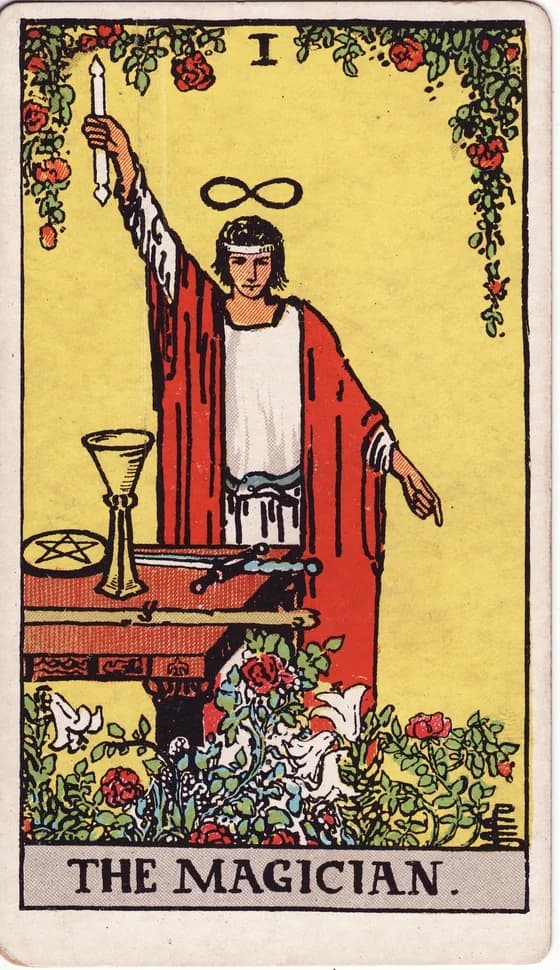
One hand raised, the other pointing down
Against a bright yellow background, a figure in a white inner robe and red outer garment faces the viewer. His right hand, on the left of the image, raises a short white wand that tapers at both ends. His left hand reaches down, its index finger pointing toward the ground. A sideways figure eight floats above his head, and a serpent-shaped belt circles his waist.
On the table are a cup, sword, pentacle, and horizontal wand. Red roses hang overhead; red roses, white lilies, and green foliage mingle in the foreground. Your eye can travel from the raised hand through the figure and table to the garden below. Reading this arrangement as a connection between intention, available tools, and growth is our response to the composition.
From a mystical gesture to practical action
Waite interprets the upward and downward gestures as a transmission of grace, power, and light from above to below. He relates the four suit emblems to the elements of natural life and the garden flowers to the cultivation of aspiration. These ideas have a specific religious and esoteric background. They are not a modern promise that wanting something will make it happen.
From that background, this article develops a practical question: how can an inner intention become an outward action? Resources can include skills, time, language, and people you can consult, as well as physical objects.
Reading it upright
Upright, the Magician emphasizes actively drawing on your abilities. After a period of preparation, you may need to choose one goal and organize what is available. The point is not to prove that you can do everything. It is to know which skill to use first and how much to do before you can gather useful feedback.
Expression is part of action. Making a clear request, writing a proposal, or showing someone a rough prototype can move an idea out of your head and into the world. Give confidence a concrete basis: what have I done, what is missing, and where do I need help?
Reading it reversed
Here, the reversal checks whether resources and action are actually connected. Equipment bought but never used, constant changes of method, or promises that run ahead of effort can all offer useful starting points.
Find the real gap. Are there too many goals, a missing skill, or a first step too large to approach? Do not automatically blame a lack of willpower. When another person is involved, compare specific promises with what is delivered. A card cannot establish that they are deceiving you.
Everyday examples
A plan that never gets started
Turn the most-discussed part into a small demonstration. Ask what the sample needs to test before choosing a tool, so selecting tools does not become a new way to delay.
Improving communication
Turn “I wish we were closer” into a specific invitation, with a time and something to do together. Leave room for the other person to adjust or decline. Taking initiative does not give you control over their response.
Courses and saved resources keep piling up
Choose one resource you already have and spend twenty minutes using it to do something. Let one real attempt inform whether you need another course.
A short exercise
Make three columns: “What I already have,” “What I genuinely need,” and “What I can finish today.” Once the first two are clear, choose just one action from the third and give it a visible finish line.
A common misreading
The infinity sign does not make personal ability limitless, and the four tools do not guarantee success. The Magician draws attention to what you can actively influence. Conditions, other people’s choices, and feedback still shape the outcome.
Artwork and English-language sources
- Pamela Colman Smith, The Magician, RWS Pam-A
- A. E. Waite, The Pictorial Key to the Tarot, Part II, I. The Magician (1911 transcription)
- A. E. Waite, The Pictorial Key to the Tarot, Part III §3, The Greater Arcana and Their Divinatory Meanings (1911 transcription)
Each image was individually inspected. The English source is the transcription labelled 1911; the artwork is the Pam-A scan identified on Commons. Sources checked: 2026-10-07.
The upright and reversed interpretations, examples, and exercises are original material for reflection, not line-by-line translations of old divinatory lists. Tarot cannot establish future events, another person’s thoughts, or a health condition.