A scroll we can read only in part
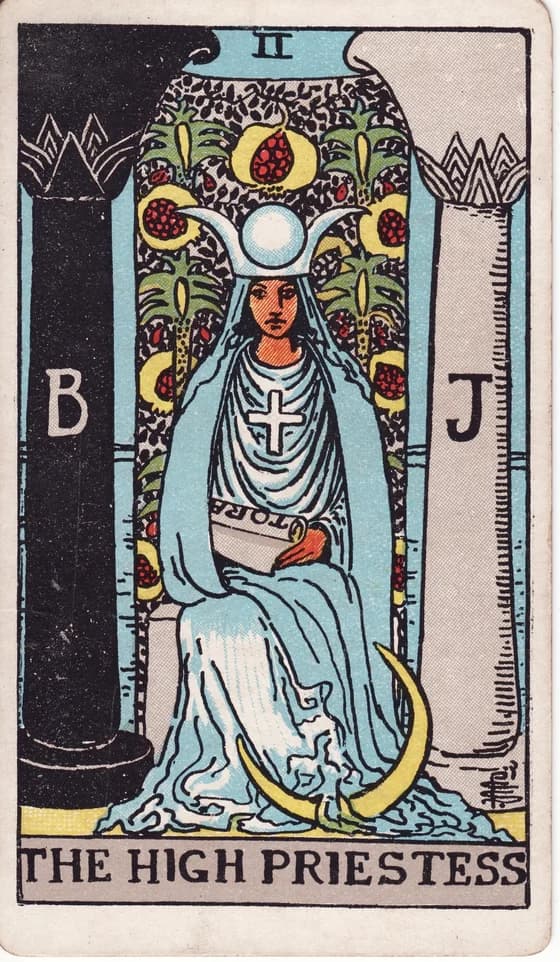
She sits between two tall pillars. On the left of the picture, a black pillar bears a white B; on the right, a white pillar bears a black J. Her blue-and-white garments flow to the ground, a white cross rests on her chest, and her crown combines curved, horn-like sides with a central disc. A yellow crescent moon lies against the lower part of her robe.
The scroll lies diagonally across her lap. It is inscribed TORA and partly covered by fabric. Behind her, a veil is patterned with pomegranates and palms, with narrow glimpses of blue at either side. The figure, pillars, and veil form a stable, frontal composition: part is available to us, while another part remains beyond view. She neither beckons nor displays the entire scroll.
Hidden knowledge is not evidence of someone’s secret
Waite explicitly explains the partly covered scroll as a sign that some things are spoken and others implied. He connects the veil and pillars with hidden religious knowledge and interprets the High Priestess through his own esoteric framework. “Hidden” has a historical context here; it is not an accusation that a real person is concealing something.
This article uses the image to practise patient observation: allow yourself not to know yet, while noticing feelings that have not taken a clear verbal form. Intuition may suggest where a further question would help, but it still needs to be checked against evidence.
Reading it upright
Upright, the card can suit a moment that calls for listening, watching, or allowing information to develop. Hear someone out before answering. Notice unstated assumptions in a document. When choosing, investigate why a detail gives you pause.
Quietness need not mean inactivity. You can record observations, ask questions, hold back an uncertain judgment, and set limits on how long to wait. Her scroll reminds us that understanding what we have not read is itself a valuable kind of knowledge.
Reading it reversed
This reversal focuses on two possible problems: turning a strong feeling straight into a conclusion, or suppressing feelings and questions until other people cannot understand your silence. Both call for greater clarity.
Write separately what you observed, what you feel, and what you suspect might explain it. If the three are tangled together, avoid jumping to a conclusion. If the evidence is sufficient but you keep waiting, consider whether it is time to express a need or respond.
Everyday examples
Something feels wrong in a meeting
Record the exact statement that gives you pause and ask about the missing condition. Turn “I have a bad feeling” into an answerable question, giving intuition a chance to produce useful information.
Someone is replying less often
First establish what has actually changed, then ask how they are. The High Priestess cannot read their mind or turn uncertainty into proof of concealment.
A plan is not ready to be shared
You can protect an idea while it takes shape. Still, identify who needs to know now and when a conversation would be appropriate. Making space and postponing a necessary conversation need separate attention.
A short exercise
Choose an unresolved question. Write three facts, three feelings, and three guesses in separate groups, then circle one question you can check. Investigate only that question today instead of rushing to fill every gap.
A common misreading
The High Priestess does not say that intuition is always right or that you should wait indefinitely. The pillars’ black-and-white contrast is first a feature of the image. It does not assign good and evil to two people in your life.
Artwork and English-language sources
- Pamela Colman Smith, The High Priestess, RWS Pam-A
- A. E. Waite, The Pictorial Key to the Tarot, Part II, II. The High Priestess (1911 transcription)
- A. E. Waite, The Pictorial Key to the Tarot, Part III §3, The Greater Arcana and Their Divinatory Meanings (1911 transcription)
Each image was individually inspected. The English source is the transcription labelled 1911; the artwork is the Pam-A scan identified on Commons. Sources checked: 2026-10-07.
The upright and reversed interpretations, examples, and exercises are original material for reflection, not line-by-line translations of old divinatory lists. Tarot cannot establish future events, another person’s thoughts, or a health condition.