Water, grain, and a place to sit
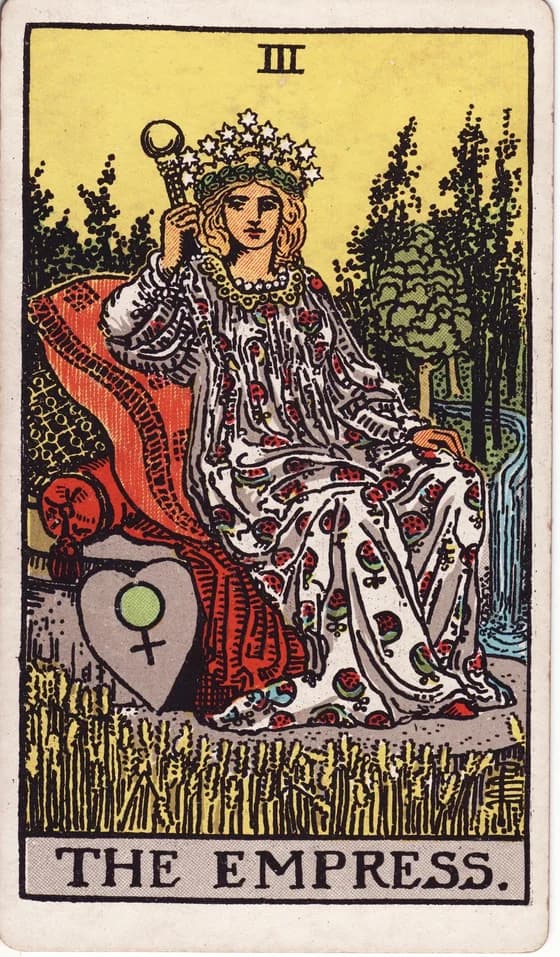
She wears a pale gown patterned with pomegranates and sits before a red cushion. Stars and green leaves adorn her head. Her right hand raises a sceptre topped by a globe; the other rests naturally beside her knee. No enclosing high wall surrounds her seat, echoing the softness of the folds in her dress.
Ripe golden grain fills the foreground, with dense woodland behind. On the right, a blue stream curves out from the trees and falls in a small waterfall. A heart-shaped shield bearing the sign of Venus rests at the lower left. Follow the water toward the grain, then back to the figure’s body. The abundance here is tangible: it can be experienced and needs to be sustained.
Making sense of the imagery of fruitfulness
Waite identifies the crown of twelve stars, the Venus symbol, ripening grain, and falling water. He places the Empress within the symbolism of an earthly paradise and universal fruitfulness. The Venus sign is a visible historical element of this image; this article does not use it to make astrological or compatibility claims.
For present-day study, “fruitfulness” can extend to creative work, relationships, living conditions, and ongoing care. That reading requires no particular gender, family role, or experience of having children.
Reading it upright
Upright, the card can ask what sustainable support this situation needs in order to grow. Perhaps it needs regular time, sufficient materials, an atmosphere that allows mistakes, or patience restored through rest. The Empress’s creativity is grounded in the body and daily life.
She also makes room for receiving what is already good. Eating a meal with attention, appreciating your work, or accepting appropriate help need not wait until every task is finished. Recognizing what nourishes you helps you decide what deserves continued effort.
Reading it reversed
Here, the reversal suggests an imbalance in how care is offered. You might keep organizing things for someone without asking what they need. Or you might protect your comfort so closely that you avoid the practice new growth requires. Too much intervention and too little care can both restrict growth.
Check whether your giving is willing and sustainable, and whether the person receiving it still has room to act independently. If creative work has stalled, look at the specific conditions before blaming a lack of inspiration.
Everyday examples
Writing or design has stalled
Make room for regular creative time and usable materials, and allow a rough first draft. Rather than demand results every day, check whether the work has conditions in which it can develop through repeated attempts.
You are always looking after others
Ask, “Do you need me to listen, or would you like us to think through solutions?” Say how much help you can offer as well, instead of hiding exhaustion behind “Anything is fine.”
Making your home more comfortable
Start with something you use often: the light, a desktop, or where you eat. Comfort can be a serious way of caring for daily life, while staying within your budget and capacity for upkeep.
A short exercise
Imagine tending a plant. Give a current project its “water, soil, and light”: what practical condition does each stand for? Find the one most lacking and make one small, sustainable provision for it.
A common misreading
The Empress cannot confirm pregnancy, diagnose a condition, or promise wealth. Abundance in the picture does not mean an endless supply. Good care includes rest, shared responsibility, and boundaries.
Artwork and English-language sources
- Pamela Colman Smith, The Empress, RWS Pam-A
- A. E. Waite, The Pictorial Key to the Tarot, Part II, III. The Empress (1911 transcription)
- A. E. Waite, The Pictorial Key to the Tarot, Part III §3, The Greater Arcana and Their Divinatory Meanings (1911 transcription)
Each image was individually inspected. The English source is the transcription labelled 1911; the artwork is the Pam-A scan identified on Commons. Sources checked: 2026-10-07.
The upright and reversed interpretations, examples, and exercises are original material for reflection, not line-by-line translations of old divinatory lists. Tarot cannot establish future events, another person’s thoughts, or a health condition.