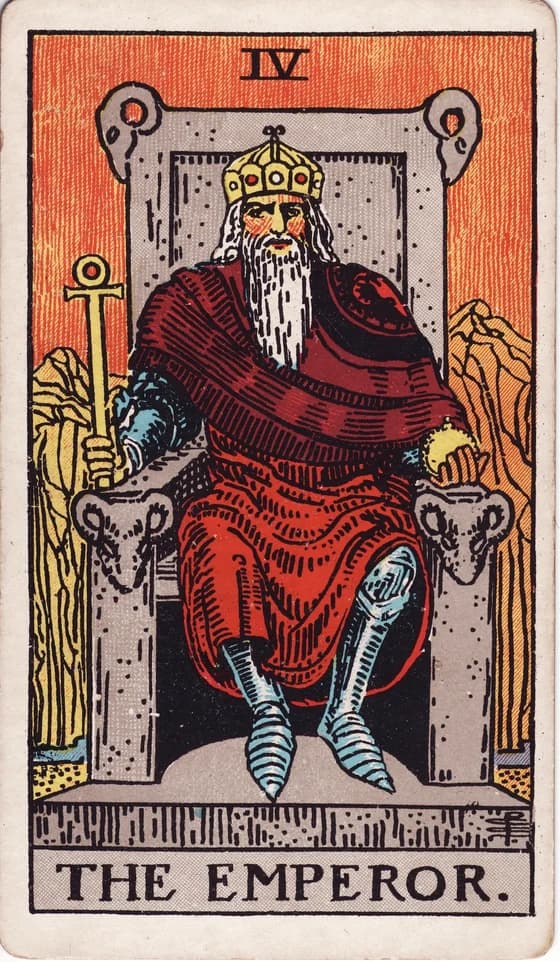
Armour remains beneath the red robe
A white-bearded figure wearing a gold crown sits facing us on a grey stone throne. Rams’ heads decorate its upper corners and the fronts of its arms. On the left of the image, he grips a sceptre topped by a looped cross; in the hand on the right, he holds a golden globe. A red robe covers his body, while blue-grey armour remains visible on his arms, lower legs, and feet.
His feet rest on a broad base. Steep, sparsely vegetated mountains rise behind him, with a narrow blue band of water at their foot. The chair’s back, arms, and platform establish clear boundaries around him, and the surrounding rock extends their solidity. Compared with the Empress’s flowing garden, this composition stresses a fixed position and a load-bearing structure.
Authority also means taking responsibility
Waite associates the Emperor with execution and realization in the world, power, and the governance of thought. His divinatory list also includes stability, protection, authority, and will. He cautions against reducing the Emperor and Empress to a literal story about a married couple.
This article turns authority into questions about responsibility: who can decide, who bears the consequences, and whom do the rules protect? That is a modern learning approach, not a fixed identification of the figure with a man, father, or manager in your life.
Reading it upright
Upright, the card is useful for checking whether arrangements are clear enough. A goal needs someone accountable; collaboration needs a division of work; personal life needs boundaries that can actually be maintained. Good rules tell people what they can rely on and who will respond when something goes wrong.
Responsibility also includes stating limits. Confirm the workload before setting a deadline; explain your available time before promising care. Stability does not require one person to make every decision. It requires a sound basis for decisions and a clear way of carrying their consequences.
Reading it reversed
Here, the reversal identifies two structural problems: rules too rigid to respond to reality, or rules for which nobody takes responsibility. The first might require approval at every step; the second might leave everyone assuming that someone else will handle the task.
Locate the particular problem before changing things. Is an owner missing, does approval take too long, or do boundaries need another conversation? Do not label someone domineering on the strength of a reversed Emperor. Also notice whether you are treating every disagreement as a challenge to your authority.
Everyday examples
Things keep getting missed in a group
Give each task a named owner, a definition of completion, and a time to check it. Repair gaps in responsibility before simply asking everyone to care more.
Someone close repeatedly asks for last-minute help
Explain the time you can offer and what you cannot take on. Specific boundaries let them plan instead of having to guess how much you can tolerate.
You are leading a team
Distinguish shared standards from methods you can leave to others. You are responsible for outcomes and fair working conditions; you do not need to make everyone a copy of yourself.
A short exercise
For one recurring problem, write four statements: who is responsible, what counts as complete, when it will be checked, and how exceptions will be handled. Ask the people involved to agree, rather than keeping the new rules only in your head.
A common misreading
The Emperor does not mean that greater force makes a decision more correct. His throne and armour suggest stability and protection, while inviting questions about excessive rigidity. A useful structure carries weight and can be revised when conditions change.
Artwork and English-language sources
- Pamela Colman Smith, The Emperor, RWS Pam-A
- A. E. Waite, The Pictorial Key to the Tarot, Part II, IV. The Emperor (1911 transcription)
- A. E. Waite, The Pictorial Key to the Tarot, Part III §3, The Greater Arcana and Their Divinatory Meanings (1911 transcription)
Each image was individually inspected. The English source is the transcription labelled 1911; the artwork is the Pam-A scan identified on Commons. Sources checked: 2026-10-07.
The upright and reversed interpretations, examples, and exercises are original material for reflection, not line-by-line translations of old divinatory lists. Tarot cannot establish future events, another person’s thoughts, or a health condition.