Standing behind the listeners
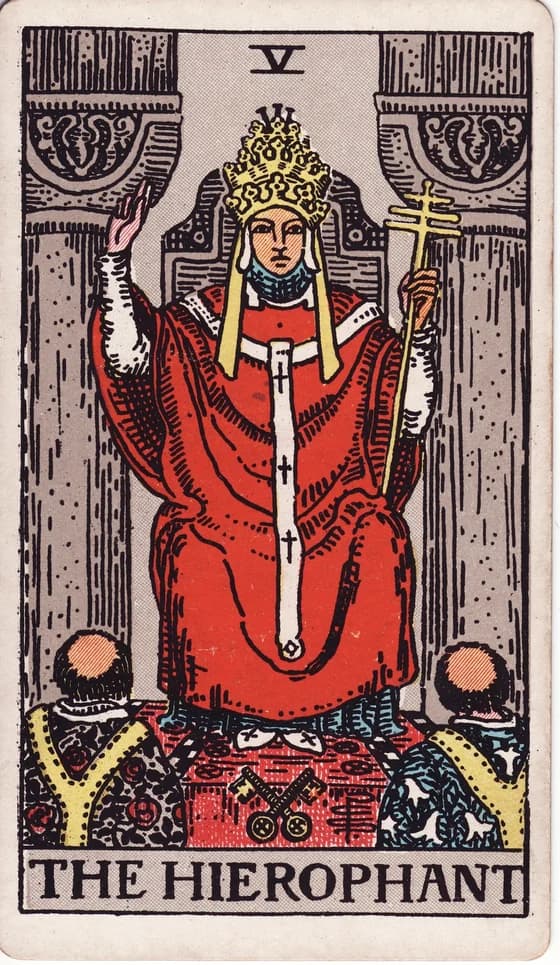
The central figure wears a red robe and triple crown and sits between two grey pillars. The hand on the left of the image rises in blessing, while the other holds a cross-staff with three horizontal bars. A white band bearing a row of crosses hangs down the front of his robe.
In the foreground, two kneeling figures face away from us, the centres of their heads shaved. Their garments bear rose and lily patterns respectively. Crossed keys lie between them at the Hierophant’s feet. The arrangement separates teacher from recipients and places us behind the listeners. Compared with the High Priestess’s partly hidden scroll, this is a form of knowledge visibly presented for transmission.
Between inheritance and rigidity
Waite specifies that these are not the same pillars as those beside the High Priestess. He connects the Hierophant with external religion, formal doctrine, and recognized institutional order. He also observes that a ritual representative can forget that he represents a larger symbol rather than containing its entire meaning himself.
That leaves two considerations for readers today: tradition can preserve experience, but authority can also become an empty form. Applying these ideas to schools, professional training, or community standards is this article’s modern extension. It does not mean Waite lists those settings himself.
Reading it upright
Upright, the card can encourage you to use an established path of learning. Consulting a teacher, joining a course with feedback, or understanding a profession’s shared standards can reduce the cost of working everything out alone. You do not need to invent every step to demonstrate independence.
While accepting guidance, you can still ask about a method’s purpose, evidence, and limits. Learning it properly means understanding why a rule exists and applying it in the right circumstances, rather than merely memorizing the approved answer.
Reading it reversed
This reversal asks whether a method fits the situation. Perhaps an old process has lost its purpose, or you are following demands you do not believe in to win approval. Another possibility is skipping essential foundations simply because you dislike being taught.
Clarify what you object to: the rule, its implementation, or the person proposing it. If you want a change, explain how an alternative would still provide the necessary quality and fairness. Questioning and learning can happen together.
Everyday examples
Beginning a craft
Find a teacher who can explain the method and identify problems. Practise the foundations against shared standards, then gradually develop your own style.
A team follows an old process by habit
Ask which problem each step is meant to prevent. Keep useful checks and change steps that add repeated back-and-forth without serving a purpose.
A relationship faces family or community expectations
Separate “what matters to us” from “what people usually do.” A ritual can express shared commitment, but its particular form still needs willing participation.
A short exercise
Choose a rule you follow and write down where it comes from, what problem it solves, and when it does not apply. If you cannot answer the last question, seek guidance before rushing either to obey or overturn it.
A common misreading
The Hierophant does not make authority automatically right, and its reversal does not automatically celebrate rebellion. The image explores teaching and institutions. The useful skill is knowing when to learn from them and when to ask further questions.
Artwork and English-language sources
- Pamela Colman Smith, The Hierophant, RWS Pam-A
- A. E. Waite, The Pictorial Key to the Tarot, Part II, V. The Hierophant (1911 transcription)
- A. E. Waite, The Pictorial Key to the Tarot, Part III §3, The Greater Arcana and Their Divinatory Meanings (1911 transcription)
Each image was individually inspected. The English source is the transcription labelled 1911; the artwork is the Pam-A scan identified on Commons. Sources checked: 2026-10-07.
The upright and reversed interpretations, examples, and exercises are original material for reflection, not line-by-line translations of old divinatory lists. Tarot cannot establish future events, another person’s thoughts, or a health condition.