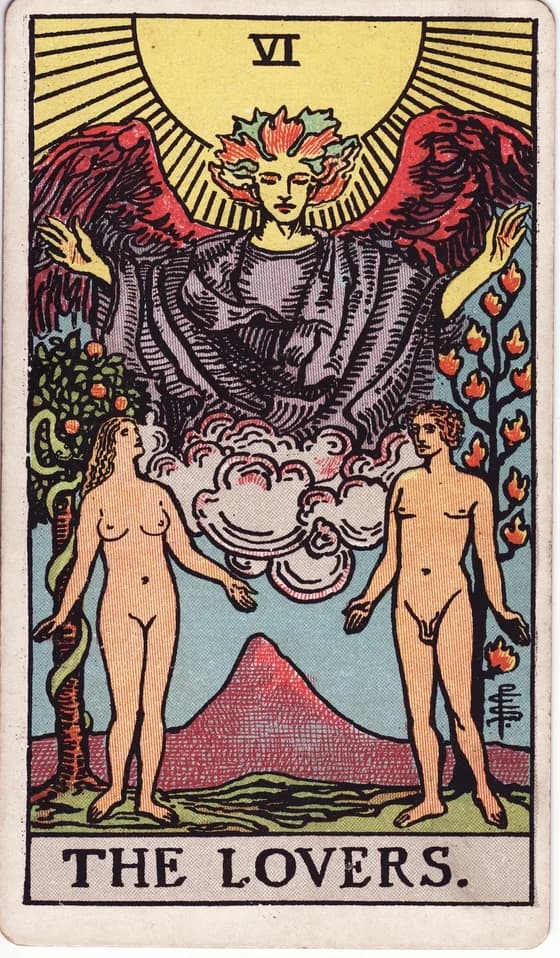
Two people looking in different directions
The sun occupies the top of the picture. Beneath it, a winged figure spreads red wings above the clouds, palms turned outward. Below, a woman and a man stand naked with their arms slightly open. The man turns his face toward the woman, who looks upward. A pointed mountain stands between them, and grass stretches beneath their feet.
Behind the woman is a fruit-bearing tree with a serpent wound around its trunk. The tree behind the man has flame-like branches. Notice their different directions of gaze, the two different trees, and the layers of space formed by cloud and mountain. Nakedness may suggest openness and vulnerability to a modern reader. That is an interpretation developed from the image, not evidence of the figures’ psychological states.
How Waite reworked the Lovers’ imagery
Waite explicitly compares the pair to Adam and Eve in Eden and identifies the Tree of Life and the Tree of Knowledge. He calls this an image of human love and rejects reducing the new design to the older image of a man choosing between virtue and vice.
This article therefore keeps love and connection at the centre, while using “choice” as a modern reflective theme. Choosing a relationship or collaboration also means choosing how to treat the other person and what responsibilities to share. That extension should remain distinct from Waite’s historical explanation.
Reading it upright
Upright, the Lovers can explore more than whether attraction exists. Can feelings become actions that both people willingly recognize as part of their relationship? Have they expressed needs, heard their differences, and chosen a direction together? Attraction brings people closer; repeated choices give a relationship its shape.
Outside romance, the card can help you ask whether a choice fits your values. Is the result you want worth the responsibilities that come with it? Finding agreement requires genuine discussion, not identical views on everything.
Reading it reversed
Here, the reversal draws attention to differences that have not been made explicit. One person may assume a relationship has reached a new stage while the other has made no such decision. Or someone may voice a value yet consistently give it last place in their plans.
Establish what each person actually means before deciding whether an adjustment is possible. Differences can open important conversations. The card cannot prove infidelity, predict an inevitable breakup, or make a commitment for either person.
Everyday examples
A relationship is ready for a next step
Talk about the pace of the relationship, boundaries, and expectations alongside your affection. A serious choice gives the other person enough information and room to respond or decline.
Finding a collaborator
Discuss quality, the distribution of benefits, and how you would handle disagreement. Getting along is valuable; working together also requires compatible values and practices.
Choosing between two opportunities
Write down what each offers you and what each asks you to give up. Do not hand the choice entirely to other people’s approval, or ask a card to decide the consequences for you.
A short exercise
Choose a current decision and complete: “I want to move toward this because…”, “I am willing to take responsibility for…”, and “I still need to clarify with the people involved…”. Take the final sentence into a real conversation.
A common misreading
The Lovers does not announce that your destined partner has arrived. Nor can this image dictate the genders of people in a loving relationship. This article focuses on mutual respect, openness, and willing participation.
Artwork and English-language sources
- Pamela Colman Smith, The Lovers, RWS Pam-A
- A. E. Waite, The Pictorial Key to the Tarot, Part II, VI. The Lovers (1911 transcription)
- A. E. Waite, The Pictorial Key to the Tarot, Part III §3, The Greater Arcana and Their Divinatory Meanings (1911 transcription)
Each image was individually inspected. The English source is the transcription labelled 1911; the artwork is the Pam-A scan identified on Commons. Sources checked: 2026-10-07.
The upright and reversed interpretations, examples, and exercises are original material for reflection, not line-by-line translations of old divinatory lists. Tarot cannot establish future events, another person’s thoughts, or a health condition.