Reclining sphinxes and no visible reins
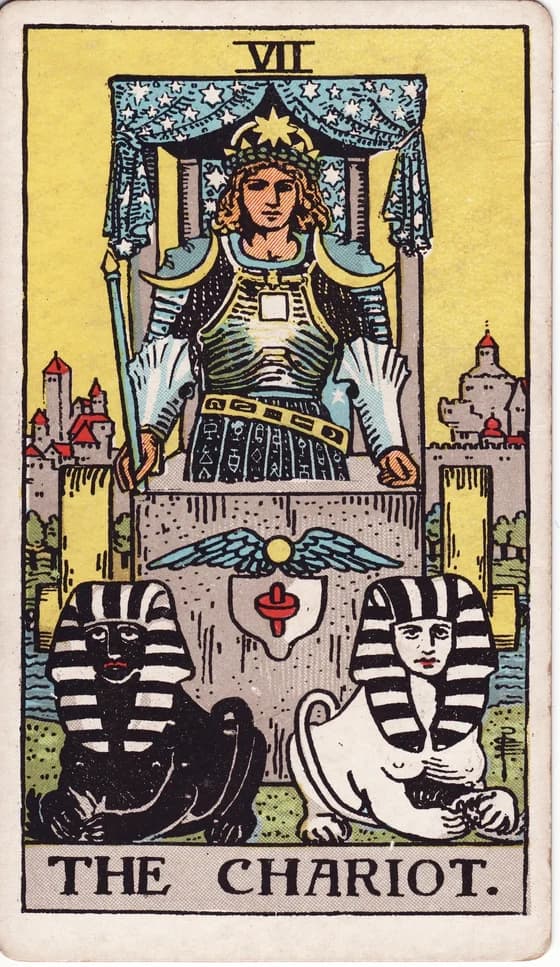
An armoured figure stands in the chariot beneath a star-shaped crown ornament and a blue canopy patterned with stars. Crescent-shaped decorations with faces sit on his shoulders; a square appears on his chest, and small symbols line the panels below his belt. On the left of the picture, he holds a staff, while his other hand rests at the edge of the vehicle.
One black and one white sphinx recline side by side before the chariot, their heads and bodies not oriented in exactly the same way. The vehicle bears a winged circular design and a shield-shaped ornament. Walls, towers, and a band of water are visible behind. The figure looks firmly positioned, but there is no running, spinning wheel, or cloud of dust to justify describing a high-speed charge.
Reaching a goal is not understanding everything
Waite associates the Chariot with conquest and victory, particularly achievements of the mind and the outer world. He also cautions that such achievements do not mean the figure has attained inner spiritual understanding. That limitation matters: reaching one goal does not resolve every question.
The text also describes the object in the figure’s hand as a drawn sword, whereas a staff is visible in the colour RWS image examined here. Our image description follows the artwork and preserves this discrepancy, rather than treating every sentence in the book as an exact inventory of the picture.
Reading it upright
Upright, the card can help organize the direction and discipline a task requires. The motivation may already be present; now priorities, a steady rhythm, and competing needs must be brought into workable relation. The two sphinxes offer a visual prompt for this idea of coordination. That is this article’s learning association.
Once a goal is clear, you still need the ability to change route. Steady progress includes checking feedback, replenishing resources, and resting when necessary. Persistence means understanding why you are moving and which changes need a response, rather than never turning.
Reading it reversed
Here, the reversal suggests a problem with how progress is being pursued. People may be aiming at different goals, speed may exceed preparation, or the insistence that “I must win” may obscure the actual cost. Visible busyness does not always bring you closer to the intended destination.
Slow down and check before applying more force. Examine the purpose, resources, and division of work separately, and identify two demands that conflict. If the goal itself no longer fits, choosing another direction is also an exercise of control.
Everyday examples
A project approaches delivery
Define the essential result for this delivery and defer new requests that would scatter the effort. Maintain coordination through checkable milestones, rather than only urging everyone to sprint.
Preparing for a competition or exam
Schedule practice, review, and recovery together. Adjust intensity to what you are actually mastering; do not use uninterrupted hours of activity as proof of effort.
Two people want to move something forward
First confirm that you share a destination, then discuss who will do what. If one wants to accelerate and the other needs preparation, discuss concrete conditions rather than argue about who is more committed.
A short exercise
Draw two circles side by side and put one of the two most conflicting demands you face in each. Then write one shared goal for this week. Give each demand a place in the plan and remove one action unrelated to the goal.
A common misreading
The Chariot does not guarantee a win, and its reversal cannot predict a traffic accident. It is more useful for checking direction, coordination, and cost. Actual safety and outcomes still depend on real-world judgment and action.
Artwork and English-language sources
- Pamela Colman Smith, The Chariot, RWS Pam-A
- A. E. Waite, The Pictorial Key to the Tarot, Part II, VII. The Chariot (1911 transcription)
- A. E. Waite, The Pictorial Key to the Tarot, Part III §3, The Greater Arcana and Their Divinatory Meanings (1911 transcription)
Each image was individually inspected. The English source is the transcription labelled 1911; the artwork is the Pam-A scan identified on Commons. Sources checked: 2026-10-07.
The upright and reversed interpretations, examples, and exercises are original material for reflection, not line-by-line translations of old divinatory lists. Tarot cannot establish future events, another person’s thoughts, or a health condition.