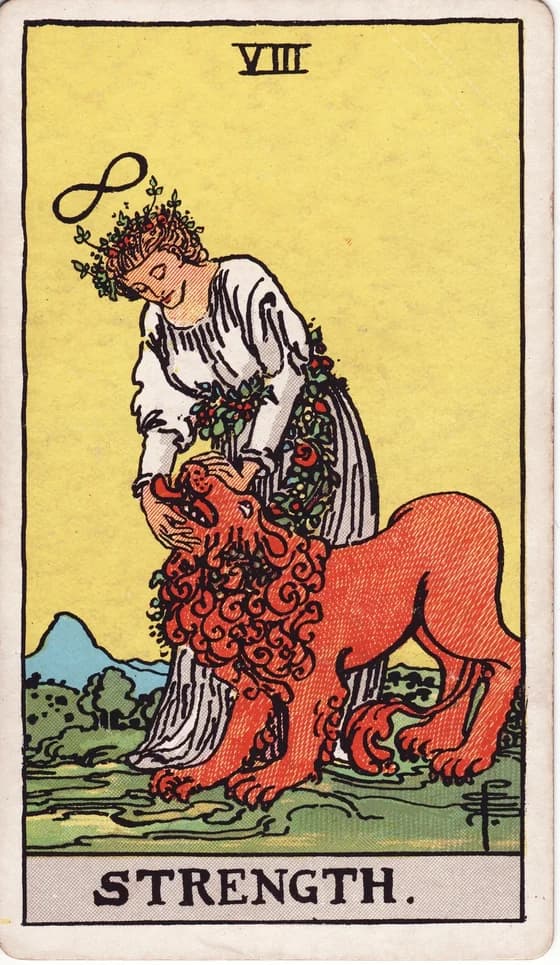
Look at her hands, then the lion’s body
Against a broad yellow background, a woman in white bends toward an orange-red lion. She wears a flower crown, and a garland at her waist hangs beside its mane. A sideways figure eight floats above her head. One hand rests near its upper jaw; the other supports the lower jaw. Neither arm is raised to strike. The lion lifts its head with its mouth open and tongue showing. Its tail curls between its hind legs, and all four paws remain on the ground.
She wears no armour, and there are no weapons in the scene. Her dress falls vertically while the lion’s body stretches sideways. Their contrasting postures meet at her hands. Behind them lie green ground, trees and a blue mountain, with plenty of open space. Notice these visible relationships before naming the action: a still image alone cannot establish whether she is opening or closing the lion’s mouth. View the card
Waite’s Strength has a religious context
Waite explicitly describes her as closing the lion’s jaws. He says her beneficent fortitude has already subdued it, and associates the flower chain with divine law. In one of his interpretations, the lion represents the passions. He also distinguishes religious trust from ordinary self-confidence. Reducing his account to “believe in yourself and you will succeed” leaves out that context. Waite, Part II, VIII
The discussion of feelings and action below is DestinyPixel’s reflective reading for present-day life. The figures’ genders do not prescribe who must be gentle or who needs to be tamed.
Upright: Give courage a practical form
An upright reading can suggest staying clear-headed and continuing with what needs doing, even when it is difficult. Anger may alert you to a boundary being crossed; fear may show that something matters. Recognise the feeling first, then choose a response. That gives your strength a direction.
Gentleness can be firm. Clearly saying “I cannot meet that request” differs from repeatedly giving way. If you are already exhausted, asking for support or reducing the task can also protect your ability to act.
Reversed: Notice both kinds of imbalance
Start with two possibilities. You may be trying to control everything through pressure, blame or a show of toughness. Or prolonged strain may have left you without the energy even to express a need. Waite’s old list includes both abuse of power and weakness. Our further suggestion is to examine triggers and workload before labelling yourself “not strong enough.” Waite, Part III, §3, entry 8
When you want to push back, or just keep going
A client adds a last-minute request. An upright Strength exercise would be to listen, then set out the additional scope, a realistic delivery date and what else must change. Reversed, check whether your tone is becoming harsher, or whether you keep saying yes to work you cannot finish.
When learning a skill, repeated failures can tempt you to practise for much longer. Try correcting one movement and making room for rest. During an argument, returning after a ten-minute pause may help more than raising your voice. If there are threats or harm, your safety and access to support come first. This card does not ask you to change someone through patience.
Practice: Give your energy somewhere to go
Recall a recent moment when you nearly lost control. Write three lines: what I felt; what I wanted to protect; what I could say next time to express a boundary. Practise one actual sentence, such as “I am willing to deal with this, but I need until tomorrow to reply.”
A common misreading
Strength does not mean never feeling angry, or becoming more virtuous the longer you endure. The contact in the picture can help you think about regulation and courage. It cannot establish who is inherently strong or weak, or decide how much you should tolerate.
Read next
The Chariot: compare outward momentum with steadiness in your own responses; Temperance: explore how to adjust effort and pace.
Sources for this article
- Pamela Colman Smith: Strength, the scan identified on Commons as Pam-A
- A. E. Waite, The Pictorial Key to the Tarot, Part II, §2, VIII Strength
- A. E. Waite, The Pictorial Key to the Tarot, Part III, §3, entry 8
Edition note: the visual descriptions were checked against the current Pam-A scans on Commons. References to Waite use the English transcription labelled [1911] on the source pages. The contemporary situations, questions and exercises are original DestinyPixel teaching material; no paid collections of card meanings were used.