The hands pour, while the feet stand in two places
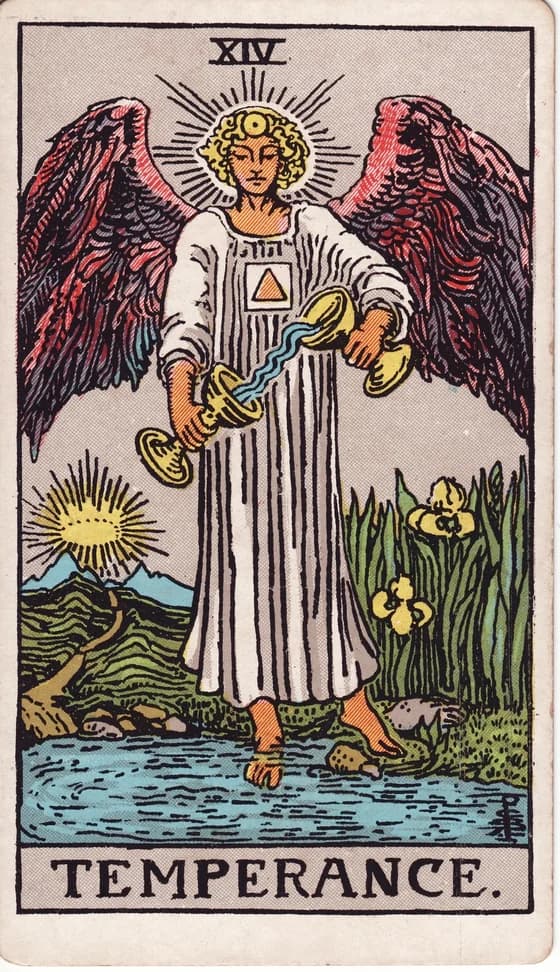
An angel in a white robe spreads red wings, its lowered gaze directed toward two gold cups. One cup is higher than the other, with blue water flowing diagonally between them. A circle with a central dot appears on its forehead, surrounded by rays. On the chest, an upward-pointing triangle sits inside a square, with lettering visible above.
One foot is in the water and the other on the bank; the feet are apart. Yellow flowers and long green leaves grow on the right. To the left, a path crosses rolling green ground toward blue mountains and a yellow glow behind them. The figure is steady, but neither the cups nor the feet are symmetrically placed. Their positions need to work together to hold the posture. View the card
Harmony takes active adjustment
Waite describes the liquid as the essences of life passing between the cups. He says that although he uses a masculine pronoun, the angel is neither male nor female. He places the feet on land and water, and the distant light and crown, within religious symbolism of life, then discusses harmony between psychic and material natures. The distant crown is not clear in this scan, so we attribute it to Waite’s account rather than claiming it is plainly visible. Waite, Part II, XIV
Upright: Adjust toward something sustainable
We use Temperance to explore proportion and cooperation. You need not do the maximum every time. Notice what changes when you add or reduce a little, then find a balance that suits current conditions. Study and rest, speaking and listening, planning and flexibility may all require such ongoing adjustment.
Two needs existing together does not make an equal split automatically fair. Sometimes the urgent need must come first, followed by time for the other to recover. Keep looking at the whole situation instead of treating one number as permanently correct.
Reversed: Find the specific mismatch
The reversed card can suggest uneven effort, incompatible ways of working or a rhythm disrupted by too many changes. Where do the parts fail to connect? Do schedules clash, handovers miss something, or do you alternate between all-out effort and a complete stop?
Waite’s upright list includes moderation and management. His reversed list includes disunion and competing interests, as well as historical associations with religious institutions. We use the practical connections as reading prompts, without reducing the card to a health diagnosis. Temperance cannot decide medication doses, dietary restrictions or treatment plans. Waite, Part III, §3, entry 14
Make “the right amount” something you can try
If exam preparation means ten hours in one weekend day and nothing during the week, try shorter, regular sessions for a week. Record what you finish and what you remember the next day, then adjust the length. Consistency need not mean doing exactly the same amount every day.
Two people write a report: one values speed, the other detail. Agree that the first draft will settle the structure and the next round will check the facts. Their strengths can then contribute at different stages instead of constantly interrupting each other.
When family care and work both intensify, separate what you must do personally, what can be negotiated and what can wait. If someone expects you to make every adjustment without making any themselves, the reversed card can also prompt a new discussion of the workload rather than more silent accommodation.
Practice: Try a small adjustment
Choose two needs that keep clashing, such as uninterrupted work and timely replies. Describe the current arrangement, then try one small change: fixed reply windows during the day, with alerts silenced at other times. After a week, check whether both work and communication have improved before keeping or changing it.
A common misreading
Temperance does not mean always doing less, suppressing desire or compromising in every conflict. It concerns a workable combination. If a demand crosses a line of safety or respect, a clear refusal can also help make life sustainable again.
Read next
Strength: compare steadying a strong reaction with regulating your pace over time; The Star: observe other ways of depicting flowing water, renewal and hope.
Sources for this article
- Pamela Colman Smith: Temperance, the scan identified on Commons as Pam-A
- A. E. Waite, The Pictorial Key to the Tarot, Part II, §2, XIV Temperance
- A. E. Waite, The Pictorial Key to the Tarot, Part III, §3, entry 14
Edition note: the visual descriptions were checked against the current Pam-A scans on Commons. References to Waite use the English transcription labelled [1911] on the source pages. The contemporary situations, questions and exercises are original DestinyPixel teaching material; no paid collections of card meanings were used.