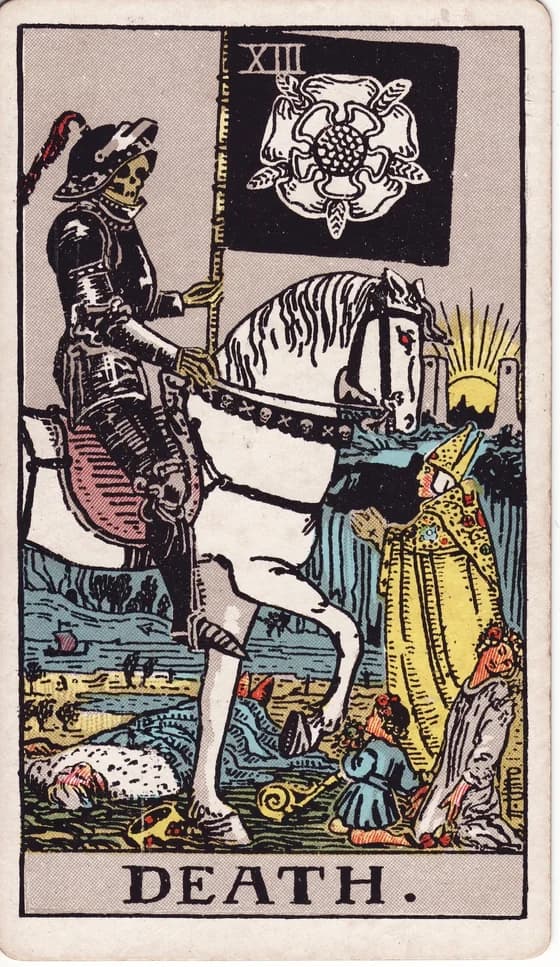
The rider carries no scythe, and the flag bears a flower
A skeleton in black armour rides a white horse toward the right of the picture. It carries a black flag bearing a white five-petalled flower, with no visible sword, scythe or other blade. The white horse fills the centre, lifting a foreleg and drawing the eye toward the figures ahead.
At lower left, a person lies on the ground near a fallen gold crown. On the right, a figure in a tall headdress and gold ceremonial robes faces the rider with hands together. Lower down are a kneeling child and a young person turning their face aside. A small boat is visible on the water in the background, and a radiant sun appears between two distant towers. The black-and-white banner, people of different stations and light in the distance place ending and continuation in the same picture. View the card
Renewal still carries the weight of an ending
Waite calls the flower on the banner the Mystic Rose and connects it with life. He places the distant sun in a religious context of immortality. His discussion includes change, passage and the transformation of consciousness without removing the weight of death imagery. Saying “nothing upsetting is really involved” makes the picture thinner than his account. Waite, Part II, XIII
Our reading is symbolic and grounded in everyday life. Drawing this card cannot predict anyone’s death, illness or lifespan. It is more useful for considering a stage that has already ended, or an ending for which there is real-world evidence.
Upright: Closing things is work too
An upright reading may suggest acknowledging that an old form can no longer continue: a project ends, an identity changes, or a habit stops being useful. Practical farewells often follow, such as returning possessions, completing a handover, organising records or allowing time to adjust.
The next stage need not feel exciting immediately. You can know change is necessary and still miss what came before. Acknowledging both feelings is more honest than demanding instant positivity. The card cannot prove that a relationship must end; major decisions still depend on real circumstances.
Reversed: Loosen one thing at the old threshold
The reversed card can help you notice unfinished farewells: declaring something over while continually reopening it, or postponing every practical task to avoid sadness. Waite’s reversed list includes inertia and petrifaction, a historical link with being stuck. We extend that into reflection on delayed closure and fear of change. Waite, Part III, §3, entry 13
Adjustment may also simply take time. Do not turn “I have not let go yet” into another accusation against yourself. Separate responsibilities that need attention from feelings you can work through at your own pace.
Turn an ending into actions you can complete
A project closes after two years. Record the completed work, materials to hand over and what will no longer continue. A brief review lets people carry the learning forward and stops old tasks quietly occupying their time.
Before leaving a long-loved home, take photographs, then decide what to keep and what to give away. The memories can remain without every object having to prove that the life you lived there mattered.
If a habit is clearly disrupting daily life, such as repeatedly checking messages at night, start by silencing notifications for one period or moving your phone away from the bed. You do not have to begin with a sweeping promise to change forever.
Practice: Make a gentle closing list
Choose something that has genuinely ended. List three actions still needed, then add “What I want to keep from this is…” Complete the smallest task first. If the loss is still heavy, support from someone you trust can matter more than rushing to find a hidden benefit.
A common misreading
Death is neither a death notice nor a promise that everything will immediately improve. It invites attention to the reality of endings and the possibility of closure. When and how to end something depend on facts, choices and practical support.
Read next
The Hanged Man: compare a pause with being unable to continue as before; Temperance: explore how to rebalance life after a change.
Sources for this article
- Pamela Colman Smith: Death, the scan identified on Commons as Pam-A
- A. E. Waite, The Pictorial Key to the Tarot, Part II, §2, XIII Death
- A. E. Waite, The Pictorial Key to the Tarot, Part III, §3, entry 13
Edition note: the visual descriptions were checked against the current Pam-A scans on Commons. References to Waite use the English transcription labelled [1911] on the source pages. The contemporary situations, questions and exercises are original DestinyPixel teaching material; no paid collections of card meanings were used.