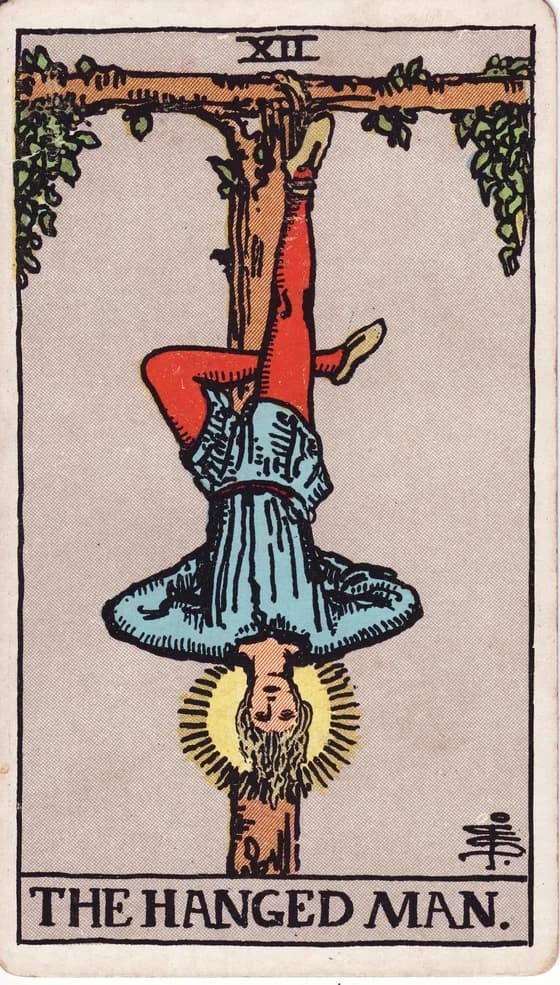
The body is upside down, but the tree still has leaves
A leafy crossbeam and an upright trunk form a roughly T-shaped frame. A figure hangs head downward from one ankle tied to the beam. The other leg bends behind the straight one. A blue tunic, red trousers and pale shoes divide the body into distinct areas. The arms fold behind the body, and the hands are out of sight.
A yellow halo surrounds the head, and the face shows no exaggerated pain. The background is almost empty, with no spectators or struggle. Leaves, light and a suspended body create a particular tension: outward movement has stopped, yet the picture does not suggest that life has entirely drained away. View the card
Keep Waite’s emphasis on life in view
Waite asks readers to notice three things: the wood is living, the face expresses entrancement rather than suffering, and the whole figure suggests life in suspension. He places the card in a mystical context of awakening and resurrection, rejecting its simple classification as martyrdom. “You must sacrifice yourself” is not a faithful conclusion to draw from that account. Waite, Part II, XII
Upright: Bring a question to the pause
Our modern reading is to set aside your usual method for a while and notice what speed has obscured. A delay, a wait or stepping out of an argument can create room to observe. The useful question is what you are stopping to look at.
Trade-offs are another layer. You may choose to do less temporarily, or give up a convenience, in return for learning or clearer judgement. The cost should be specific, manageable and freely chosen. The picture does not tell us how the figure arrived there, and cannot establish that a person in a real situation has chosen to suffer.
Reversed: Is this wait still doing anything useful?
Has the pause produced new information? If the deadline keeps moving and no one owns the next step, it may simply be stagnation. Conversely, rushing back into action before the conditions are ready may bring the same problem straight back.
Waite’s old list connects the upright card with discernment, trials and sacrifice. His reversed terms include selfishness and the crowd, rather than forming a neat opposite; he does not simply write “procrastination.” The checks on waiting periods and boundaries here are our practical extension. Waite, Part III, §3, entry 12
Three pauses that need different arrangements
If a design remains difficult to use after several revisions, pause the polishing and watch a real user complete a task. Change your view of the problem, rather than merely choosing another colour.
If flatmates each insist their own schedule is the reasonable one, try restating the times that most affect the other person before agreeing on quiet hours. Taking another perspective can support negotiation without requiring either person to yield forever.
If you keep waiting for someone to confirm a collaboration, name a clear point for moving on: “If it is not confirmed by Friday, I will schedule other work.” When waiting keeps consuming opportunities, a reversed reading can prompt you to reorganise your own actions. Repeated draws cannot answer for the other person.
Practice: Give the pause a testable purpose
Write down what is stuck, then finish three sentences: the step I am pausing; the information I need during that time; the date I will decide again. Rewrite the problem from the viewpoint of the other person, a beginner or an observer, and see what changes.
A common misreading
The Hanged Man does not automatically turn pain into growth or require you to stay in a harmful situation. A meaningful concession needs purpose, choice and boundaries. Spending longer in limbo does not, by itself, make a decision better.
Read next
The Hermit: compare deliberately stepping back with observing while suspended; Death: compare temporarily letting go with an actual ending.
Sources for this article
- Pamela Colman Smith: The Hanged Man, the scan identified on Commons as Pam-A
- A. E. Waite, The Pictorial Key to the Tarot, Part II, §2, XII The Hanged Man
- A. E. Waite, The Pictorial Key to the Tarot, Part III, §3, entry 12
Edition note: the visual descriptions were checked against the current Pam-A scans on Commons. References to Waite use the English transcription labelled [1911] on the source pages. The contemporary situations, questions and exercises are original DestinyPixel teaching material; no paid collections of card meanings were used.