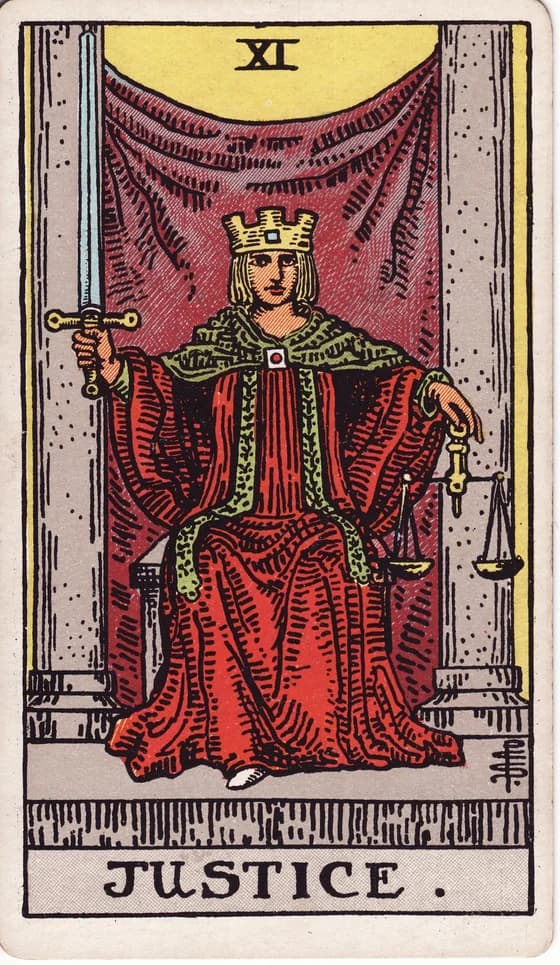
One hand weighs, the other holds a sword
Justice sits facing forward between two grey pillars, eyes open and without a blindfold. A blue square decorates the gold crown. A green mantle lies over a red robe, with a purple-red curtain behind. The figure’s right hand, on the viewer’s left, holds a long upright sword. The left hand holds scales, their two pans suspended on the right of the picture.
The body and seat are roughly centred. The sword creates a taller vertical line, while the scales extend sideways. A toe emerges beneath the robe onto the step. Eyes, scales and sword can invite a sequence of looking closely, weighing and acting. That is a modern reading of the composition, not three rules written on the card. View the card
Actions and the responsibilities that follow
Waite discusses the moral principle of dealing with people according to their actions. He distinguishes these pillars from those beside the High Priestess, reminding us that similar compositions need not carry the same meaning. His old divinatory list does connect Justice with fairness and legal matters, but these are historical fortune-telling terms, not guarantees about a case today. Waite, Part II, XI; Part III, §3, entry 11
Upright: Fairness needs reasons you can explain
An upright reading can suggest checking agreements, clarifying responsibility and making an explainable choice. What is this decision based on? Would I use the same standard if it concerned someone else?
Responsibility includes repairing your own impact. Acknowledging an omission, completing the work or apologising clearly is more practical than insisting that you meant well. Fairness need not mean equal amounts for everyone, but the reasons for a distribution should be open to discussion and scrutiny.
Reversed: Check whether a finger is pressing the scales
Reversed, the card can prompt a look at bias, missing information, avoided responsibility or excessively harsh rules. Waite’s reversed list includes bigotry, bias and excessive severity. We turn that historical connection into questions about process: was only one side heard? Were the criteria changed afterwards? Is someone being held responsible for consequences beyond their control?
The reversed card proves neither that you are wrong nor that someone else is unfair. If you keep blaming yourself, separate what you actually did, what you can repair and what was never yours to determine.
Make fairness something people can discuss
Flatmates divide chores, but someone always feels they do more. Record the actual work for a week, then discuss frequency, difficulty and everyone’s available time instead of comparing who complains loudest.
When a team reviews work, agree on accuracy, usability and completeness before giving examples against each criterion. If you choose a favourite first and invent reasons afterwards, the reversed-card check becomes useful.
For a return or service dispute, organise the order, messages and agreed terms, then state what you are asking for. If it becomes a legal dispute, rely on evidence and appropriate professional advice. A card cannot establish an offence or predict a ruling.
Practice: Turn a judgement into three sentences
Take a recent evaluation such as “They are always irresponsible.” Rewrite it as: the specific behaviour I observed; the effect it had; what I would like to happen next. Then check whether you have omitted information the other person could verify.
A common misreading
Justice does not mean that someone who suffers must be at fault, or that the universe will punish a particular person for you. It can help clarify responsibility and standards. When treated unfairly, you can still appeal, seek support and protect your rights.
Read next
The Emperor: compare establishing order with examining whether its rules are fair; Judgement: compare weighing responsibility with responding to a fresh start.
Sources for this article
- Pamela Colman Smith: Justice, the scan identified on Commons as Pam-A
- A. E. Waite, The Pictorial Key to the Tarot, Part II, §2, XI Justice
- A. E. Waite, The Pictorial Key to the Tarot, Part III, §3, entry 11
Edition note: the visual descriptions were checked against the current Pam-A scans on Commons. References to Waite use the English transcription labelled [1911] on the source pages. The contemporary situations, questions and exercises are original DestinyPixel teaching material; no paid collections of card meanings were used.