Who calls, and who answers?
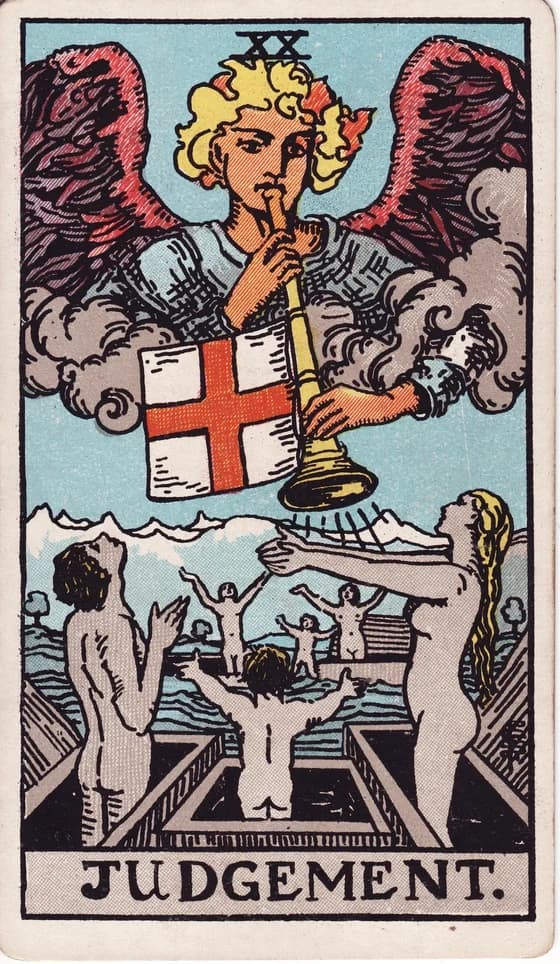
Above, an angel emerges from clouds, its red wings outspread, blowing a golden trumpet angled downwards. A white banner with a red cross hangs from it. Below, grey-white figures rise from open rectangular coffins, looking up and reaching towards the sky.
An adult stands on each side of the foreground, with a smaller figure between them, back turned to the viewer. Farther away is another group, also raising their arms. Water and a mountain range give the scene depth. This is not a picture of one person standing alone to be reprimanded. The trumpet’s summons and the bodies reaching upwards in response form a collective transformation. View Judgement.
The title is Judgement; Waite’s emphasis is transformation
In Part II, Waite retains the religious imagery of the Last Judgement and resurrection, while stressing the figures’ shared wonder, devotion and joy. He interprets the card as transformation accomplished in response to a higher summons, heard and answered inwardly as well. This is his mystical interpretation, not evidence that a reader has received a supernatural command. Waite on Judgement.
His Part III entry includes a change of position, renewal and outcome. The reversed list contains weakness but also deliberation and decision, rather than punishment alone. Waite’s divinatory meanings.
Review the past in order to give a new answer
Our upright reading concerns a point that needs a definite response. What happened, what part you played, and what you want to do next belong in the same view. This might involve acknowledging a mistake, choosing a different direction, or accepting that you have changed. Alongside concern about how others will judge you, ask which facts already support a decision.
Reversed, the card may describe knowing a reply is needed but delaying through endless preparation. It can also suggest turning reflection into relentless self-blame, leaving no room to act again. Distinguish “I still need information” from “I have enough information, but fear taking responsibility for the consequences”. The first calls for further checking; the second for smaller steps you can take responsibility for.
In everyday situations
Career. After a period in a role, you become increasingly certain that you do not want to keep doing the same duties. Write down the relevant experiences, acceptable conditions and possible next steps, then decide whether to discuss changes or explore another direction.
Repairing a relationship. You realise that an earlier response hurt a friend. Renewal can begin by acknowledging the specific behaviour and hearing how it affected them. Saying “I understand now” does not entitle you to immediate forgiveness.
A review. A project ends, and everyone wants to move on quickly. Describe recurring mistakes and agree who will take responsibility in future. That gives reflection a new outcome, rather than making one person the target of every accusation.
Try it for yourself
Write a five-sentence reply to your future self: what happened, what you acknowledge, what you will stop excusing, what you can repair, and when you will take the first step. Keep each sentence about actions, rather than labels for your character.
Common misreadings
Judgement does not pronounce you guilty, or guarantee the return of an old relationship or a particular person. Rising again can help us think about renewal, but reconciliation in real life still requires both people’s willingness.
Read these cards together
- Justice: Compare weighing responsibility against facts with Judgement’s emphasis on review, response and renewal.
- Death: Compare the ending of a stage with the answer you give to a new life after it.
- The World: Notice how a definite response can lead towards completing a stage.
Sources and further reading
- A. E. Waite, The Pictorial Key to the Tarot, Part II, XX: English text
- The same book, Part III, Section 3, entry 20: original upright and reversed meanings
- Pamela Colman Smith, RWS card: Commons image and version history
The English transcription is dated 1911; the image page identifies the card as Pam-A, 1910. The visual description follows the downloaded Commons JPG. The modern quick takes and exercises are DestinyPixel's original interpretations. Sources checked: 2026-10-07.