First, notice who has stepped into the light
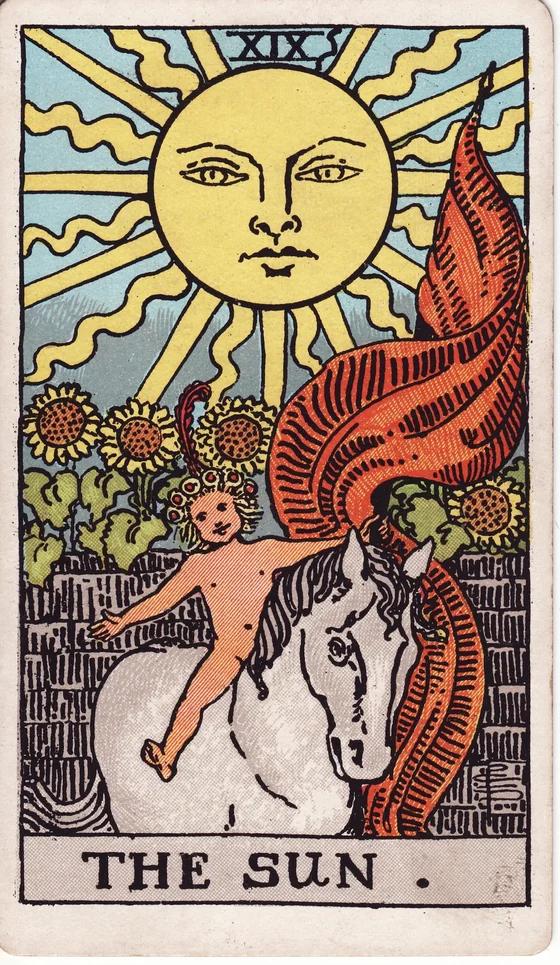
Before memorising “success”, look from the sun overhead down to the child in front of the wall. The picture makes vitality outward and expressive without erasing every boundary.
The sun and sunflowers: where the light falls. The enormous sun has a human face, with alternating straight and wavy rays; sunflowers rise behind the wall. The sun fills the sky, while the flowers bring our gaze back to earth. One modern association follows: an abstract sense of “I feel good” is more useful when connected to visible progress, such as a concept you can finally explain clearly. The flowers' number and direction deserve attention, but need not be forced into a single secret code.
The child and white horse: how strength is used. The unclothed child sits on a white horse with arms outstretched; no reins are visible. The pairing combines a child's openness with a large animal's strength. Waite discusses simplicity and innocence through the child, as well as the harmony of renewed consciousness with animal nature. Following the image, we might read a confidence that does not require constant tension: having the capacity to support action makes it easier to let go. Openness in real life still requires judgment about whom to trust and where to draw boundaries.
The wall and red banner: how to express yourself after stepping out. A grey wall runs behind the figure, who is in front of it; a large red banner unfurls upwards. The wall gives “coming out” a location, and the banner gives joy a gesture. One reading is to let an achievement be seen while acknowledging its limits. You can say, “This step worked,” without declaring the whole future a success. The conspicuous banner also invites a check: when expressing yourself, are you leaving room for others?
The traditional Sun goes deeper than a good mood
In Part Two of The Pictorial Key to the Tarot, Waite associates the Sun with the direct light of spiritual consciousness and uses the child to describe innocence accompanied by wisdom. This is his mystical interpretation, not an established psychological mechanism. Read the English text
The divinatory meanings in Part Three are shorter: upright, they concern material happiness, a happy marriage and contentment; reversed, similar meanings remain, but to a lesser degree. The passage is helpful because it reminds beginners that turning a card upside down need not turn its entire meaning into its opposite. Check the upright and reversed meanings
Ask why, whether upright or reversed
The upright Sun can help us consider three situations: information is becoming clearer, action is receiving positive feedback, or happiness can be acknowledged without embarrassment. Follow that with, “What fact supports this judgment?” In a relationship, someone stating their intentions matters more than your sense that the atmosphere is pleasant; in studying, explaining a problem independently is more reliable than feeling you understood everything during a lesson.
For a reversal, try two possible readings. These are modern applications, not translations of Waite's wording.
- The light is difficult to take in. There is real progress, but you habitually discount yourself; or things are going well and you are already exhausted. Start by making fewer comparisons, acknowledging one small achievement and allowing your feelings time to catch up.
- The light is too dazzling. You want only praise, confuse enthusiasm with completion, and treat anyone who mentions a difficulty as a spoilsport. Ask someone willing to be honest to examine the details.
To distinguish them, listen to the person's experience and look at actual feedback. Clear good news that someone struggles to believe fits the first possibility more closely; repeated criticism dismissed out of hand makes the second worth considering. With insufficient evidence, keeping both possibilities open is more honest than rushing towards either a frightening or a pleasing answer.
A different deck shifts the emphasis
The RWS child on horseback readily draws attention to personal openness and the coordination of strength. When comparing other versions, first examine the relationships between figures, then decide how to adjust your interpretation.
Marseille-style Suns often show two figures approaching one another, with a wall behind them. Here you might ask, “Does the light reach both people?” Reading mutual help and shared growth from this is a question this article brings to the image, not a universal conclusion for every Marseille deck. Part One of Waite's book also records the motif of two children and an enclosure in older Sun designs. An English account of the traditional design
The Visconti-Sforza Sun held by the Morgan Library instead shows an unclothed, winged youth on clouds, holding up a radiant human face with both hands. The RWS white horse and sunflowers are absent, so explanations of those six details cannot be imported wholesale. It cannot represent every early Italian Sun card either. Read the collection's description of the object
The same approach works for modern redesigns: identify what has been added or removed, then ask where those changes direct your attention. If only the sun remains while the people, animals and setting change, observe those relationships afresh. An identical card name does not make every detail's interpretation transferable.
A complete worked reading
An original fictional example. Xiaolan is preparing for a portfolio review. She asks, “How should I present this set of work?” The upright Sun appears in the advice position.
First establish the question: she is asking about presentation. The Sun's open posture can inspire her to make the work easier to understand, but cannot establish that she will be selected.
Then connect the picture to facts. Xiaolan has two well-developed pieces, yet keeps introducing them with “It's really nothing special.” The child's ease and the banner's expressiveness can become practical advice: lead with the work that best demonstrates her ability and explain what she did through concrete details of the process.
Next check excessive optimism. The third piece still has unfinished details. Here the wall's sense of a boundary becomes a reminder to distinguish finished work from ongoing experiments when presenting, so confidence does not conceal gaps.
Finally choose an action. Ask a friend to listen to a three-minute introduction, then repeat back “what problem the work solves”. If their account misses the point, adjust the explanation. The Sun's brightness becomes clarity that can be checked.
If the card were reversed in the same position, first ask about her difficulty. If she has received good feedback but fears showing the work, begin with a small practice audience; if she thinks preparation is unnecessary, a candid mock review would be more useful. The same reversed card can lead to actions in two different directions.
Leave with one question
Choose one thing that makes you happy today, write down the evidence for it, and add, “What do I still need to see clearly?” This lets joy stand while leaving room for the next step.
Tarot can help organise thoughts; questions about health or pregnancy should be addressed through examinations and professional advice. Real outcomes still need to be judged using actual information.
Sources and references
The sources below serve different purposes: Waite’s Part II, Section 2, XIX discusses the image and his mystical interpretation; Part III, Section 3, XIX gives upright and reversed divinatory meanings; Part I, Section 2, XIX records older Sun designs. The Morgan Library’s M.630.13 page describes that particular object. The modern quick readings, fictional case and exercise are our own writing. The artwork creator and image-source link appear in the caption above.
- A. E. Waite, The Pictorial Key to the Tarot, Part II §2, XIX: The Sun — image and mystical interpretation
- A. E. Waite, The Pictorial Key to the Tarot, Part III §3, XIX: The Sun — upright and reversed divinatory meanings
- A. E. Waite, The Pictorial Key to the Tarot, Part I §2, XIX: The Sun — older designs
- The Morgan Library, M.630.13 — description of the Sun card in the collection