Return Your Gaze from Distant Stars to Nearby Water
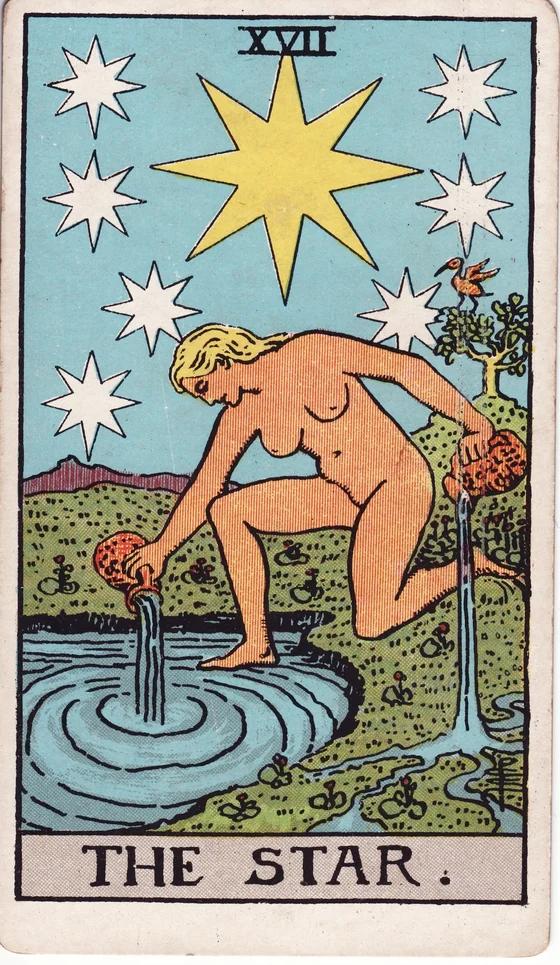
A very large yellow eight-pointed star occupies the center of a blue sky, surrounded by seven smaller white eight-pointed stars. Below, a naked woman bends and kneels at the water's edge. The knee on the right of the picture rests on grass, while her other leg reaches toward the water. Her head is lowered, gaze directed toward the pouring water.
Two reddish-brown pitchers tip outward together. One stream enters the pool, creating rings of ripples; the other falls on land and divides into several small streams. Little flowers grow in the grass, a bird perches in a tree at the rear right, and hills rise in the distance. No wall encloses her and no audience waits for her to deliver. The open space and continuing water together create a gentle rhythm that can continue. Look closely at the Star image.
Water goes both to pool and land. These two destinations allow recovery to concern daily conditions as well as inner feelings. The figure looks down at the present task rather than wishing at a star, letting hope become an act of participating again. Nakedness and open space may suggest less defensiveness, but real honesty still needs a safe recipient. The sky's eight-pointed stars are striking and their number visible, but cannot calculate how many weeks a wish will take. In a redrawn version, removing pitchers, land, or figure also shifts the emphasis on care and giving.
“Hope” Does Not Exhaust the Original Text
In Part II, Waite calls the pitchers' contents waters of life irrigating land and water, and speaks within his mystical framework of inner light and unveiled truth. He considers “hope” an insufficient summary of the card. Waite on the Star.
An easily missed complication occurs inside Part III, §3, entry 17 itself. Its upright entry lists loss, theft and privation, then introduces hope and bright prospects as another reading. The disagreement is already within that list: distinguishing Part II's symbolism from Part III's divination does not resolve it. Nor should the first group quietly become the reversed meaning; reversal has its own list. Waite's divinatory entry.
At the section's end, Waite also criticises the allocation of divinatory meanings to the major cards as artificial and arbitrary. What this establishes is a text retaining different readings and its author's reservations about them. It does not supply a timeline in which loss must be followed by good fortune. A historically recorded interpretation is not evidence that an event will happen to you.
Pollack: quiet and creativity, without a promise of the next prize
In the Star section of Seventy-Eight Degrees of Wisdom, Rachel Pollack reads it after the Tower: upheaval gives way to openness and quiet, while water returns to the pool and also reaches the land. She interprets this through the unconscious, creativity and spiritual connection. This is her modern symbolic framework, not a psychological law shared by every tarot tradition, and it does not establish that real events follow the major cards' sequence.
On printed page 159, also actual PDF page 159 in the scan consulted, she connects making art with a source of inspiration and considers how the work can bring fresh inspiration in return. Pages 160–161 distinguish inner quiet from outward action, allow the outward journey to wait, and discuss hope and comfort in a reading. She is not requiring an immediate return to productivity. This helps separate a renewed willingness to participate from an expectation that the outside world will deliver a particular result. You can observe the former; the latter needs external information.
This article's upright emphasis on renewal, support and participation is a modern editorial choice, compatible with that approach; it does not erase the older list's disagreements. Pollack's continually flowing water of life is a symbolic metaphor, not proof of unlimited personal energy. A reversal likewise cannot establish that someone is arrogant, closed off or psychologically unwell.
Hope Needs Somewhere to Land
DestinyPixel's upright reading leans toward restoring trust and flow. After a setback, being willing to do a little of something you enjoy, honestly stating how much you can currently manage, or accepting help without having to repay it immediately can all be everyday forms of this card. The pictured water does not remain in the pitchers. Hope happens through tending present life rather than waiting for distant promises.
Reversal can mean shaken confidence, numbness about the future, or long-term care for others without replenishing yourself. First check where the water goes: Is your giving seen? Can you accept help? Is the goal too large to begin? Sometimes reducing each burst of effort preserves the small daily stream that can continue.
Distinguishing Related Meanings
The Star and Sun are both readily read as good news. The Star better suits the process of just beginning to trust again, with flow still returning; the Sun leans toward existing progress being clearly seen and freely expressed. Unlike Temperance's exchange between two cups, the Star sends water into its environment, prompting observation of where support comes from and what you want to give. Reversal is not an order to be positive: if someone is already exhausted, more self-improvement tasks only add weight. Hope can be small, such as returning once to an enjoyed activity, without first believing the entire future will go smoothly.
After a Rejected Submission, Find What You Still Want to Draw
Original fictional case. Yilin asks, “My work wasn't selected twice in a row. How can I keep drawing?”
Known facts: She received rejection notices without specific comments. She still likes drawing street plants, but thoughts of submitting make her choose only subjects she thinks judges might like. Recently she has done almost no casual sketching. She draws the upright Star in the recoverable-resources position.
The act of looking down and watering the land suits tending concrete creative activity again, rather than waiting for distant recognition to prove her worth. Upright cannot guarantee selection next time or explain the judges' minds. Since she is known still to enjoy a particular subject, she can restore participation through low-pressure daily observation, easing the demand that every drawing carry an outcome.
Another possibility: If she no longer enjoys the current medium, recovery need not mean continuing the same way of drawing; another form of expression can be explored. If a notice supplies specific technical feedback, read and practice it rather than using “be yourself” to ignore useful advice.
A practical next step: This week, make three small studies simply recording plant forms, with no publication assignment. Choose one and ask a trusted reader to describe the features they see. Only then decide about submitting, letting continued creation rest on both interest and actual feedback rather than entirely on one result.
Give loss, hope and outcomes different jobs
Return to Yilin's original fictional submission case, without drawing more cards to guarantee a comeback:
- What is known: Two submissions were rejected, without specific comments. That supports discussing disappointment; it does not establish that the judges dislike her or prove that the older list predicted the rejection.
- What support can be found now: She still enjoys drawing street plants; whether she wants to restart with small studies can be checked with her. That continuing interest can support this article's hope-oriented reading, without establishing that she is ready to act or that all her confidence has returned.
- What remains unknown: The next selection criteria, other submissions and the final decision. The Star cannot supply that information. If the question is whether she will be selected next time, this example cannot answer yes.
These three distinctions are the site's own reading exercise, not a three-card spread prescribed by Waite or Pollack, or a merger of competing historical meanings into a guaranteed sequence. Practise allowing counterexamples in connecting three cards, then preserve the initial interpretation and later facts in a tarot journal. Give each sentence a job, so that hope does not stand in for evidence about an unknown outcome.
Always Comforting Others: Where Does Your Water Come From?
Original fictional case. Shuhan asks, “I really want to be there for my friends, but lately I feel emptier after every conversation. What can I do?”
Known facts: She often listens to friends late at night and has canceled several of her own walks and reading sessions. Her friends have not demanded round-the-clock availability, and she has never stated when she is available. She draws the reversed Star in the support-imbalance position.
Reversal here can correspond to continuing outflow without replenishment. Two pitchers do not prove unlimited supply, and a tranquil image does not require her to remain gentle and available at all times. Known changes to her routine and activities support examining how she gives, not diagnosing her psychological state or declaring friends deliberately demanding. She can care for others while giving her own recovery a place.
Another possibility: If a friend faces actual immediate danger, suitable real-world support is needed, not merely rescheduling conversations. If Shuhan already rests sufficiently yet persistently finds coping difficult, seeking help from trusted people or professional support is also worthwhile.
A practical next step: State when she can usually talk, and restore one walk or reading session that need produce nothing. When more support is needed, look with her friend for resources that do not rely solely on her. After a week, observe energy and the quality of their time together, rather than proving care through reply speed.
Try It Once
Name the pitchers “What restores me” and “What I want to keep giving.” Write one small action for this week under each. If one side remains blank, care for that side first rather than adding goals.
A Common Misreading
The Star does not guarantee wishes coming true or require positivity during difficulty. Hope and disappointment can coexist. The quiet of the card is better used to find sustainable support.
Sources and references
The added author comparison draws on Rachel Pollack, Seventy-Eight Degrees of Wisdom, translated into Chinese by Sun Meijun, 商周出版, first edition December 2010, Chapter 6, Star section: actual PDF pages 158–161 and printed pages 158–161 in the scan consulted. That page sequence identifies this scan only. The known facts / available support / unknown outcome distinctions are the site's original exercise. No book case or illustration is reproduced, and symbolic interpretations are not presented as scientific prediction or health assessment.
- The Pictorial Key to the Tarot
- The Pictorial Key to the Tarot
- RWS Tarot 17 Star.jpg
- The Star: Making Real Space for Recovery
- Rachel Pollack, Seventy-Eight Degrees of Wisdom; Chinese translation by Sun Meijun, 商周出版, first edition December 2010, Chapter 6, Star: actual PDF 158–161 / printed 158–161 (scan consulted)