Stability and free fall in the same picture
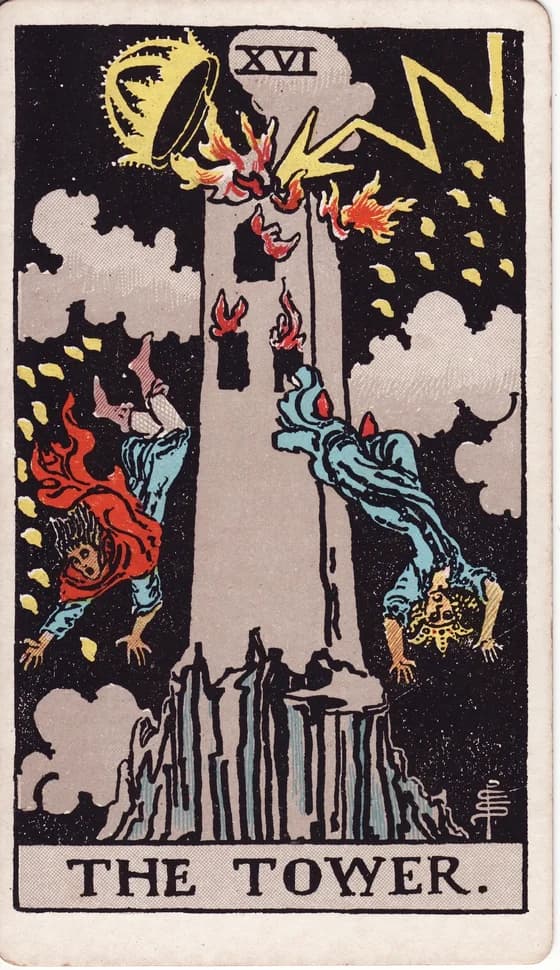
A narrow grey tower stands on jagged rock against an almost black background. Yellow lightning zigzags down from the upper right towards its top; an enormous golden crown is thrown to the left. Red and yellow flames emerge from several black window openings. Small yellow droplet shapes scatter down both sides of the tower.
Two people fall headfirst, their clothes billowing and their hands reaching out. The figure on the left wears a red cloak; the one on the right still has a small crown. The straight tower and the diagonally falling bodies sharply conflict: the building remains, but its protection has failed. The picture does not show what happens when the people reach the ground, or any new house that might replace this one. View the Tower.
From a building to an explanation that fails
In Part II, Waite does not stop at describing a building’s destruction. He discusses a structure of doctrine or falsehood being torn open, and challenges several existing interpretations. He also notes that the two falling people are the ones actually suffering. Abstract symbolism must not erase them. Waite on the Tower.
His Part III meanings do use stark language about calamity, distress and ruin. The reversed entry includes a lesser degree of impact, as well as oppression and imprisonment. These are historical divinatory meanings, not evidence that an accident is about to happen to a reader. The original meanings.
Deal with the impact before assigning meaning
Our upright reading is that reality has interrupted an assumption you relied on. This might be a sudden decision, or a long-ignored fact that can no longer be avoided. Forcing optimism, or rushing to say that everything has happened for the best, can distract from losses that need attention. First establish what happened, who is affected, and what can be stabilised today.
Reversed, the card offers two distinct possibilities. You might keep patching the arrangement to preserve an old explanation, concealing more cracks each time. Or you might have recognised a risk and deliberately dismantled part of the structure, making change more manageable. Ask whether you are making a real adjustment or merely restoring appearances. Use concrete evidence; a reversal does not automatically mean a greater disaster.
In everyday situations
A project. A trial shows that nobody wants to keep using the central feature. The Tower-like issue is a failed starting assumption. Before polishing the presentation, acknowledge what has not been validated, then decide what is worth keeping.
A collaboration. Someone withdraws at short notice, exposing a division of labour that depended entirely on one person. Sort out handover, access and a short-term replacement before examining why there was no backup.
A personal plan. An application you had pinned your hopes on is rejected. Allow the disappointment, while separating “this route didn’t work out” from “none of my abilities counts”. One interruption need not become a verdict on your whole life.
Try it for yourself
Complete three sentences: “I used to assume…”, “What I now know for certain is…”, and “What I can still rely on is…”. Use only established facts in the second sentence, then choose one manageable action for the next twenty-four hours.
Common misreadings
The Tower does not mean that disaster is inevitable, and it cannot justify calling someone arrogant or deserving of misfortune. An ordinary disagreement need not mean total collapse. Start with the actual scale of the consequences.
Read these cards together
- The Devil: Compare an arrangement maintained despite its constraints with the moment it can no longer hold.
- Death: Compare endings and transformation with the Tower’s stronger emphasis on sudden disruption and exposure.
- The Star: Notice the contrast between the Tower’s compressed space and falling bodies and the Star’s openness and flowing water.
Sources and further reading
- A. E. Waite, The Pictorial Key to the Tarot, Part II, XVI: English text
- The same book, Part III, Section 3, entry 16: original upright and reversed meanings
- Pamela Colman Smith, RWS card: Commons image and version history
The English transcription is dated 1911; the image page identifies the card as Pam-A, 1910. The visual description follows the downloaded Commons JPG. The modern quick takes and exercises are DestinyPixel's original interpretations. Sources checked: 2026-10-07.