First Look at Where the Chains Lead
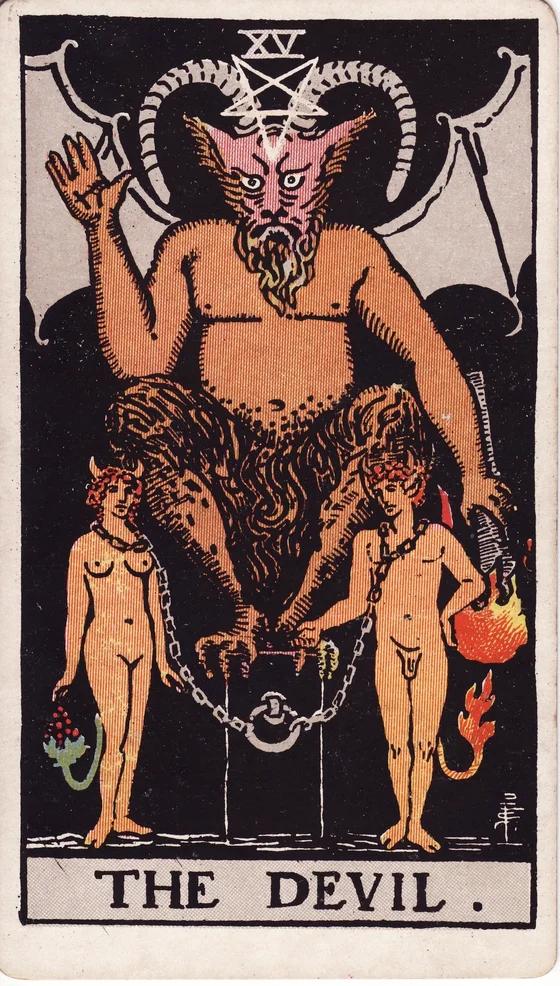
Against a black background, a huge figure with curved horns, batlike wings, and animal claws crouches on a black pedestal. An inverted pentagram appears at its forehead. The hand on the left of the picture opens upward; the hand on the right holds a burning torch pointing down. Wings and body almost fill the upper half of the card, leaving narrow space for the two people below.
A ring at the pedestal's front connects two chains, one around a man's neck and one around a woman's. Both are naked, with small horns and tails: fruit grows at the end of the left tail, while the right tail ends like a flame. The chains hang in curves, and their hands are unbound. Neither pulls at the chain or steps away. The most useful relationship to observe is “room to move, yet still tethered to the same place.” This is a pictured relationship, not evidence that people trapped in real situations can leave at any moment. View the actual card image.
The chains lead to one pedestal, making both people's movements revolve around the same point. For a real-life cycle, begin with “Why do I return here each time?” The downward torch and tails offer strong imagery of desire and instinct, but enjoyment itself need not be condemned. Loose chains prove only that the picture contains slack, not that leaving has no real-world cost. Some restrictions involve resources, relational pressure, and safety; a changed mindset alone cannot remove them. A modern reading can start with a specific exchange: the immediate benefit, the later cost, and which conditions can change with available support.
Waite Describes Bondage and Leaves Room for Loosening
In Part II of The Pictorial Key to the Tarot, Waite connects the chains with bondage to material life and the tails with human animal nature. Yet he also emphasizes that the figure towering over the pair will not remain their master forever. This belongs to his religious and mystical framework, not a condemnation of every desire. Waite on the Devil.
His Part III divinatory entries include strong force, violence, and fatality, while reversal includes weakness and blindness. Memorizing reversal simply as “liberation” is therefore not a faithful repetition of his list. Waite's divinatory meanings.
Look at the Attraction and the Bill Together
DestinyPixel's modern reading begins with exchange. Upright can indicate an attractive cycle that gradually narrows choice: immediate pleasure, feeling needed, income, or status temporarily outweigh sleep, boundaries, and long-term goals. Liking money, pleasure, or intimacy is not itself a problem. The question is whether you can stop and how much stopping costs.
Reversal can mean beginning to recognize the cycle and loosen it a little, or talking about change while still defending the old pattern. Judge by behavior: Has an automatic renewal been canceled, an opportunity for contact changed, or a trustworthy person asked to help? Greater self-disgust without greater choice does not yet count as release.
Distinguishing Related Meanings
The Devil and Lovers both contain two people but depict different connections. In comparing them, ask whether participation remains voluntary, whether someone can say no, and what happens after refusal. The card cannot directly establish that a relationship is evil. Compared with the Ten of Wands' heavy burden, the Devil also asks why the burden attracts: being needed, winning back losses, or fear of missing out can all keep someone engaged. Calling reversal “loosening” requires behavioral evidence. Stronger shame and more verbal promises do not automatically increase choice. If real threats or harm are involved, seek support based on the facts.
Limited Editions Turn a Hobby into an Endless Chase
Original fictional case. Siqi asks, “I love collecting little ornaments, but lately I'm always afraid of missing out. What can I do?”
Known facts: She once chose only one piece she liked each month. Since joining new-release groups, she orders almost every time. Some boxes remain unopened. Spending and space already cause stress, yet she continues refreshing countdowns. She draws the upright Devil in the ongoing-cycle position.
The pedestal-and-chain connection can correspond to repeatedly being pulled back by release alerts without condemning collecting itself. Unopened boxes, ongoing stress, and refreshing behavior support a reading in which immediate attraction is narrowing choice. The focus is restoring conditions that allow stopping, not diagnosing addiction from a card or calculating future losses.
Another possibility: If collecting remains affordable and she freely skips pieces she dislikes, quantity alone is no reason to criticize spending. The pressure might also come mainly from storage rather than purchasing; address those separately.
A practical next step: Record the triggers before and feelings after the last three purchases, pause some of the strongest release alerts, and put desired pieces on a review-later list. Decide after a cooling-off period she finds acceptable, observing whether liking the work becomes easier to distinguish from fear of missing out.
Beginning to Loosen the Habit of Always Being Available
Original fictional case. Alin asks, “I no longer want to organize every gathering. How can I tell whether I've really changed?”
Known facts: His friend group routinely asks him to book tables, chase replies, and collect payments. He recently stated clearly that he would attend without coordinating, and handed one gathering to a willing friend. Yet seeing slow progress makes him want to take everything back. He draws the reversed Devil in the progress-during-change position.
The “beginning to loosen” reading is chosen because clear communication and a real handover have occurred. The chains can do more than symbolize entrapment; they can prompt noticing available room. Yet he is still drawn to the familiar reward of “they can't manage without me,” so the issue cannot be declared resolved. Reversal asks whether his new boundary can last through one actual event.
Another possibility: If the recipient never agreed to take over, the handover is not complete. If there is a genuinely urgent omission, helping with one thing need not mean returning entirely to the beginning. Distinguish limited support from taking over again; change need not happen perfectly in one attempt.
A practical next step: Confirm the scope the new organizer willingly accepts, and offer only one agreed form of help when explicitly requested. Afterwards, record what happened without his coordination. Let actual results revise the expectation that he must handle everything, rather than guarding boundaries through self-blame.
Try It Once
Draw two columns: “What it gives me immediately” and “What it takes away later.” Circle one small condition you can genuinely change, try it for three days, and see whether your choices expand. Do not turn the exercise into self-punishment.
A Common Misreading
The Devil cannot prove someone evil, show that you are cursed, or establish that a relationship is destined to harm. Do not use loose chains to accuse trapped people of “refusing to leave.” Resources, power, and safety all affect whether leaving is possible.
Sources and references
- The Pictorial Key to the Tarot
- The Pictorial Key to the Tarot
- RWS Tarot 15 Devil.jpg
- The Devil: Seeing the Exchange That Keeps You Hooked