Follow This Path Slowly
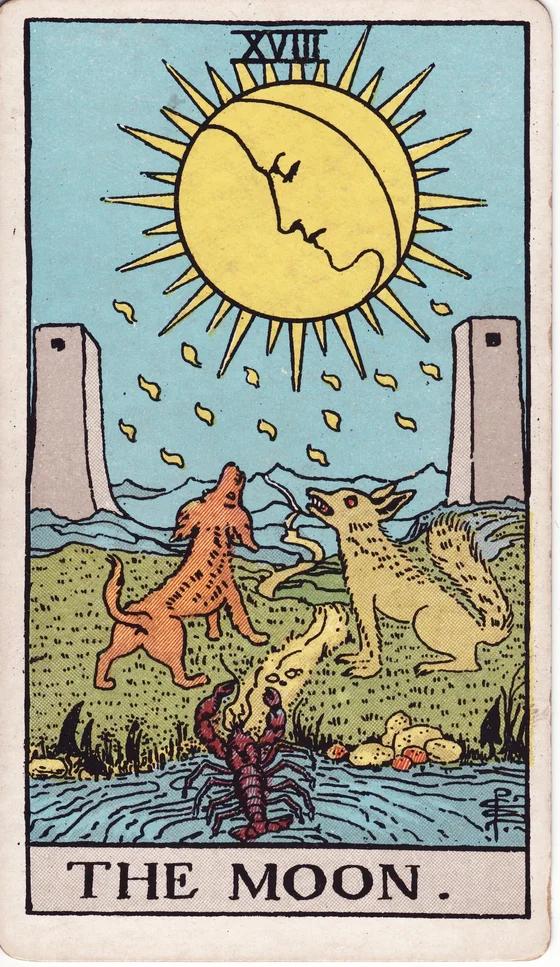
A very large moon fills the upper picture. Its disk contains a crescent outline with a face in profile, surrounded by rays of varying lengths and scattered yellow droplet shapes below. The scene is predominantly blue rather than a black-painted night. Unease comes chiefly from unfamiliar proportions, animals howling upward, and a path whose end cannot be seen.
In nearby water, a red crustacean raises its claws and reaches toward the bank. A yellow path begins before it, passes between a dog and wolf, continues between two towers, and winds into distant mountains. The animal on the left is slimmer; the one on the right has raised, shaggy fur. Both look upward, neither moving along the road. The route draws the eye into the distance while the implied nearby calls pull attention back. The Moon image.
The moon is high, the road on the ground, with animals and towers between. This separates seeing light from seeing a route clearly. The nearby crustacean emerges from the water while the distant road disappears into mountains, placing familiar and unknown in one continuous composition. A modern reading can break unease into smaller pieces: Which stretch is unclear, and which already has evidence? Upturned animals do not prove an enemy is approaching, and yellow droplet symbols supply no event date. If a redrawn card replaces the path with a mirror, first observe how the new image organizes uncertainty rather than mechanically transferring every association of the road between towers.
Waite's Key Idea Is Reflected Light
In Part II, Waite describes the path between the towers as an exit into the unknown and connects dog and wolf with human fear before the unknown. He emphasizes that only reflected light provides guidance at this point, placing the whole card in a symbolic account of imagination and mind. This is his conceptual framework, not a scientific explanation of the pictured animals. Waite on the Moon.
Part III's divinatory entries include deception, fear, and error; reversal adds instability and lesser degrees of deception and error. When learning tradition through this historical language, preserve a crucial distinction: drawing this card cannot be evidence that “someone is deceiving me.” Waite's divinatory meanings.
What needs a fresh look in another deck?
This article mainly observes the RWS Moon. The moon, towers, animals and water are not unique to this deck, but versions can change the lunar phase, animals or setting. In Part I, Section 2, entry XVIII, Waite records older designs with different lunar phases and either two dogs or a wolf and a dog. Check his account of older Moon designs.
If your card depicts two dogs, do not impose a dog-versus-wolf contrast. When the path, towers or water are redrawn, observe their relationships with the other elements anew. Using the picture to identify gaps in information is a modern reading exercise offered here, rather than a fixed meaning shared by all Marseille, Thoth or modern decks.
Start with the card in your hands and its companion book, then state which reading you are using. We do not add unverified Thoth symbolism here or treat Waite’s judgments of older decks as present-day historical consensus.
Feelings Can Prompt Verification
This site's upright reading concerns how people complete stories when information is insufficient. You may genuinely notice something unusual, or allow past experience to fill in the present. Feelings deserve recording, but verification is still needed between “I feel uneasy” and “this must be what is happening.” Temporarily withholding a conclusion can be the clearest choice.
Reversal can mean finally hearing an explanation or discovering a misunderstanding, so outlines grow clearer. It can also mean repeated guessing and repeated card draws making discernment harder. Check whether reality has supplied new information. If the other person still has not replied and the document remains unread, changing the card has not increased what you know.
Distinguishing Related Meanings
The Moon and High Priestess both encourage holding judgment open, but the Moon better examines how imagination fills information gaps. Compared with the Nine of Swords' intense worry, the focus here can be verifiability: Is there firsthand material? Was an account relayed in full? Has timing or context been omitted? Reading reversal as clearing mist requires new facts, not simply feeling a little better. Reading it as growing confusion calls for checking whether repeated searches and draws genuinely add information. Emotional relief matters, but it is not the same step as factual confirmation.
One Chat Excerpt Cannot Contain the Whole Story
Original fictional case. Acen asks, “Someone shared a screenshot in the group. Are my friends excluding me from an activity?”
Known facts: The screenshot contains only a few lines of itinerary discussion, without dates or context. She missed the last two gatherings and already worries the relationship is fading, but has not asked the organizer. She draws the upright Moon in the information-status position.
Moonlight revealing only part of the route suits the actual incompleteness of the material. Her unease has understandable context, but the screenshot cannot prove deliberate exclusion. Upright asks what stories were inserted between “I saw a few lines” and “they don't want me,” rather than selecting a pleasant explanation for comfort. Possibilities such as last-minute planning, an outdated screenshot, or a genuine invitation omission can all remain open.
Another possibility: If the organizer explicitly says she is not invited this time, that is a new fact to respect while discussing her feelings. “The Moon means it is unclear” cannot then be used to reject the answer. If the screenshot proves inaccurate, the earlier judgment should also change.
A practical next step: Ask directly about the event's time, who is included, and the screenshot's context, stating only what she saw and what she wonders. After receiving an answer, decide whether to join or discuss disappointment. For now, do not forward the screenshot to recruit more guesses about motives.
A Clearer Recording Still Needs Certainty Separated from Guesswork
Original fictional case. Muchuan asks, “Part of an interview recording is unclear. Can I fill it in from context?”
Known facts: He initially guessed a particular place name. A clearer backup later let him identify two characters, but the final one remains indistinct and the interviewee is reachable. He draws the reversed Moon in the part-becoming-clearer position.
The “mist is lifting” reading has a clearer recording as its basis. Reversal does not make the entire passage automatically reliable; it asks him to separate the two confirmed characters from the remaining uncertain one. A path revealed section by section can become an item-by-item verification method, preventing a little evidence from validating the whole initial guess.
Another possibility: If the backup is not the same interview passage, or its sound has been unreliably processed, it cannot count as valid new information. The interviewee may also have misspoken, requiring confirmation of intended meaning rather than merely guessing the sound correctly.
A practical next step: Keep the unclear-audio marker, send the relevant passage and context to the interviewee for confirmation, and record any correction. If it cannot be verified before the deadline, omit an unnecessary precise place name or state the uncertainty. Do not invent an apparently complete answer just to make the draft flow.
Try It Once
Divide your concern into “What I saw myself,” “The story I filled in,” and “Who can confirm it.” Choose only one item from the third column to ask about. Record new facts afterwards, then decide whether action is needed.
A Common Misreading
The Moon cannot diagnose mental or physical illness, prove a partner's infidelity, or establish that someone has cast a spell. Intuition can raise questions; conclusions still need evidence. If real danger is already present, seek help according to the facts.
Sources and references
Waite’s image interpretation, historical divinatory entries and accounts of older designs are listed separately below. Our modern quick readings, original fictional cases and exercises are not Waite’s text. The Commons scan of Pamela Colman Smith’s Moon supports artwork observation, not textual interpretation. The creator and source link for the current site artwork appear in the caption above.
- A. E. Waite, The Pictorial Key to the Tarot, Part II §2, XVIII: The Moon — reflected light, path, dog and wolf
- A. E. Waite, The Pictorial Key to the Tarot, Part III §3, XVIII: The Moon — upright and reversed divinatory meanings
- A. E. Waite, The Pictorial Key to the Tarot, Part I §2, XVIII: The Moon — older lunar phases and animal variants
- Pamela Colman Smith, RWS_Tarot_18_Moon.jpg — Commons artwork scan for image observation