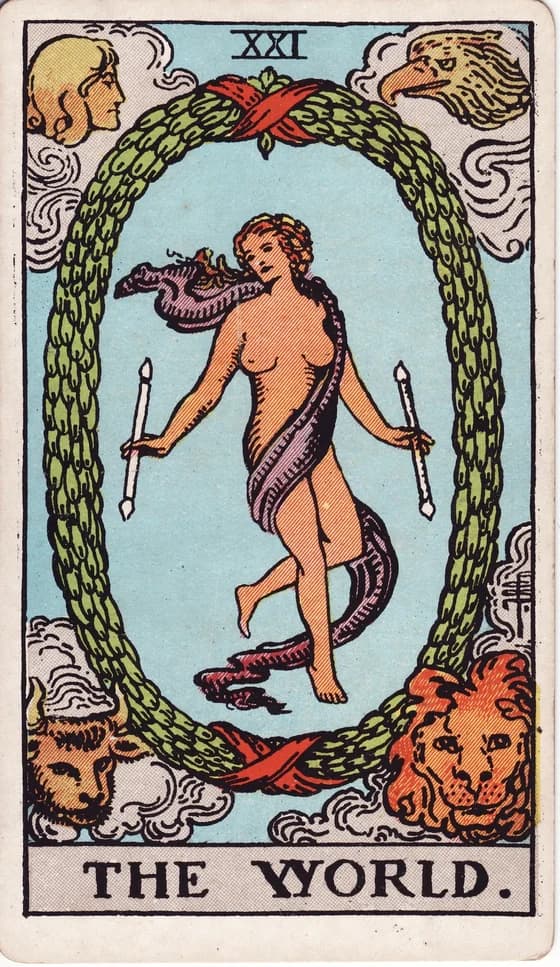
Movement within a completed boundary
The central figure is enclosed by a green oval wreath. Most of the body is naked; a purple sash winds over the shoulder, around the torso and downwards in curling folds. Each hand holds a pale short wand. The legs cross, one bent, and the head turns towards the left of the image. There is no throne or ground fixing the figure in place. The light pose resembles a dance caught for a moment.
Red ribbons bind the wreath at the top and bottom. Heads appear in the clouds at the four corners: a human, an eagle, a bull and a lion. They surround the centre without crowding into it. The enclosed outline and moving body allow completion to look like parts finally working together, rather than permanent stillness. That final observation is DestinyPixel’s interpretation of the composition. View the World.
Waite describes completion on a larger scale
In Part II, Waite discusses the completion of the cosmos, divine vision and a restored world, using his religious and mystical language. He also explicitly rejects reducing the central figure to a magician who has reached the highest level of initiation. When reading the source, do not attribute every later interpretation to him. Waite on the World.
His Part III entry includes success, reward, journeys and changes of place; the reversed entry includes stagnation and fixity. It holds completion and movement together, while reminding us that staying in the same external position does not necessarily mean the inner work is finished. Waite’s divinatory meanings.
First define what finished looks like
DestinyPixel brings the upright meaning down to a recognisable stage: a result is ready to hand over, learning can be put to use, or separate threads finally form a whole. Acknowledge the progress, organise the documentation and thank collaborators, so the experience can travel with you. Completing one stage does not require solving every problem in your life at once.
Reversed, one possibility is that the final steps are incomplete: acceptance, handover or filing. Another is that the conditions have been met, but attachment to an identity, fear of what comes next, or a demand for absolute perfection delays the ending. The first needs remaining actions; the second needs a fresh look at the completion criteria. If you keep adding requirements, the finish line keeps moving away.
In everyday situations
Learning. The course is over and you have the certificate. The World can redirect attention to whether you can use what you learnt independently once, rather than simply collecting a record of study.
A project. The features are largely ready, but nobody has written handover instructions, so the next person cannot use them independently. Reversed, the card suggests replacing “I’m done” with delivery criteria both parties can verify.
Moving home. The boxes are in the new place, but daily life has not found a rhythm. Arrange a few necessary routines so the new address gradually becomes somewhere you can live. The sense of completion need not arrive on moving day.
Try it for yourself
For something nearly finished, make a three-item closing list: the actual deliverable, the people who need to know, and the experience worth taking forward. Once the items are checked, write “This is enough for this stage”, leaving room for what comes next.
Common misreadings
The World does not mean that everything will now be perfect, or that travel, migration and every goal will happen automatically. A reversal is not simply failure either. First distinguish unfinished work from difficulty allowing yourself to finish.
Read these cards together
- The Fool: Compare completing a cycle with meeting new uncertainty while carrying experience forward.
- Wheel of Fortune: Compare a turning cycle of change with different parts temporarily working as a whole.
- Judgement: Distinguish the moment of answering a call from the practical completion that follows.
Sources and further reading
- A. E. Waite, The Pictorial Key to the Tarot, Part II, XXI: English text
- The same book, Part III, Section 3, entry 21: original upright and reversed meanings
- Pamela Colman Smith, RWS card: Commons image and version history
The English transcription is dated 1911; the image page identifies the card as Pam-A, 1910. The visual description follows the downloaded Commons JPG. The modern quick takes and exercises are DestinyPixel's original interpretations. Sources checked: 2026-10-07.