The leafy staff has yet to touch the ground
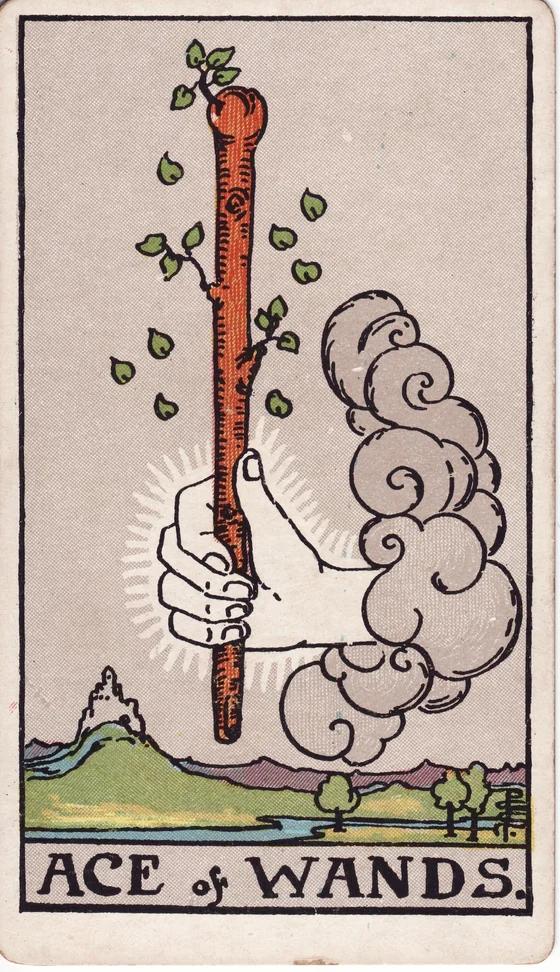
A gray cloud extends from the right side of the picture. From it, a hand firmly grips a thick reddish-brown staff, with white rays surrounding the palm. The staff retains the texture of bark; green leaves grow from its tip and sides, while other leaves scatter through the air. It is not planted in the soil. Someone holds it, and further action is still to come.
Below are a winding blue waterway, green ground, and trees, with a pale building on the hill to the left. The hand and staff occupy most of the picture, leaving the distant landscape small. New leaves may suggest the possibility of growth, but the picture does not say what they will grow into, or give a date for results.
The detail most worth dwelling on is that the hand already grips the staff, yet the staff has not been put to any particular work. That sequence lets us distinguish “feeling a response” from “being fully prepared.” The distant building gives an imagined outcome some shape, but terrain and distance still lie between. If the question concerns motivation, the new leaves are suggestive. If it concerns whether resources are sufficient, we must look beyond the picture and check time, skills, and practical support. This reading avoids turning every moment of excitement into a long-term commitment.
How Waite describes creation and beginnings
In the Ace of Wands entry in The Pictorial Key to the Tarot, Waite explicitly mentions creation, invention, the beginning of enterprises, and beginnings and origins. Using the card to discuss an idea beginning to generate the energy for action therefore has a direct basis in the historical text.
The old book also lists various meanings concerning wealth, family, and birth, and its reversed entry is especially severe. This article does not turn them into real-world predictions. Instead, it develops an original modern learning approach around “beginnings”: identify an interest, then give it an action that can be tested.
Understanding the upright card
Upright, the card can draw attention to the feeling “I want to try this myself.” It may be a new idea or renewed interest in an old project. The most useful thing now is not immediately to map out your whole life, but to establish whether you want to engage with the actual process. Enjoying the imagined result and enjoying the activity itself are still different things.
Give the beginning a small container: an hour, a page of sketches, or one trial attempt. Afterward, note which parts increased your interest and which differed from your expectations. Information gained through action can guide your next choice more usefully than repeatedly asking “Do I have talent?”
Understanding the reversed card
This article uses the reversal to examine why a spark fails to become action. Sometimes too many ideas keep pulling attention in different directions. Sometimes the threshold for starting is too high: you must buy every supply first or wait until everything feels perfect. You may also simply lack enough spare capacity right now and need to narrow the scope.
You need not interpret a temporary lack of energy as failure, or force enthusiasm through additional commitments. First distinguish “I genuinely want to do this but am blocked” from “I think I should want to do this.” In the former case, you can remove an obstacle; in the latter, you can allow yourself to choose again. The two situations call for different approaches.
In a current-situation position, this card can describe a newly emerging interest. In an advice position, it lends itself better to a bounded experiment. In an obstacle position, even its upright vitality might suggest constantly chasing novelty while neglecting something already growing. The spread position determines the angle of the question; orientation cannot replace that step.
Try recording before deciding to make a series
Original fictional case. Aheng enjoys listening to local oral histories and has listed more than a dozen topics, but has never recorded an interview. He has only one free evening each week, and a friend is willing to make a test recording with him. His question is: “How can I judge whether this podcast idea is worth pursuing?” He draws the Ace of Wands upright in the advice-for-the-next-step position.
The hand in the cloud offers a tool he can grasp rather than a complete program plan, so the reading centers on firsthand experience of the process. The new leaves correspond to his existing curiosity, and the distant building to the finished work he has not yet made. Recording once can help him discover whether he enjoys hearing stories, asking questions, or imagining the published program. That question fits the known circumstances better than “Do I have talent?” and does not require a commitment to long-term production.
But drawing an ace alone is no reason to recommend buying equipment. If he had already made many test recordings and was actually blocked by interview permissions and organizing material, “start small” would be outdated advice; the focus should shift to those specific processes. If his friend did not want to participate, he should instead try recording a monologue. The card cannot justify pressuring someone else to cooperate.
He decides to record five minutes on his existing phone, agreeing beforehand with his friend that it is practice only and will not be published. That evening, he edits a short segment and notes what he most wants to redo. Afterward, he will judge whether he wants to repeat this work. For now, he leaves the series name and release schedule undecided.
Not wanting to begin may mean having no room
Original fictional case. Xiaoyi used to sketch regularly. Recently, she moved house and took over the day-to-day running of her household. She has saved many courses, but every evening she only wants to lie down, and worries that she has lost her creativity. Her question is: “How can I recover my interest in drawing?” She draws the Ace of Wands reversed in the current-obstacle position.
The leaves in the picture still look alive, but holding the staff requires a hand that is free. In the context of Xiaoyi’s life, the reversal can direct attention to insufficient spare capacity rather than pronounce judgment on her interest. Saving courses may be a way of keeping a connection to her hobby. A temporary absence of action is not enough to prove that enthusiasm has disappeared. First, she needs room to describe how her days unfold; only then can she identify a threshold that might be lowered.
Another explanation is that she enjoys looking at art but no longer enjoys making it. If, after rest and time become available again, she still does not want to pick up a pen, that possibility deserves greater respect. Forcing continued practice may not help. Conversely, if she becomes absorbed as soon as she starts drawing, scheduling and preparation costs are more likely to be the main obstacles.
She puts paper and pens within easy reach and chooses a day to draw the cup on her table for just five minutes, stopping when the time is up. She also discusses an uninterrupted stretch of free time with her family. At the next review, she will ask only whether the experience has become lighter, rather than using the quality of the drawing to prove that her interest remains.
A small exercise
Write “What I really want to try is…” Then turn the first step into an action you can finish within twenty minutes. Afterward, record only three facts: what you did, what was interesting, and what you still want to learn. Leave your potential ungraded for now.
Common misreadings
The Ace of Wands does not guarantee a successful business and cannot confirm a pregnancy. New leaves and a strong hand may evoke vitality, but real outcomes still depend on circumstances and subsequent action. The ace presents a beginning available for exploration.
Image and English sources
- Pamela Colman Smith, Ace of Wands, RWS Pam-A / TaionWC
- A. E. Waite, The Pictorial Key to the Tarot, Part III §2, Ace of Wands (1911-labelled English transcription)
- A. E. Waite, The Pictorial Key to the Tarot, Part III §2, Wands
This article primarily uses the RWS deck. The existing image version and original English text were cross-checked on 2026-10-08. The modern questions and cases are original work, not item-by-item translations of the old book’s divinatory meanings.