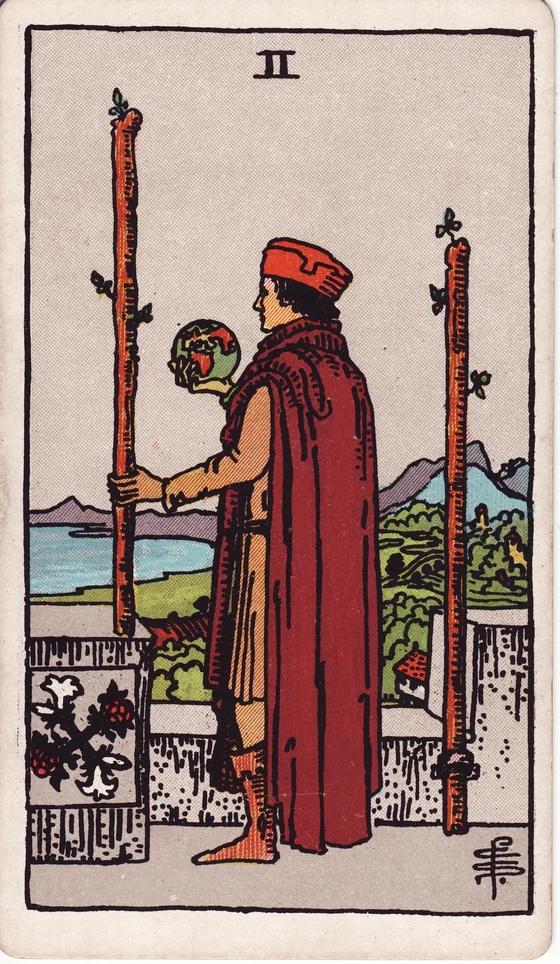
The world in a palm, feet still on the battlements
A figure wearing a red cloak and cap turns sideways toward the left of the picture. One hand holds a globe; the other grips an upright staff. A second staff behind the figure is fastened to the wall with a ring. Both staffs bear leaves, but their relationships to the figure differ: one is in hand, while the other remains fixed in place.
Beyond the wall are blue water, a coastline, trees, and distant mountains, with red-roofed houses nearby. A decorative panel on the stone wall at lower left shows crossed flowers; a red rose and white lily are recognizable. The figure is looking out from a height rather than traveling along a road. “Planning” is a reading developed from that composition, not an action explicitly stated in the picture.
Moving your gaze between the globe in hand and the fixed staff reveals a tension between desire and an existing foundation. A globe turns easily; the fastening ring does not turn with it. Some ideas can change at any time, while some commitments already affect other people. Planning here is not only about expansion, but also about deciding what kind of life is worth preserving. A high viewpoint extends the horizon yet may make everyday details seem tiny. This card therefore especially needs a follow-up question: what would that distant vision look like within an ordinary week?
An older interpretation where prominence and dissatisfaction coexist
Waite specifically notes irreconcilable differences between the old divinatory meanings for this card. Alongside wealth and magnificence, he invokes an Alexander-like image of dissatisfaction after acquiring vast territory. The globe in hand and the land before the figure therefore do not represent straightforward expansion alone.
This article retains the tension of “having some resources already, yet still looking outward” and turns it into a modern theme of choosing a direction. It adopts a planning interpretation without collapsing all of Waite’s entries into “success is coming.”
Understanding the upright card
Upright, the card can help you move from “I still want more” to “Where, specifically, do I want to go?” You may already have a basic position, a skill, or a workable option, and now need to compare several possible paths. The criteria should come from your real goals, not simply from which path looks most enviable.
Put your vision and your conditions on the same page: what must you invest, what must you maintain, and what information is still missing? Planning is not automatically procrastination. Pausing to look ahead has value when the investigation can change your choice and there is a clear time for deciding.
Understanding the reversed card
Here, the reversal examines how a choice becomes stuck. You may want to keep every direction available, so none receives real investment. Or you may decide too early that only one path is possible, mistaking unfamiliarity for impracticality. Both require checking the evidence rather than adding another round of imagining.
If you keep moving between two options, identify one question that would genuinely change the decision and arrange an interview, trial, or information check. If the problem is not missing information but the impossibility of having every option at once, acknowledge the trade-off and set a point for review.
When reading this card, distinguish “I am pausing because I lack information” from “I have enough information but cannot bear to lose the other path.” The first calls for investigation; the second calls for choosing and accepting the cost. The modern hesitation reading is not identical to Waite’s reversed meanings of surprise, emotion, and fear. Stating that difference clearly preserves the complexity of a card where dissatisfaction and the unknown coexist.
Bring a long-distance life back to a concrete week
Original fictional case. Sining and her partner have lived in different cities for two years and both say they want to stop commuting between them. Her work is flexible, but her partner has just started a training program that requires in-person attendance. So far, they have discussed only their ideal city. Her question is: “How should we discuss whether to move to the same city?” She draws the Two of Wands upright in the shared-planning position.
The globe resembles the distant future they repeatedly discuss, while the staff fixed to the wall can draw attention to existing responsibilities. Upright, the card supports making the idea concrete; it does not authorize either person to choose the other’s future. The figure still stands inside the walls, suggesting that this conversation can remain a comparison of conditions. They need not move immediately to prove their love. The picture connects with the facts where a desire already exists but the arrangements to support it remain unclear.
If one of them does not actually want to live together, even a detailed budget will not resolve their differing goals. Both first need to express their wishes independently, rather than treating silence as agreement. If the training creates only a short-term constraint, the issue is more likely a timetable. If a long-term work location cannot change, then they need to compare cities again.
Each writes down the routine of an ordinary workday, the conditions they cannot change, and where they can compromise. They then arrange one conversation devoted solely to the possibility of a three-month trial stay. Whether they proceed will depend on both people’s wishes and real circumstances, with the card serving as no judge.
Before choosing a class, find the question that could change your decision
Original fictional case. Zhouchuan has spent a month comparing classes, and two courses meet at conflicting times. He wants to make friends through learning but fears missing the option with better prospects. He has already read the course pages many times. His question is: “Why can’t I decide whether to study photography or pottery?” He draws the Two of Wands reversed in the decision-sticking-point position.
Looking out from a height while holding a small globe makes it easy to mistake an overview for complete experience. Zhouchuan has enough information to compare descriptions, but has not experienced the actual classes. The reversal can therefore point to choosing through promotional material alone. The two staffs also suggest wanting to retain two paths when his available time allows serious participation in only one. The reading should help him state his real purpose rather than announce which course better suits his destiny.
If his core goal is solitary creative work, class size and social atmosphere are not the most important measures. If he cares about connecting with people, the way classes are organized may matter more than technical prospects. If the cost exceeds what he can afford, he should address the budget first rather than have caution labeled cowardice.
He asks each teacher one question: does the class include regular peer feedback or shared practice? He then attends an available taster session. After that, he chooses this term’s course according to “Do I want to come here every week?” and leaves the other activity available to try later.
A small exercise
For each of two real options, write down one attraction, one cost, and one unknown. Investigate only the information most likely to change your choice, then set a decision date. That date can be a review point rather than an irreversible commitment.
Common misreadings
The Two of Wands does not necessarily mean going abroad, nor does it show someone who already has everything. The globe and coastline bring distant places into the picture, but how far you can go and whether to leave must still be judged from real circumstances.
Image and English sources
- Pamela Colman Smith, Two of Wands, RWS Pam-A / TaionWC
- A. E. Waite, The Pictorial Key to the Tarot, Part III §2, Two of Wands (1911-labelled English transcription)
- A. E. Waite, The Pictorial Key to the Tarot, Part III §2, Wands
This article primarily uses the RWS deck. The existing image version and original English text were cross-checked on 2026-10-08. The modern questions and cases are original work, not item-by-item translations of the old book’s divinatory meanings.