Seeing the ships also means distinguishing their story
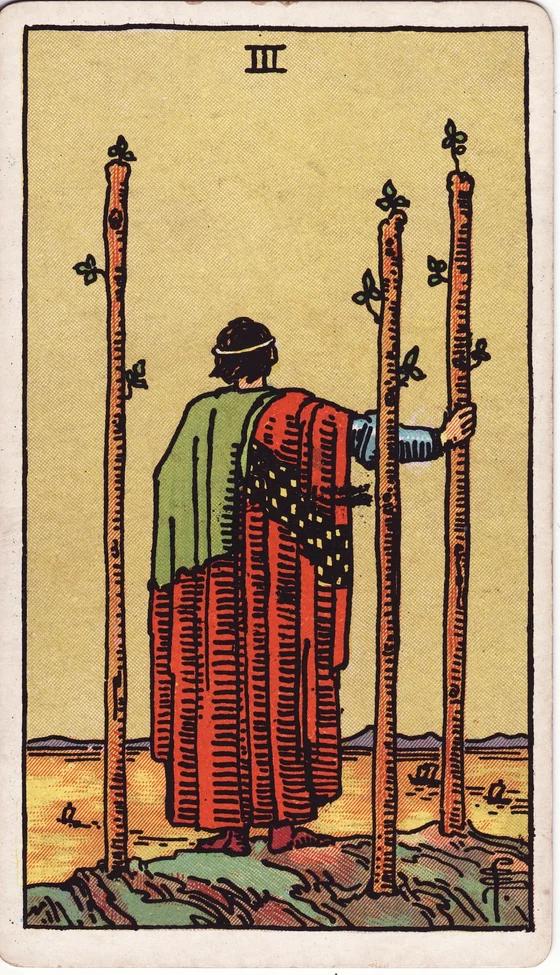
A figure in a red robe, draped with green fabric, stands on a rocky height with the right hand resting on the rightmost staff. Two other staffs are planted in the ground, one to either side, and all three bear green leaves. The figure’s face is hidden from the viewer. The stance looks stable, and the gaze is directed toward open water.
The sky and water are mainly yellow and golden orange. An undulating mountainous shoreline stretches across the distance, and several sailing ships can be seen on the water. The picture contains no cargo manifest and does not specify whether the ships are entering or leaving port. Their ownership and commercial context come from Waite’s written account and should be distinguished from details visible to the eye alone.
The three staffs are already set in the ground while the ships are on the water. That spatial relationship presents “my preparations” and “the outside world’s response” together. The figure can observe the voyage but cannot control every gust of wind from shore. A modern application therefore concerns not just expansion, but also what can and cannot be controlled in collaboration. A turned back does not prove loneliness, and a steady stance does not prove an absence of risk. These details are better used to remind us to keep some observational distance, rather than change an entire direction over one immediate reaction.
The ships’ commercial story comes from Waite
Waite associates the Three of Wands with established strength, enterprise, effort, trade, and discovery. In his own description, he identifies the ships as carrying the figure’s merchandise. He also mentions capable business cooperation. The historical interpretation therefore includes outward activity and assistance from others.
His reversed entry speaks of an end to troubles and difficulties, which is not the same as “blocked expansion.” This article uses a separate, original reflective approach to reversal, examining whether reliable feedback can follow an action sent outward. The two are not presented as the same tradition.
Understanding the upright card
Upright, the card can indicate a stage that calls for broadening your contacts. An idea has already become some kind of action. Now it needs new readers, partners, or users so the real world can supply information. You need not control every response, but you do need to know what kind of response you are waiting for.
Useful waiting includes standards for observation. After a presentation, for example, you may want to know which parts people do not understand; after a trial, you may want to know which step takes the most effort. Cooperation also requires clarity about what each person provides. “A wider perspective” should not be mistaken for taking on more things at once.
Understanding the reversed card
The reversal can help locate a stalled step: was the information actually sent, was the recipient appropriate, were the agreements clear, and is the response window reasonable? Without checking these points, it is difficult to distinguish normal waiting from a delay that needs correction.
Another point to examine is whether too much attention has gone toward distant possibilities while nearby capacity to support them is neglected. When someone responds, will you have time for further communication, revision, or delivery? Strengthening that capacity before expanding is usually more helpful than simply urging others to hurry.
The Two of Wands often centers on comparing conditions before departure; the Three suits examining what happens after action has been handed to the outside world. This is not a fixed sequence everyone must follow. If no invitation has actually been sent, drawing a three is no reason to say opportunities are returning. First check whether the “ship” ever left your hands.
What to ask after people have seen your work
Original fictional case. Nancy has finished an eight-page picture book and shared it with a community reading group. All five readers say the illustrations are charming, but only two can accurately describe the story’s turning point. She is considering immediately printing a batch. Her question is: “After showing my picture book for the first time, what should I change next?” She draws the Three of Wands upright in the using-feedback position.
The person on shore already has a foothold, and the ships carry action farther outward, echoing the work leaving its author’s hands. Upright, the card can encourage her to make serious use of external feedback. Praise shows that some of the communication works; the unclear retelling of the turning point gives a more specific direction for improvement. “Expansion” here means expanding understanding, not necessarily the print run. The author can see the whole story, while readers see only the clues left on the page. Both perspectives matter.
However, difficulty retelling the story could also come from interruptions during the reading rather than page design. If everyone understands after rereading in a quiet setting, the scale of revision should be reduced. If confusion centers on the same spread, changing that spread has a stronger basis than redrawing the whole book. The card cannot replace this check.
She chooses two readers willing to continue and asks them to point out, as they read, when they do not understand a character’s motivation. She revises only that spread, then holds another small reading trial. The print quantity can wait until the content is stable, allowing the “ships” already launched to bring back usable information.
Before waiting longer, check whether a response was agreed
Original fictional case. Haowen sent a draft travel itinerary to a friend ten days ago. The friend replied only, “Looks good.” Haowen has therefore put his other plans on hold, but has never asked whether the friend has time off or proposed a reply date. His question is: “My friend who lives far away still hasn’t agreed to the trip. Should I keep waiting?” He draws the Three of Wands reversed in the cause-of-delay position.
A ship at sea is not necessarily sailing toward you. In light of their actual conversation, the reversal can suggest that he has treated a friendly reaction as a shared commitment. What is missing first is confirmation, not patience. The shore-side figure can determine the ships’ actual state; the modern application is checking whether the other person received a question requiring an answer and has the practical ability to participate.
Another possibility is that the friend really is waiting for a work schedule but has not explained this. If the friend names a specific unresolved issue and a date, they can discuss whether waiting is worthwhile. If the friend clearly declines, Haowen should accept that information. The reversal cannot justify guessing that the friend is evasive, hiding something, or indifferent to their friendship.
Haowen sends one clear question without pressure, explaining when he needs to finalize arrangements and allowing his friend to decline directly. After the agreed date, he will plan according to the actual reply. If there is no shared commitment, he will travel alone or arrange another time, rather than reserve his schedule indefinitely.
A small exercise
Choose something you have already “sent out.” Write down the recipient, the feedback you hope to receive, a reasonable waiting period, and the next step. If any of those four is blank, fill it in before judging whether to keep waiting.
Common misreadings
Ships do not guarantee overseas opportunities or profits, and standing high above the scene does not mean victory is assured. The Three of Wands supports practicing a broader perspective and reading feedback. It cannot replace market research, checking agreements, or observing actual responses.
Image and English sources
- Pamela Colman Smith, Three of Wands, RWS Pam-A / TaionWC
- A. E. Waite, The Pictorial Key to the Tarot, Part III §2, Three of Wands (1911-labelled English transcription)
- A. E. Waite, The Pictorial Key to the Tarot, Part III §2, Wands
This article primarily uses the RWS deck. The existing image version and original English text were cross-checked on 2026-10-08. The modern questions and cases are original work, not item-by-item translations of the old book’s divinatory meanings.