At a glance
Upright: There is somewhere to settle, feel at ease and celebrate together
Reversed: The scene may be lively without feeling secure or welcoming to everyone
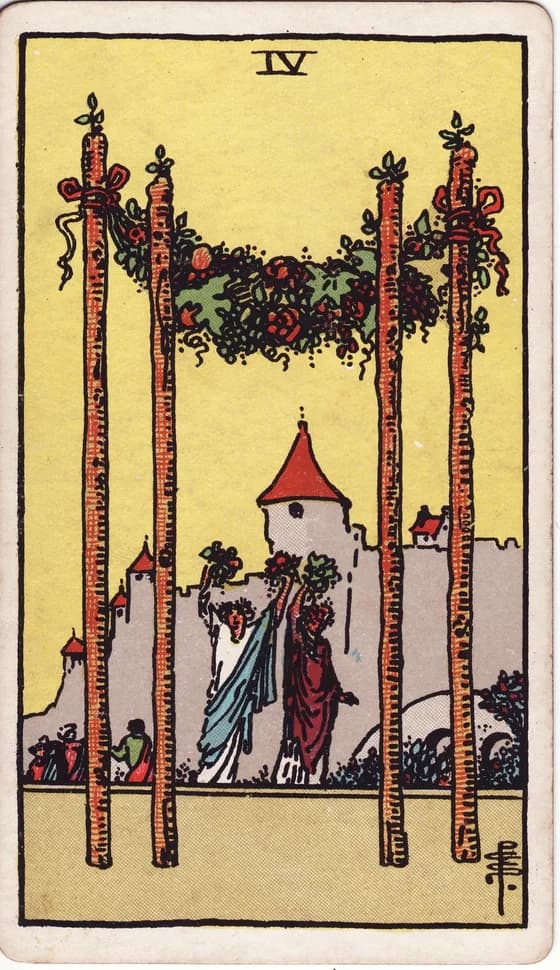
The garlanded structure in the Four of Wands does not enclose the people. Four poles mark out a place to gather while leaving the front open, bringing celebration and welcome into the same picture.
The space beneath the garland stays open
Four tall, leafy wands stand in the ground against a bright yellow background. A garland of flowers, fruit and foliage stretches across the top, with red bows tied to the outer poles. There is no door or fence across the middle, so we can look through the temporary structure to the scene behind.
Two people raise bouquets. One wears mainly pale and blue fabric; the other is draped in red. Behind them are walls, red-roofed towers, a bridge to the right and a small distant group. The atmosphere is clearly festive, but the event is not named and there is not enough evidence to establish the relationship between the two central figures.
Waite retains joy in both orientations
Waite directly links the Four of Wands to repose, refuge, harmony and a domestic harvest celebration. Notably, he says the main meaning remains largely unchanged when reversed, continuing with prosperity, happiness and embellishment.
From that background, this article develops a contemporary question: what helps people genuinely settle in? It uses the reversal to explore a gap between celebration and belonging. That is an explicitly modern exercise, not a claim that Waite described the reversed card as family discord.
Reading it upright
Upright, the card can invite you to acknowledge a completed stage and give the achievement a visible place. Celebration need not be elaborate. It might be finishing work on time, eating with collaborators or arranging a space that is finally ready to use. Pausing to feel completion helps distinguish what is already done from what remains in progress.
Belonging also has practical conditions: who is invited, who prepares everything, and can people participate comfortably? A stable setting offers more than a lively atmosphere. People know the arrangements, the division of work and where they can rest. Maintaining those conditions together can turn a brief gathering into dependable support.
Reading it reversed
Here, the reversal compares feelings with arrangements. A celebration may be ready while someone is still too busy to join. A home may look comfortable while everyday rules remain undiscussed. An achievement may deserve recognition while you keep feeling it is insufficient. Each situation needs closer, specific attention.
Ask what is missing: rest, a say in how things happen, acknowledgment or a way of celebrating that suits you better. A lack of excitement does not erase what you accomplished. Nor does preserving a festive appearance require everyone to display the same emotion.
In everyday life
Finishing a project stage
Hold a short review, thank people for specific contributions and identify any remaining loose ends. When celebration and handover are both clear, the team can more genuinely put the stage behind them.
Moving into a shared home
Alongside decorating, discuss quiet hours, visitors and everyday responsibilities. Giving everyone room to state their needs contributes more to feeling at home than appearance alone.
Preparing a gathering
Keep the scale manageable for everyone. Ask how people want to take part and make it easy for those who would rather not stay long to leave. Welcome should not become an obligation.
A short exercise
Choose a small stage you recently completed. Write down what was actually finished, who took part and what kind of celebration would feel comfortable. Mark it in one simple way, then list the unfinished parts separately.
Common misreadings
Even when the Four of Wands is used to discuss a wedding or setting up a home, the image does not require marriage or guarantee a stable relationship. Its learning focus can remain on shared space, a sense of completion and the real conditions for belonging.
Artwork and English sources
- Pamela Colman Smith, Four of Wands, RWS Pam-A / TaionWC
- A. E. Waite, The Pictorial Key to the Tarot, Part III §2, Four of Wands (1911-labelled English transcription)
Sources checked: 2026-10-07. This article translates the original Chinese learning text. The English source is a transcription labelled 1911; the image file page describes a 1910 Pam-A card. Historical context and contemporary exercises are identified separately.