At a glance
Upright: Everyone is putting in effort. First find out what the disagreement is about
Reversed: Differences may be getting avoided, or the argument may be growing more confused
Five people each hold a wand and make large movements, yet there is no clear shared direction. The most useful question in the Five of Wands is not who will win, but whether all this effort is serving the same purpose.
Five people exert themselves without a shared direction
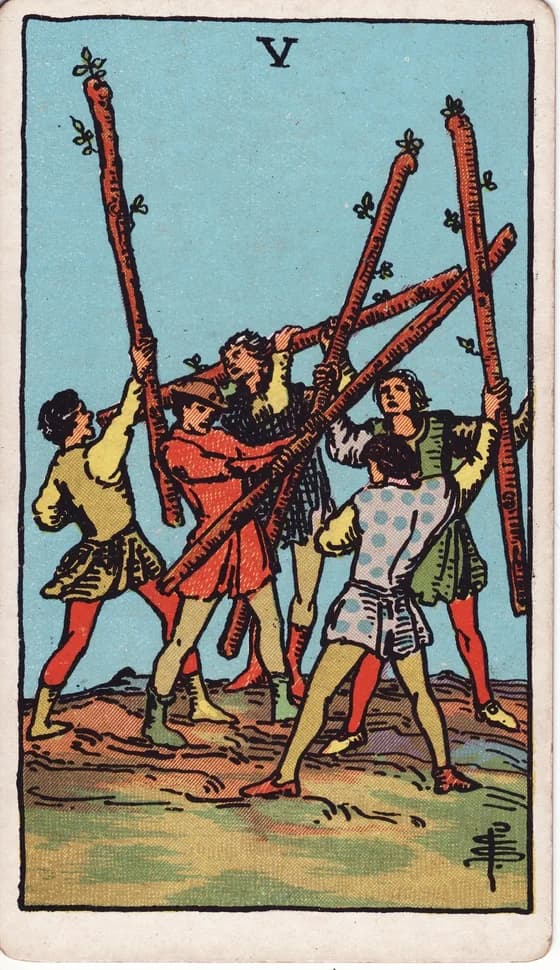
Under a blue sky, five people in short tunics of different colours and patterns stand on uneven ground. One raises a wand upright, another lifts one over a shoulder, and another reaches diagonally towards the centre. The five poles cross in the air. The nearest figure faces away from us; the others do not all turn or look in the same direction.
There is no blood in the image and no obvious central leader. The crossing wands might suggest an argument, but could also resemble training or a game. The picture alone cannot establish everyone’s intentions, and not every difference of opinion should be read as hostility. Different clothing is visible; different goals are an interpretation to check.
Understanding competition through a mock battle
Waite describes people who may be engaged in sport or strife and explicitly calls the scene a mock battle. He also connects the card with competition and the effort to secure results. Its historical theme therefore extends beyond interpersonal arguments to practice and striving to get ahead.
The old reversed entry mentions disputes, litigation and contradiction. This article retains the need to address differences without predicting legal trouble. The discussion rules, cooperation and avoidance of conflict below are original contemporary applications.
Reading it upright
Upright, the card can reveal a situation that is not yet coordinated. One person values speed, another quality, and another wants their proposal noticed. If people are addressing different levels of the problem, more effort can create more collisions. Separate goals, resources and evaluation criteria so disagreement can produce useful information.
Competition with clear rules can also support practice. You can compare methods, test ideas and hear objections without turning the result into a measure of personal worth. Participants need to understand the rules, be able to disagree and leave the discussion knowing what happens next.
Reading it reversed
Here, the reversal checks two possibilities: has conflict been pushed out of sight, or has it become a drain with no way forward? If nobody objects openly but everyone acts on a different understanding, the problem remains. Repeating the same argument does not necessarily mean proposals are being compared seriously.
Try narrowing the topic, resolving one observable difference and agreeing what evidence will guide the decision. If there are actual threats or disrespect, respond to those behaviours and seek appropriate support. “Necessary adjustment” should not become a reason to keep enduring them.
In everyday life
A group discussion keeps circling
Ask each person to state the problem they most want this meeting to solve in one sentence. List agreement and differences. Before voting, make sure everyone is voting on the same decision.
Entering a skills competition
Treat it as a test: what do the rules require, and which step needs practice? Others’ performances offer a reference point, but the result need not become an overall verdict on your worth.
Planning a weekend together
If one person wants rest and another wants to go out, discuss needs before the itinerary. The real difference may concern what each hopes will restore them, rather than which place to visit.
A short exercise
Recall a disagreement. Write down each side’s proposed solution and the need behind it. Then draft a question to check your understanding: “Are we trying to solve… and… respectively?” Check understanding first, without immediately requiring agreement.
Common misreadings
The Five of Wands does not automatically mean someone is targeting you, nor does it make every argument healthy competition. Check actual behaviour and rules to distinguish useful adjustment, incompatible goals and a draining exchange that needs to stop.
Artwork and English sources
- Pamela Colman Smith, Five of Wands, RWS Pam-A / TaionWC
- A. E. Waite, The Pictorial Key to the Tarot, Part III §2, Five of Wands (1911-labelled English transcription)
Sources checked: 2026-10-07. This article translates the original Chinese learning text. The English source is a transcription labelled 1911; the image file page describes a 1910 Pam-A card. Historical context and contemporary exercises are identified separately.