At a glance
Upright: Your effort has been recognized. You can receive the appreciation
Reversed: The recognition you wanted is missing, or other people’s judgments matter too much
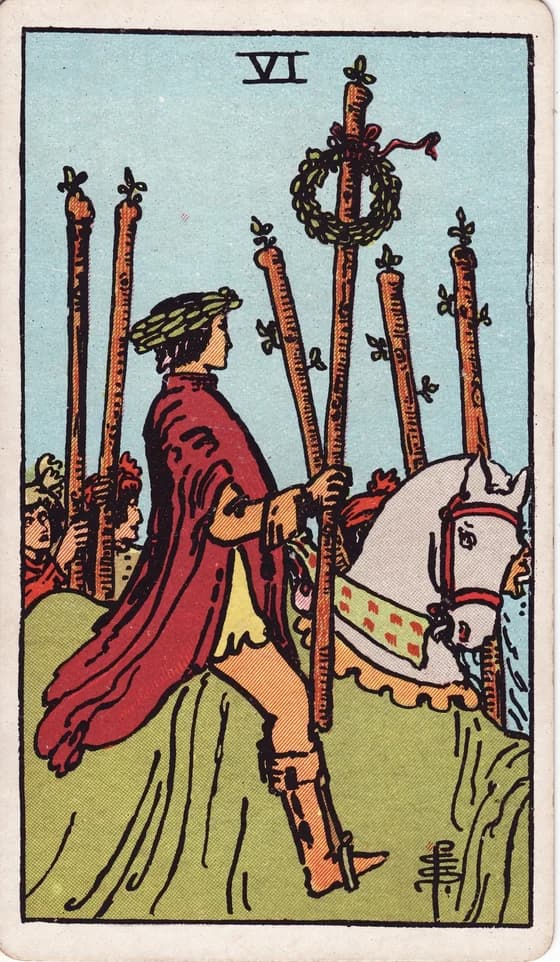
The laurel appears twice in the Six of Wands: on the rider’s head and on the wand. An achievement is no longer known only to the person who made it; it has entered public view.
Two laurels and the people alongside
A rider draped in red sits on a white horse, wearing a green laurel wreath. Another circular wreath, tied with a red ribbon, decorates the upper part of the wand. The horse faces right and wears green coverings. Against the blue background, five more leafy wands rise from the group.
Several companions are visible, with some faces obscured so their expressions cannot all be established. The rider sits higher than the people on foot and draws the most attention. This supports a reading of publicly visible achievement, but does not prove that everyone approves or show how the achievement was earned.
Triumph and news carried with ceremony
Waite describes the surface image as a victor’s triumph. He also mentions important good news conveyed ceremonially and hope receiving fulfilment. Recognition and achievement are therefore clear historical themes; they do not require an additional hidden symbol to support them.
The old reversed entry lists apprehension, delay and terms involving enemies. This article does not turn those into suspicion of people around you. Instead, it develops a contemporary reflection on whether recognition is accurate and timely, and how we handle its temporary absence.
Reading it upright
Upright, the card can help you acknowledge that you really accomplished something. Explain the result and accept reasonable praise without immediately dismissing it as nothing. Useful recognition names something specific: the problem solved, the change made and the methods worth keeping.
When sharing an achievement, notice the people who came alongside you. Explaining collaboration and circumstances does not diminish your contribution; it makes the account more trustworthy. Reputation grows from repeated actions. Being seen this time can support continued responsibility without becoming pressure to be even more impressive next time.
Reading it reversed
Here, the reversal examines the distance between recognition and facts. Work may be finished but not yet acknowledged. You may have done a great deal without making the concrete results visible. Or the criteria may have been unclear from the start, leaving people with different ideas of what “good” means.
Gather actual evidence before deciding whether you need clearer communication or adjusted expectations. If you keep checking likes, rankings or praise, return attention to progress you can explain. A lack of applause does not make work worthless, and applause does not remove every area for improvement.
In everyday life
Reporting work you completed
Explain your contribution through a clear before-and-after comparison, naming collaborators and unresolved issues. Avoid exaggeration without hiding your own work inside a vague reference to team effort.
Receiving a compliment
Say thank you and remember the specific point being recognized. You need not immediately contradict it or promise to perform at that level forever. A moment of appreciation can simply be genuine appreciation.
Someone else receives an opportunity you wanted
Find out the selection criteria and relevant gaps before deciding whether to seek feedback. The card cannot prove favouritism or exclusion. It can help turn disappointment into questions you can investigate.
A short exercise
Record one recent accomplishment in three sentences: what changed, what you contributed and who helped. Choose a suitable way to save or share the record so recognition has facts to rest on.
Common misreadings
The Six of Wands does not guarantee winning, promotion or universal approval. It does not require you to stay in the spotlight. An achievement can be celebrated before you return to ordinary practice and cooperation.
Artwork and English sources
- Pamela Colman Smith, Six of Wands, RWS Pam-A / TaionWC
- A. E. Waite, The Pictorial Key to the Tarot, Part III §2, Six of Wands (1911-labelled English transcription)
Sources checked: 2026-10-07. This article translates the original Chinese learning text. The English source is a transcription labelled 1911; the image file page describes a 1910 Pam-A card. Historical context and contemporary exercises are identified separately.