At a glance
Upright: Stand your ground under pressure and explain what needs protecting
Reversed: You may be answering every challenge, or yielding because you cannot keep it up
Only one person is visible in the Seven of Wands, yet six wands reach towards that figure. First identify the pressure that genuinely requires a response rather than imagining an enemy behind every pole.
A foothold above and six wands below
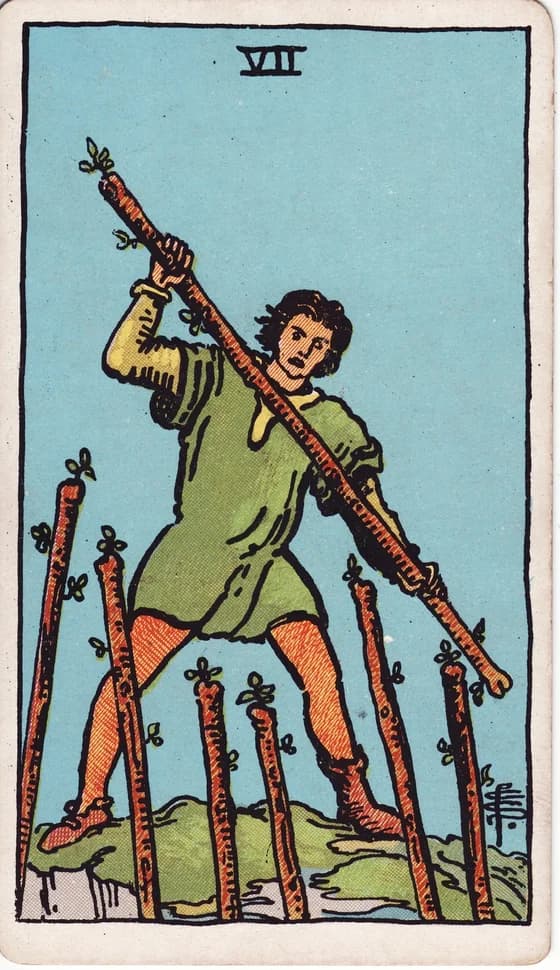
The figure stands with feet apart on green high ground, holding a wand diagonally across the body with both hands. A green tunic covers the slightly leaning body, and the face turns towards the lower right. The footwear differs: one side resembles a low shoe while the other covers the ankle. The difference is visible, but its cause is not explained.
Six wands extend upward from the lower edge; their holders are not shown. Rocky faces and uneven ground lie underfoot, with blue sky above. The difference in height creates tension: the figure has a foothold while facing pressure from below. The image does not show the outcome.
Historical themes of courage and positional advantage
Waite links the card with courage and regards the higher position as an advantage. He also applies it to discussion, verbal contention, negotiation and competition. The confrontation can therefore be read in terms of positions and ideas, not only physical combat.
The old reversed entry mentions confusion, anxiety and a warning about indecision. Building on those themes, this article offers an original boundary exercise: decide what needs holding firm and what can change. Higher ground does not automatically confer moral rightness; firmness still needs reasons.
Reading it upright
Upright, the card can ask you to take responsibility for an important position. When requests, objections or expectations keep coming, identify what you are protecting: time, quality, an agreement or basic respect. Specific boundaries are easier for other people to understand and easier to put into practice.
Standing firm does not require answering every remark. Address the most consequential objections first, provide evidence where it is needed and leave irrelevant judgments alone. Accepting reasonable changes can coexist with protecting core conditions. A strong position does not have to treat every concession as defeat.
Reading it reversed
The reversal checks whether responding has exceeded your capacity. You might be explaining and defending constantly, spending time even on unimportant opinions. Or fear of being disliked may lead you to accept requests you cannot fulfil.
Rank the pressures and choose the one that most needs attention. If necessary, delay your response, ask for help or state the conditions you can accept. Where actual threats exist, safety and appropriate support matter more than proving courage. The card need not become an instruction to cope alone.
In everyday life
New requests arrive before a deadline
State what can be completed within the current deadline and which conditions must change to add more. Discussing specific trade-offs helps a shared decision more than a general statement that you cannot do it.
A view you hold is challenged
Identify whether the objection concerns evidence, wording or the conclusion. Correcting a factual mistake does not require abandoning every judgment. Keep your response focused on what you can support.
You do not want to attend an event
Explain your availability briefly and clearly without inventing an excuse or offering endless justifications. If questions continue, you can repeat the decision rather than submit a new defence each time.
A short exercise
Complete: “I am willing to…, but I cannot currently…; to continue, we would need….” Check whether each blank describes a specific action. Remove anything added to please someone that you cannot actually deliver.
Common misreadings
The Seven of Wands does not prove that a group is against you, or that the person who holds out longest is right. It offers practice in reasoned firmness while leaving room to check facts, change methods and seek support.
Artwork and English sources
- Pamela Colman Smith, Seven of Wands, RWS Pam-A / TaionWC
- A. E. Waite, The Pictorial Key to the Tarot, Part III §2, Seven of Wands (1911-labelled English transcription)
Sources checked: 2026-10-07. This article translates the original Chinese learning text. The English source is a transcription labelled 1911; the image file page describes a 1910 Pam-A card. Historical context and contemporary exercises are identified separately.