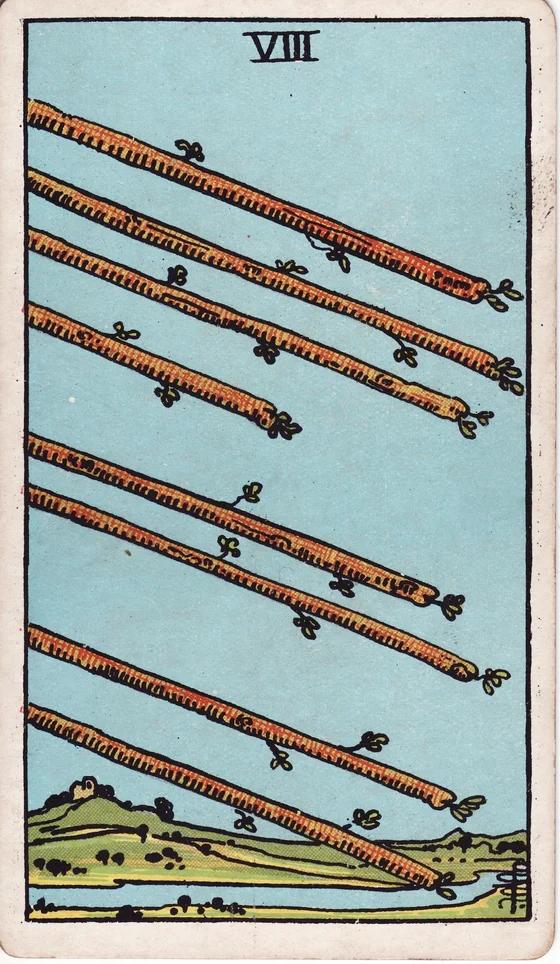
No rider, only movement in one direction
Eight long staffs bearing small leaves pass diagonally through a blue sky from upper left to lower right, roughly parallel to one another. No hands hold them, and no sender or receiver is visible. Compared with the crossing staffs of the Five of Wands, their direction is notably consistent, with broad blue gaps remaining between them.
Along the lower edge lie green fields and a winding blue river, with a pale building on a distant hill at lower left. The staffs have not been shown landing. Their movement is clear, but the image contains no clock, date, or scale for converting it into days or weeks.
The most distinctive feature is the absence of a central person. Speed comes from several staffs moving in similar directions, yet there is no figure who can command everything. A modern application can therefore focus on handovers: when one step finishes, can the next actually receive it? The gaps in the sky matter too. A shared direction does not require everything to happen simultaneously. If information spreads rapidly while conclusions remain unclear, examine receiving and confirmation instead of treating busyness as proof of progress.
From swift messages to accelerating action
Waite describes staffs flying over open countryside near the end of their journey. His associated meanings include activity, swiftness, a messenger’s communication, and progress toward an aim. He also uses the metaphor of arrows of love. This is a textual association; the pictured objects remain leafy wooden staffs.
This article retains accelerating action and information transfer, focusing on real-world coordination. The reversal uses a modern reflective reading to examine delays, excessive speed, and confused information rather than translate Waite’s old reversed entries, including quarrels, item by item.
Understanding the upright card
Upright, the card can point to a stage requiring timely responses: earlier preparation becomes a series of actions, and information, confirmations, and deliveries arrive in succession. Clear next steps matter. Relevant people should know who needs what, who confirms it, and when responsibility passes on.
Speed can come from reducing pointless waiting, not just making everyone busier. Keeping information about the same matter together and using clear versions and deadlines can prevent repeated questions. Decisions that cannot be undone still require necessary checks, even when the surrounding pace is fast.
Understanding the reversed card
The reversal helps distinguish two apparently opposite situations: everything is stuck, or everything arrives at once. The first needs identification of the real dependency; the second needs an order for receiving things. Repeatedly urging a step whose prerequisites are unmet will not complete it automatically.
If messages fly back and forth but no one explicitly confirms a conclusion, pause to state a shared understanding. Express important points fully where possible, avoiding changes of meaning through fragmented replies. A few minutes spent checking now may save more time than later rework.
For timing questions, make clear that any schedule comes from real arrangements. This card offers only the observational direction “notice acceleration and coordination.” The traditional text’s approach to the endpoint does not mean every draw signals near-completion. If inputs, owners, and conditions for implementation are unconfirmed, delay remains possible. Reversal cannot arbitrarily calculate a new date either.
The more event-day messages there are, the more one reliable notice matters
Original fictional case. A community craft day moves to a nearby activity room because the original venue has a leak. Participants are spread across two group chats. Volunteers have forwarded three versions of the location instructions, and some people still ask about the old entrance. The question is: “After the last-minute venue change, how can we help everyone arrive smoothly?” They draw the Eight of Wands upright in the immediate-action position.
Eight staffs flying in one direction can suggest fast communication, but the absence of a pictured receiver reminds organizers not to equate “sent” with “received.” A definite change has occurred, and messages need to converge on one verified location. Upright supports prompt action while preserving checks so well-intentioned forwarding does not amplify an error.
If use of the new venue is not yet confirmed, a provisional arrangement cannot be presented as final simply to notify people quickly. State what is still being checked. If some participants do not use group chat, one announcement cannot reach everyone; add contact through their actual channels instead of assuming they will see it.
After confirming the new address, the organizer sends a short notice with an update time and asks volunteers to stop using old versions. They individually confirm receipt with those needing help. Directions go at the old entrance, and the unconfirmed list is checked again before the event, making transmission effective in practice.
Frequent replies have not resolved the shared question
Original fictional case. Two friends are planning a short weekend trip and have exchanged sightseeing and restaurant links for several days. One assumes a Saturday departure, the other Sunday. Each thinks the other should understand their availability from the conversation. Their question is: “We talk so much every day, so why is the trip still undecided?” They draw the Eight of Wands reversed in the communication-blockage position.
The flying staffs suggest many messages, but it is their broadly shared direction that creates progress. The actual evidence here is that no shared departure date exists. The reversal can therefore describe high-speed conversation lacking confirmation. There is no need to interpret it as a worsening friendship or keep adding destinations. The current issue is whether they are arranging the same outing at all.
Another possibility is that one person has not decided to participate and is merely sharing interests. If that friend clearly says they still need to consider it, acknowledge that there is no shared plan yet. If the date is already confirmed and only a ticketing-system fault is blocking progress, address that practical obstacle rather than continuing to blame communication.
They pause the links and use one complete message to confirm the departure date, return time, budget range, and responsibility for each step. They choose sights only after both explicitly reply. If their dates cannot coincide, they end this attempt and arrange another time, rather than letting ongoing chatter create an illusion of progress.
A small exercise
Find something you have recently been repeatedly urged to complete. Write down its prerequisites, the next person taking over, and its completion standard. If any is unclear, ask one specific clarifying question before deciding how to accelerate.
Common misreadings
Eight staffs cannot be converted into eight days, nor do they guarantee a message will arrive immediately. The card depicts movement. Actual timing still depends on confirmed arrangements and real progress, and speed itself is not quality.
Image and English sources
- Pamela Colman Smith, Eight of Wands, RWS Pam-A / TaionWC
- A. E. Waite, The Pictorial Key to the Tarot, Part III §2, Eight of Wands (1911-labelled English transcription)
- A. E. Waite, The Pictorial Key to the Tarot, Part III §2, Wands
This article primarily uses the RWS deck. The existing image version and original English text were cross-checked on 2026-10-08. The modern questions and cases are original work, not item-by-item translations of the old book’s divinatory meanings.