At a glance
Upright: You have already endured a stretch. Protect what matters and allow a breather
Reversed: You are too tired to keep going, or too guarded to relax
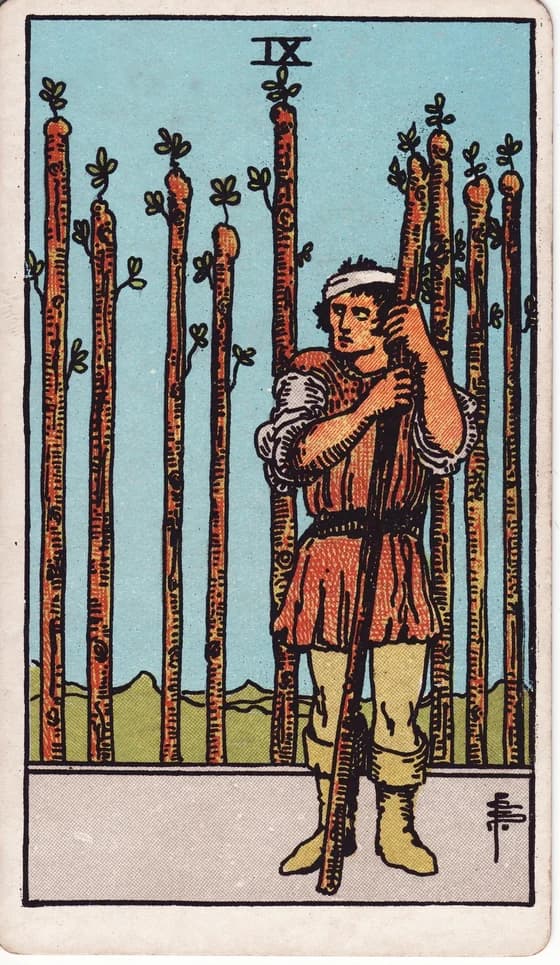
The figure in the Nine of Wands is still standing, yet has begun to lean on the wand. In this image, persistence and the need for support are not mutually exclusive.
The figure stands while also leaning on support
A white band wraps around the figure’s forehead. The person wears a reddish-brown tunic, pale trousers and boots, and holds a long wand with both hands. The body faces roughly towards us while the face turns left. The eyes and sideways glance can suggest vigilance, but the subject of that attention is not shown.
Eight leafy wands stand behind the figure like a fence with uneven spacing. Beyond them are low green hills and blue sky, with pale level ground underfoot. The visible head bandage does not tell the whole story. No approaching attacker is shown, and the figure’s condition cannot be used to judge someone’s actual health.
The relationship between resistance and a pause
Waite describes the card as strength in opposition, writing that the figure looks as though waiting for an enemy. He also mentions delay, suspension and postponement. “As though” matters: this is the situation he assigns to the pose, not another clearly visible enemy in the picture.
This article develops a contemporary lesson from the relationship between resistance and pausing, considering experience, sustained effort and the conditions for recovery. Reversal asks whether persistence has become inflexible, without adopting the old entry’s direct prediction of calamity.
Reading it upright
Upright, the card can acknowledge that you have been through a difficult period and gained experience in recognizing risks. You may not need to prove all your abilities again. What matters more is protecting the essential parts and choosing what still deserves your effort. Experience can help you prepare without requiring you to expect the worst every time.
Sustainable persistence needs concrete support: which repeated tasks can be removed, when can you rest, and under what conditions should someone take over? Pausing to check does not erase progress. Rather than simply telling yourself to hold on a little longer, establish whether the conditions for continuing actually exist.
Reading it reversed
Here, the first question is whether exhaustion is being ignored. If every new request can only be met by cutting more rest, tasks and support need adjusting, not merely stronger willpower. Alternatively, the original pressure may have eased while you remain on the same high alert.
To distinguish these situations, examine present facts: which risks remain, which precautions still help, and which defences interfere with ordinary cooperation? You need not force yourself to trust immediately, nor automatically make past experience the verdict on every new person.
In everyday life
A long project reaches its later stages
List the remaining essential work, move optional improvements out of the current scope and establish who can help. Whether to keep pushing should depend on real capacity and deadlines, not simply on how much you have already invested.
You are more cautious after a difficult collaboration
Turn the specific point that went wrong into a new arrangement, such as written confirmation or staged acceptance. This preserves the lesson while allowing a new collaboration to earn trust through actual behaviour.
Practice brings repeated setbacks
Shorten the sessions temporarily and record which step keeps causing trouble. An observable change in method is more useful than interpreting every difficulty as insufficient effort.
A short exercise
Write down three arrangements that still protect you, then choose one burden you can reduce or hand over. Set a review point for continuing, specifying which actual circumstances would require a change of method or a pause.
Common misreadings
The Nine of Wands is not an instruction never to give up, and it cannot predict illness or another injury. It can help distinguish supported persistence from endurance with no way out. Stopping or adjusting may still be a responsible choice.
Artwork and English sources
- Pamela Colman Smith, Nine of Wands, RWS Pam-A / TaionWC
- A. E. Waite, The Pictorial Key to the Tarot, Part III §2, Nine of Wands (1911-labelled English transcription)
Sources checked: 2026-10-07. This article translates the original Chinese learning text. The English source is a transcription labelled 1911; the image file page describes a 1910 Pam-A card. Historical context and contemporary exercises are identified separately.