At a glance
Upright: Too much is resting on you. It is time to redistribute the load
Reversed: You want to put something down. First arrange where it goes and how to hand it over
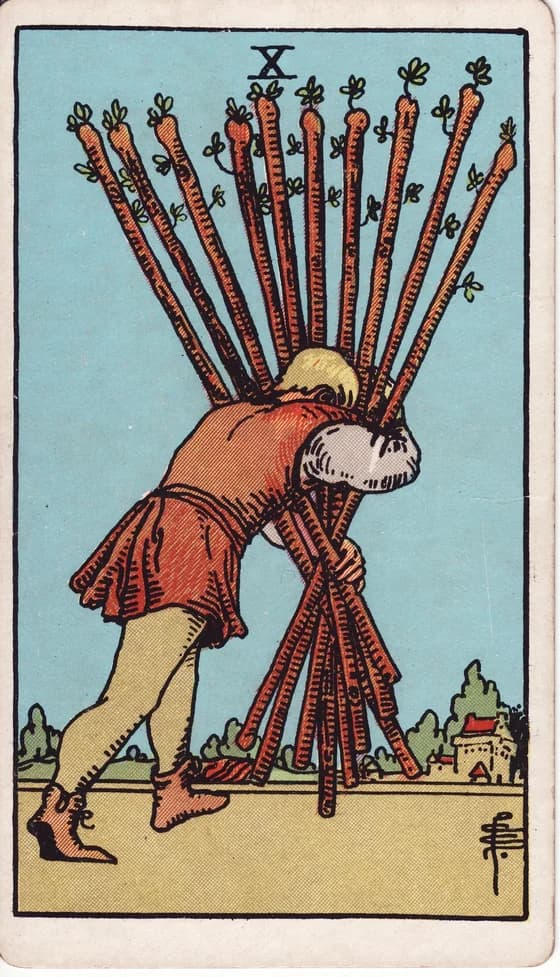
Ten long wands gather in one person’s arms, and the body bends with them. The Ten of Wands shows that each task may have value while their combined weight still needs to be counted.
Ten wands gathered into one pair of arms
Under a pale blue sky, a person in a reddish-brown tunic and light stockings steps to the right. The upper body leans markedly forward, both arms gathering ten wands in front. They overlap near the body and spread out above, with green leaves still growing. The head is lowered and the face almost hidden behind arms and wood.
Pale walls, red roofs and trees stand in the lower-right distance. Space remains between the person and the buildings, and nobody else is shown helping to carry the load. The ground is level, not an uphill slope. We can see concentrated weight and effortful movement, but cannot know the expression, destination or time still needed to arrive.
Success itself can become a burden
Waite places burden and oppression at the centre of this card, while noting that gain or success can create pressure themselves. He also acknowledges multiple older meanings that are difficult to reconcile. The idea that even worthwhile achievements can become hard to carry is therefore a historical thread worth retaining.
This article develops that thread into a contemporary exercise on total responsibility and division of work. It reads reversal as a change in the existing way of carrying things, then checks how that change happens. This is not a term-by-term translation of the old reversed meanings about difficulties and intrigues.
Reading it upright
Upright, the card is useful for checking whether the total workload fits the available time, energy and support. Pressure may come from too many tasks, unclear responsibilities, standards set too high or frequent switching. Finding the specific problem is more helpful than labelling yourself incapable.
Sort tasks into those that must be yours, those whose ownership can be negotiated, those that can shrink or wait, and those already finished but still occupying attention. If work genuinely must be concentrated temporarily, add an ending condition: until when, with what help from whom, and how normal responsibilities will resume afterwards.
Reading it reversed
The reversal can ask whether the load has genuinely been adjusted. Shared responsibility, a clear handover and reduced scope may make pressure manageable. Loosening some control so another person can complete agreed work may also be necessary.
If a task is merely ignored, passed to someone without explanation, or left without any arrangement, the work may still remain. Establish what has actually changed rather than using a card to decide who is avoiding responsibility. Ask, “Where will this wand go when I release it?” A clear destination makes the adjustment easier to sustain.
In everyday life
Requirements keep growing before delivery
Separate essential work from what can be scheduled later, discussing deadlines, scope and staffing together. If the workload cannot shrink, specify the additional support or change to the original agreement that is needed.
Invisible work in a shared home
Alongside doing chores, list the work of remembering, reminding and coordinating. Choose one recurring task and identify who notices it, decides, acts and checks completion. This reveals where the load actually falls.
Pursuing several goals at once
Decide which goal takes priority at this stage and give the others explicit conditions for restarting. A pause can be a clear arrangement. Everything meaningful does not have to advance in the same week.
A short exercise
Give one wand a real task’s name. Ask why it is yours, what would actually happen if it were not done this week, and how it could shrink or be handed over. Turn the adjustment into a sentence you can discuss: “I can finish A this week; if B is also needed then, the deadline needs to change.”
Common misreadings
The distant buildings do not prove that a little more endurance guarantees success, and a lone carrier does not prove that nobody in real life will help. Study the available support, requests actually made and reasonable division of work, rather than treating endurance as the conclusion.
Artwork and English sources
- Pamela Colman Smith, Ten of Wands, RWS Pam-A / TaionWC
- A. E. Waite, The Pictorial Key to the Tarot, Part III §2, Ten of Wands (1911-labelled English transcription)
Sources checked: 2026-10-07. This article translates the original Chinese learning text. The English source is a transcription labelled 1911; the image file page describes a 1910 Pam-A card. Historical context and contemporary exercises are identified separately.