At a glance
Upright: Something new interests you. You are willing to ask questions and try
Reversed: The ideas sound exciting, but practice and action have not caught up
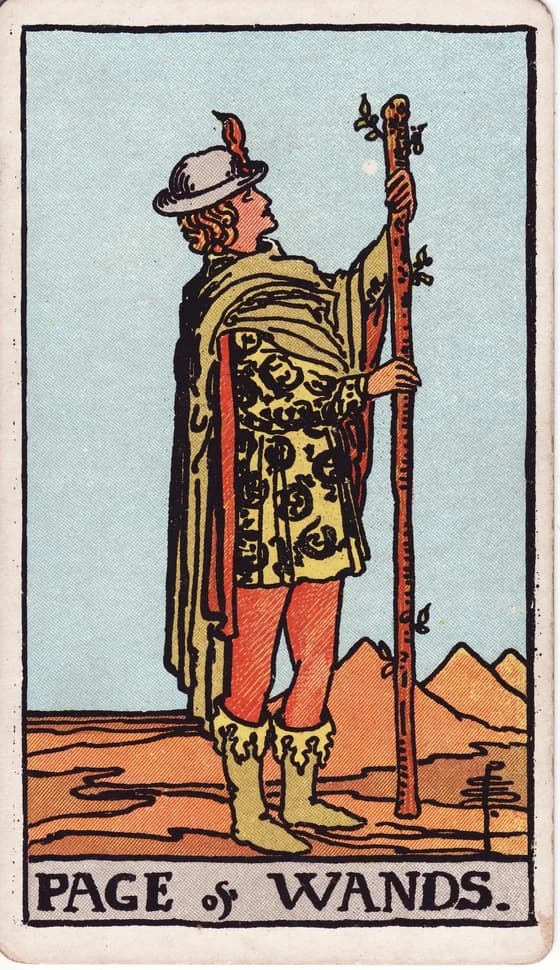
The Page of Wands is not swinging the staff, but looking up at it carefully. Curiosity has not yet turned into a large action. Observing and asking questions are already part of learning.
Look closely before lifting the wand into action
The figure stands on orange-toned ground, holding an upright wand with one hand above the other. The head tilts slightly upward towards the upper part of the wand. A red feather decorates the hat, a long cloak falls behind the shoulders, and black lizard-like patterns cover the yellow clothing. The boots are decorated, and new leaves appear on the wand’s sides and top.
Blue sky and several pyramid-shaped hills fill the background. No other person or finished work appears nearby. The direction of the gaze is visible; the particular proclamation belongs to the textual interpretation. Observation, expression and action still have space between them and need not be compressed into a single moment.
Expression through the roles of herald and messenger
Waite describes the Page as making a proclamation, using the roles of envoy, messenger and bearer of news to explain the function. This offers an easily overlooked aspect of the card: enthusiasm can mean discovering something worth passing on, not just taking action.
The old text identifies people through appearance, age and gender in ways characteristic of its period. This article does not retain those fixed correspondences. It treats the Page as a learning stance anyone can practise: approaching unfamiliar material, trying to explain what they observe and accepting the need for further practice.
Reading it upright
Upright, the card can remind you to allow yourself to be a beginner. Curiosity need not first prove its usefulness, but once you enter a field, basic methods, questions about terminology and small practical exercises still matter. Compared with the Ace’s initial spark, the Page is especially useful for considering how interest becomes continued exploration.
When sharing a discovery, distinguish what you have tried, what you are learning and what is still an idea. You can keep the excitement while helping the listener understand how much weight the information carries. Questions do not weaken enthusiasm; they make the next experiment more specific.
Reading it reversed
Here, reversal checks for a gap between exploring and talking. Excitement may prompt a large announcement before you have experienced the basic work. Or fear of asking a simple question may keep your interest on the sidelines. Either can reconnect through a small, real exercise.
If your interests change often, you need not immediately label yourself someone who never sticks with anything. Ask whether you change direction after learning enough to choose, or whenever you encounter being unskilled. The first is useful exploration; the second needs some room to stay with practice.
In everyday life
Joining a new community
Observe how people discuss and collaborate, ask a specific question, then share something you have actually tried. You do not have to act experienced or exaggerate your background to take part.
Learning a new skill
Choose a small task that can receive feedback: a short piece of writing, a set of photographs or a basic operation. Even rough work helps identify what to learn next.
Hearing exciting news
Before passing it on, check its source, content and appropriate audience. Enthusiasm can enliven an exchange, but anything unverified should be clearly identified as a possibility rather than a fact.
A short exercise
Make a beginner’s record: what you discovered today, what you tried yourself and the question that remains. Make the last item specific enough to ask someone, rather than a general statement that you know nothing.
Common misreadings
The Page of Wands does not necessarily represent a young man or guarantee incoming good news. Court roles can help you observe ways of acting, but a draw cannot establish a real person’s age, gender, loyalty or intentions.
Artwork and English sources
- Pamela Colman Smith, Page of Wands, RWS Pam-A / TaionWC
- A. E. Waite, The Pictorial Key to the Tarot, Part III §2, Page of Wands (1911-labelled English transcription)
Sources checked: 2026-10-07. This article translates the original Chinese learning text. The English source is a transcription labelled 1911; the image file page describes a 1910 Pam-A card. Historical context and contemporary exercises are identified separately.