At a glance
Upright: You have drive and are willing to take the initiative and try
Reversed: You rush or keep changing direction, leaving things unfinished
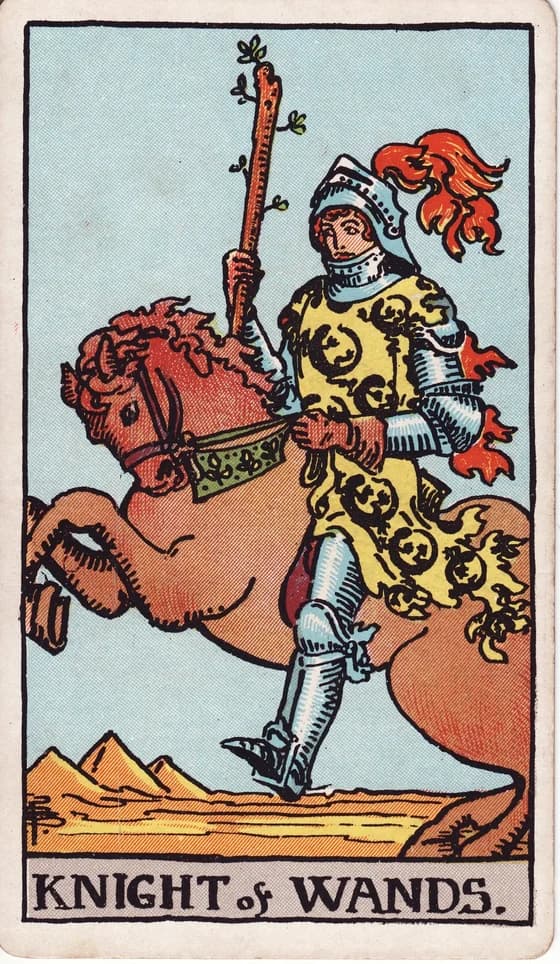
The horse in the Knight of Wands raises its forelegs, and the red plume on the helmet streams behind. The strong movement catches the eye before a practical question follows: where is all that drive meant to take the rider?
Raised forelegs and a streaming plume
The rider wears silver-blue armour beneath yellow cloth patterned with black lizard-like forms. Red ornaments trail from the helmet and beside the arms. One hand raises a short, leafy wand; the other holds the reins. The brown horse lifts towards the left, its front legs raised and its body occupying much of the lower picture.
Behind are open blue sky, orange-yellow ground and pyramid-shaped hills. There is no opposing army or gate to break through. The horse’s pose has an urgent sense of movement, but this moment alone cannot tell us whether the rider has a thorough plan or whether the road is safe.
Waite explicitly distinguishes the journey from war
Waite specifically says that despite the armour, this rider is not on a warlike errand. He treats the horse’s movement as a clue to the rider’s impetuous mood and connects the card with departure, absence, migration and a change of residence. Movement and action fit this historical description better than assured victory in battle.
This article studies the Knight as a style of action, not a real person defined by age or gender. Its reversed discussion of interruption and discord takes those themes from Waite and develops a contemporary examination of pace, promises and follow-through.
Reading it upright
Upright, the card can encourage you to put an established direction into action. When reaching out, trying something in person or quickly making a sample is needed, some drive can move things beyond a long period of hesitation. Use that courage for a manageable experiment and know when to review the feedback.
Energy in action also needs to consider companions. Explain plans, timing and changes so people know how to participate, and keep promises within a scope you can complete. Enthusiasm is most convincing when it becomes something others can actually see and work with.
Reading it reversed
The reversal checks whether movement has outrun judgment. Changing the goal today and the method tomorrow can create activity while leaving many loose ends. Taking on promises beyond your current capacity to keep the excitement going can also make your drive difficult to sustain.
An outside interruption may instead be the real reason for rearranging things. Find where the obstacle comes from rather than blaming every delay on insufficient initiative. Slowing to a pace at which you can honour commitments is often more useful than generating another, larger burst of excitement.
In everyday life
A new proposal can finally be tested
Choose the part you most want to test, limit time and investment, and finish before deciding whether to expand. Completing one trial prevents activity from growing endlessly without producing a conclusion.
Feeling deeply involved in a new relationship
Express your interest while noticing the pace of meetings and communication both people can sustain. An intense beginning is not a long-term commitment. Reliability becomes clearer through repeated words and actions.
Suddenly wanting a different way of life
Check existing responsibilities and necessary conditions before arranging an experience you can reverse. Novelty is worth exploring without using a rushed major decision to prove courage.
A short exercise
Write a short plan for the thing you most want to advance immediately: its purpose, next step, limit on what you will invest, how you will finish and when you will review it. Fill any blank before proceeding, giving your drive reins you can hold.
Common misreadings
The Knight of Wands cannot prove that someone is fickle or unfaithful, and it does not require you to resign or travel immediately. Its movement can help you examine your pace. Major decisions and judgments of people still need real information and experience.
Artwork and English sources
- Pamela Colman Smith, Knight of Wands, RWS Pam-A / TaionWC
- A. E. Waite, The Pictorial Key to the Tarot, Part III §2, Knight of Wands (1911-labelled English transcription)
Sources checked: 2026-10-07. This article translates the original Chinese learning text. The English source is a transcription labelled 1911; the image file page describes a 1910 Pam-A card. Historical context and contemporary exercises are identified separately.