At a glance
Upright: You feel grounded in yourself and help others relax and engage
Reversed: You work too hard for approval, or make yourself smaller and smaller
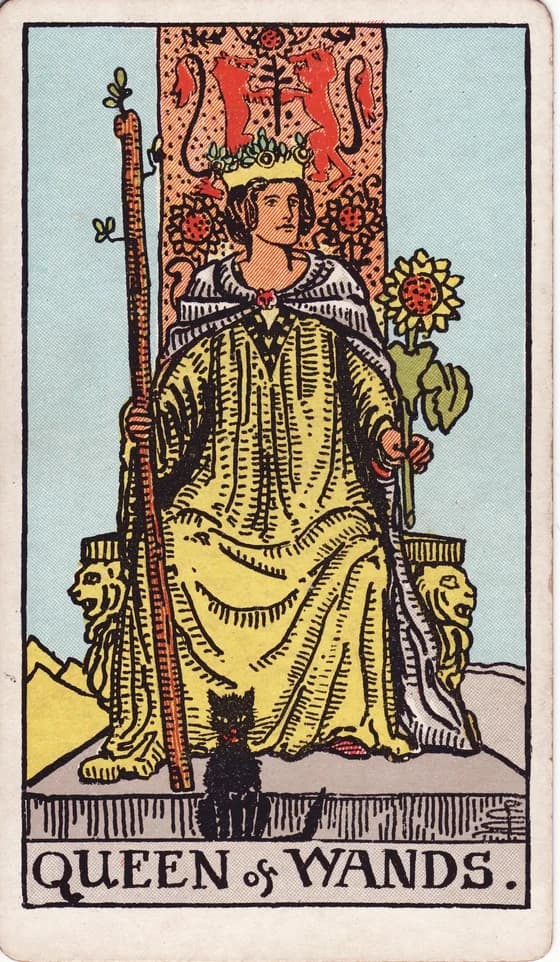
The Queen of Wands holds a staff in one hand and a sunflower in the other, with a black cat looking directly at us below. A striking presence and a settled seated posture share the picture. Confidence does not need large gestures alone.
The sunflower and the black cat before the throne
The crowned figure wears a yellow robe and a pale cloak, seated on a frontal stone throne with the face turned slightly to the right. The right hand, on the image’s left, holds a leafy wand; the left holds a sunflower. Lion-shaped carvings flank the seat, while the tall fabric behind is patterned with lions and sunflowers.
A black cat sits at the front step, its tail curving to the right. Blue sky appears beside the throne and low hills lie in the distance. The cat, flower and lions are visible objects. They can prompt associations with independence or vitality, but the origin of those associations should be made clear rather than automatically attributed to the artist or author as fixed meanings.
Leafy wands and personal magnetism
In this entry, Waite emphasizes that the suit’s wands bear leaves, linking them with life and animation. He describes the Queen’s personality as corresponding to the King’s while being more magnetic. Contemporary readings of friendliness and warmth can be considered alongside this historical background.
This article does not use the old text’s gender, appearance and relationship categories to identify a real person, or adopt its speculation about fidelity. It treats the Queen as a way of expressing yourself and influencing others: being confident in your interests while allowing other people their own choices.
Reading it upright
Upright, the card can encourage you to make your tastes, abilities and views visible. Confidence need not be the loudest voice. It can be the clear statement, “This is what I enjoy” or “This is something I can do well,” without first seeking everyone’s permission. Some self-knowledge makes it easier to choose what you genuinely want to engage with.
Warm influence is not about making everyone revolve around you. It leaves room for others to participate. You can invite and encourage specifically while letting someone decline or use their own method. Autonomy and welcome can together create a steady presence.
Reading it reversed
Here, reversal checks whether expression has become too dependent on approval. To appear warm and capable, you may continually take responsibility for the atmosphere and everyone’s feelings. Or fear of judgment may lead you to hide your interests and opinions. Either can use up your capacity.
Identify what you truly want to offer and what you do only to maintain an image. Reducing one reluctantly accepted task or expressing a real preference in a safe setting can begin an adjustment. There is no need to turn the card into a fixed label of jealousy, control or inadequate confidence.
In everyday life
Hosting a shared activity
Explain the format, notice whether quieter participants want to join and accept that some prefer listening. A good atmosphere does not require the host to fill every minute alone.
Showing your work
Choose a comfortable form of presentation and explain what you made and why. Accept appreciation while allowing differences in taste. Unanimous praise is not a prerequisite for showing a piece.
Always keeping a relationship lively
Say how you would like to be responded to as well, then observe the other person’s actual participation. Enthusiasm can be freely offered, but one person cannot indefinitely carry every interaction.
A short exercise
Write down one preference that remains valid without anyone else’s agreement. Take a small step to express it, then record how you feel before counting who liked it. Practise separating self-knowledge from other people’s responses.
Common misreadings
The Queen of Wands is not limited to an outgoing woman, and the black cat does not establish magical powers or a bad omen. People of any age, gender or temperament can practise the autonomy and warm influence discussed here.
Artwork and English sources
- Pamela Colman Smith, Queen of Wands, RWS Pam-A / TaionWC
- A. E. Waite, The Pictorial Key to the Tarot, Part III §2, Queen of Wands (1911-labelled English transcription)
Sources checked: 2026-10-07. This article translates the original Chinese learning text. The English source is a transcription labelled 1911; the image file page describes a 1910 Pam-A card. Historical context and contemporary exercises are identified separately.