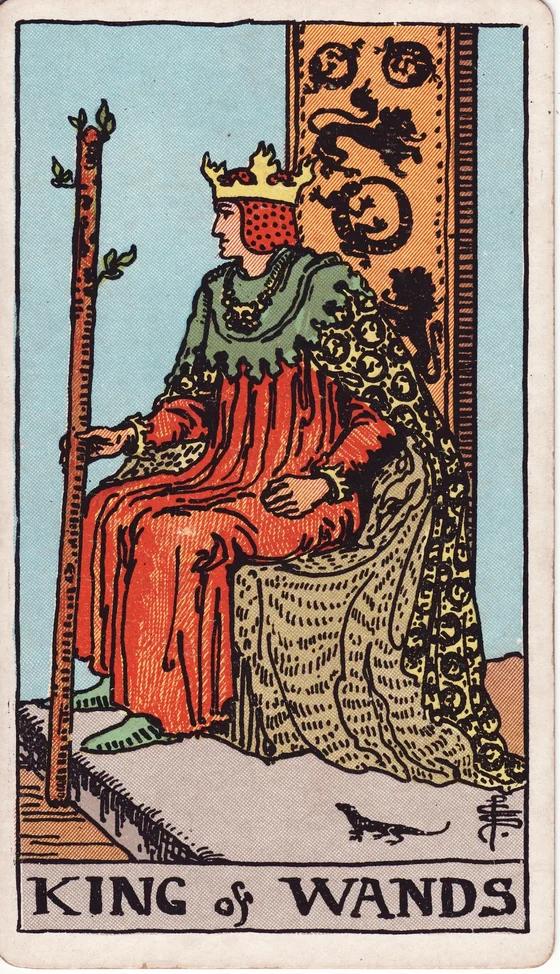
The person on the throne still holds a leafy staff
The figure sits sideways on a stone throne facing left. A gold crown rests above a red head covering; red robes are accompanied by green fabric across the shoulders and a cloak patterned with black lizard-like shapes. One hand holds a long leafy staff upright against the ground; the other rests on a knee.
Lions and lizard-like designs decorate the tall chair back, and a small reptile stands on the platform before the feet. Blue sky and a little barren land remain in the background. The gaze extends beyond the frame, readily suggesting outward attention. But no subjects, armies, or orders being carried out appear. A crown alone cannot justify inventing a ruling scene.
The king’s staff touches the ground while the gaze points beyond the picture, linking direction and implementation through those details. The throne suggests stability and authority, while the leafy staff retains room for development. Maturity can thus mean maintaining direction while accepting that methods still need to grow. Observe the small reptile separately from the cloak’s patterns; not every circular ornament needs the same mystical explanation. What actually needs verification is whether your decisions have taken practical effect, and whether affected people know how they can participate.
Historical descriptions of vitality and conscientiousness
Waite describes the King of Wands as ardent, animated, and passionate, explicitly noting the lion symbols on the throne. His upright entry emphasizes honesty and conscientiousness. Reversed combines severity with tolerance, so the historical interpretation is not simply a good-to-bad switch.
Against this background, the article develops the king as a modern role responsible for direction and influence. It does not retain the old identification of people through appearance, gender, or marital status. Nor can one card vouch for an actual person’s honesty.
Understanding the upright card
Upright, the card can remind you to organize enthusiasm into a direction others can understand. Explain not just what you want to achieve, but why it matters, what comes first in this stage, and what will not be done for now. A clear direction lets collaborators use their own judgment rather than await instructions at every turn.
Responsibility also includes acknowledging decisions’ costs. If a plan you advance affects others’ time and work, you need to hear relevant information, provide resources, and take responsibility for explaining and rearranging things when circumstances change. Leadership can occur in a family, community, or small project without a formal title.
Understanding the reversed card
Here, reversal checks whether taking the lead has become one-way demands. You may have thought far ahead without explaining assumptions to companions. Or you may treat every objection as insufficient enthusiasm, making people afraid to voice important limits. The more impact an action has, the more it needs to be open to challenge and correction.
Another issue is a grand direction whose promises lack named owners and resources. Narrow the scope and turn expectations into workable arrangements rather than simply mobilizing everyone again. If a decision goes astray, explaining the adjustment is more reliable than maintaining an image of permanent correctness.
In a person position, the king can prompt questions about a leadership style instead of identifying a man or superior from one card. In an advice position, it more often asks someone to own influence they already have. Reversal sometimes requires less control, and sometimes an end to ambiguity through clear responsibility. These apparently opposite actions depend on whether power and responsibility currently reside together.
You can take responsibility for direction without a formal title
Original fictional case. Several neighbors want an exhibition of stories attached to old objects. Peiwen proposes a theme, everyone is excited, and ideas keep multiplying. Some will lend objects but do not know when they will get them back. The event date is unconfirmed, and Peiwen worries that without being the organizer he should not speak up. His question is: “How can we turn the neighborhood exhibition from an idea into a completable event?” He draws the King of Wands upright in the role-I-can-take position.
The king sits in a fixed place while still holding a leafy staff, suggesting movement from inspiring enthusiasm to owning arrangements. Upright does not require Peiwen to appoint himself leader. It reminds him that his proposal already affects others’ time and possessions, so shared confirmation needs to move forward. The outward gaze suits retaining an overall direction; the grounded staff invites questions about concrete conditions such as timing, scope, and returns.
If everyone merely wants an informal story exchange and has not agreed to a formal exhibition, “organizing it” may instead expand the burden. Shared goals and willingness to participate need confirmation first. If venue or safekeeping conditions are insufficient, reduce it to a brief sharing session. A leadership card is no reason to increase scale.
Peiwen invites a short discussion to confirm whether the event should happen, then lists its minimum scope, what each person is willing to own, and the conditions that must be resolved. Collection continues only after someone explicitly takes responsibility for borrowing and returning objects, establishing direction and responsibility together.
Why do others grow quieter as you argue the plan more forcefully?
Original fictional case. Jingshen is good at researching trips and has planned every day for four friends. When someone requests half a day of free time, he immediately explains why his plan is better value. Later, he is the only one still posting in the group and others rarely respond. His question is: “How can I lead my friends in deciding this shared trip?” He draws the King of Wands reversed in the blind-spot-in-leadership position.
A throne readily suggests decision-making authority, yet the image does not show others agreeing to follow. Reversal can turn that absence into an important question. Jingshen’s quick dismissal of different needs supports examining whether his leadership reduces room to participate, rather than guessing that his friends all secretly dislike him. Responsibility includes letting affected people change the plan, not only providing a complete proposal.
Silence may also come from busyness, so it cannot always be read as protest. If friends explicitly asked him to arrange everything, he should still confirm whether that authority covers all budget and pacing decisions. If they asked only for research, that cannot automatically become permission to decide the itinerary. Actual agreements change how this reversal should be used.
He turns the itinerary into two comparable options, separately showing free time and cost differences. He asks each person for one essential need and allows a reasonable reply period. Before confirmation, he makes no irreversible arrangements, letting good organizational ability serve shared choice.
A small exercise
For something you currently lead, write four sentences: where we are going, what comes first in this stage, what each person can decide, and what evidence would make us adjust. Ask an affected person to explain it back and check whether your understandings match.
Common misreadings
The King of Wands is not necessarily a boss, married man, or entrepreneur, and forcefulness is not automatically leadership. The card can teach direction and responsibility. A real person’s trustworthiness still depends on sustained behavior and responsibilities fulfilled.
Image and English sources
- Pamela Colman Smith, King of Wands, RWS Pam-A / TaionWC
- A. E. Waite, The Pictorial Key to the Tarot, Part III §2, King of Wands (1911-labelled English transcription)
- A. E. Waite, The Pictorial Key to the Tarot, Part III §2, Wands
This article primarily uses the RWS deck. The existing image version and original English text were cross-checked on 2026-10-08. The modern questions and cases are original work, not item-by-item translations of the old book’s divinatory meanings.