Follow the flowing water
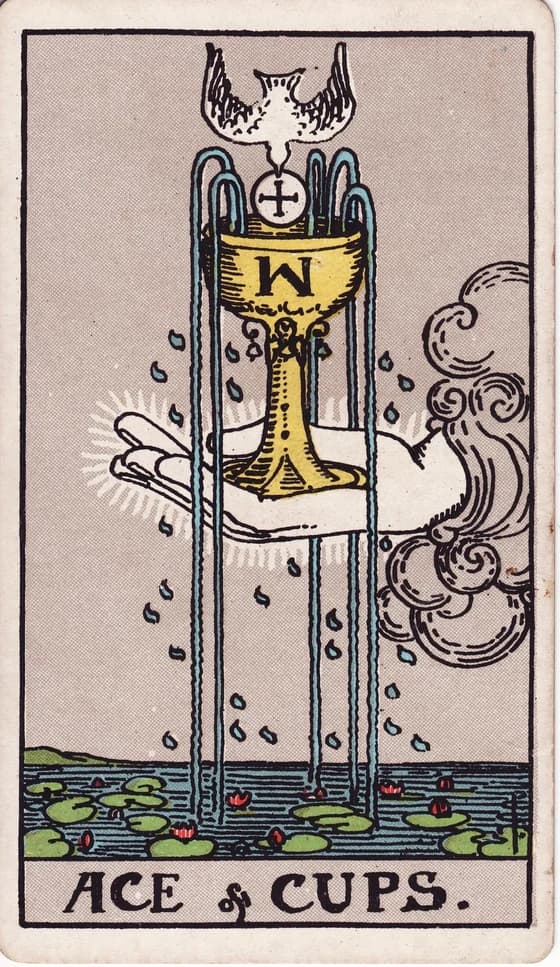
A hand emerges from a cloud on the right, supporting a golden chalice in its palm, with rays around the hand. A black mark resembling a W appears on the cup. Above it, a white dove descends with a cross-marked disc at its beak. Five curved blue streams overflow from the rim into water dotted with round floating leaves and red flowers. Separate droplets fall around them.
The large cup occupies the centre, but nobody drinks from it. The composition shows giving, receiving and flowing. The image alone cannot tell you who is offering affection or how long it will last. Nor do we assign one definitive code to the letter and every drop. View the card image
Communion imagery and a difference between text and image
The English transcription of A. E. Waite’s The Pictorial Key to the Tarot, labelled 1911, identifies the dove’s disc as a cross-marked Host. Its historical meanings include joy, nourishment and abundance, within a Christian Communion context. One detail deserves attention: the transcription says four streams, while the Pam-A scan inspected for this article shows five. We record each separately rather than silently changing the text to match the picture. Waite’s entry for this card
Waite’s reversed meanings concern a false heart, change and instability. The discussion below of suppression, overflow and attending to needs is this site’s extension for everyday reflection, not a sentence-by-sentence translation of Waite.
Upright: Let care become accessible
Upright, the card can remind you that you are still capable of being moved and of expressing a need. It can suit the first approach in a new relationship, a return to creative work, renewed friendship or accepting help. There is no need to label the experience a lifelong commitment yet.
Openness does not remove boundaries. If someone shows concern, begin by thanking them. If you want to know someone better, make one specific invitation. Small, clear responses are more reliable than imagining the entire relationship on both people’s behalf.
Reversed: Find a container for the feeling
The reversal can help you examine two opposite states: continually keeping feelings to yourself, or pouring out every expectation as soon as you feel understood. The first calls for a safe opportunity to speak; the second for slowing down and checking whether the other person has the time and willingness to listen.
If you have felt neither attraction nor inspiration lately, you need not force a sense of abundance. Restore basic routines, reduce unnecessary demands, then notice what genuinely feels good. A card cannot diagnose your physical or mental state.
What to do when a feeling appears
If someone you have just met says they would like to meet again, suggest a time that works for you and notice whether they respect the arrangement. One enjoyable conversation is a beginning, not enough evidence that you have made a mutual commitment.
If an image suddenly occurs to you after a creative block, write it down and spend ten minutes on a rough draft. When a friend offers help, name a concrete need, such as company while sorting some papers. Accepting a small piece of help is also practice in receiving.
Practice: Name the feeling and the need
Choose one moment today that moved you and write three sentences: what happened; what I felt; how I want to care for this feeling. Finish with one small action that does not require someone else to cooperate, such as saving an idea or expressing genuine thanks.
A common misreading
The Ace of Cups does not guarantee romance, pregnancy or a fulfilled wish. Fertility in the old meanings belongs to historical divinatory language; it is not evidence about reproduction. Learning this card is more useful as practice in recognising and expressing feelings than in treating every emotional shift as an omen.
Read alongside
Two of Cups: Move from a new feeling to a response between two people; Page of Cups: See how inspiration becomes a concrete expression.
Sources for this article
- Pamela Colman Smith: Ace of Cups, Commons Pam-A scan
- A. E. Waite, The Pictorial Key to the Tarot, Part III §2, Ace of Cups
Edition note: the text was checked against the English transcription at Sacred Texts labelled [1911]. The image is the scan currently labelled Pam-A on Commons. The modern situations, questions and exercises were written originally by DestinyPixel. Historical divinatory terms are learning material, not predictions or evidence about real events.