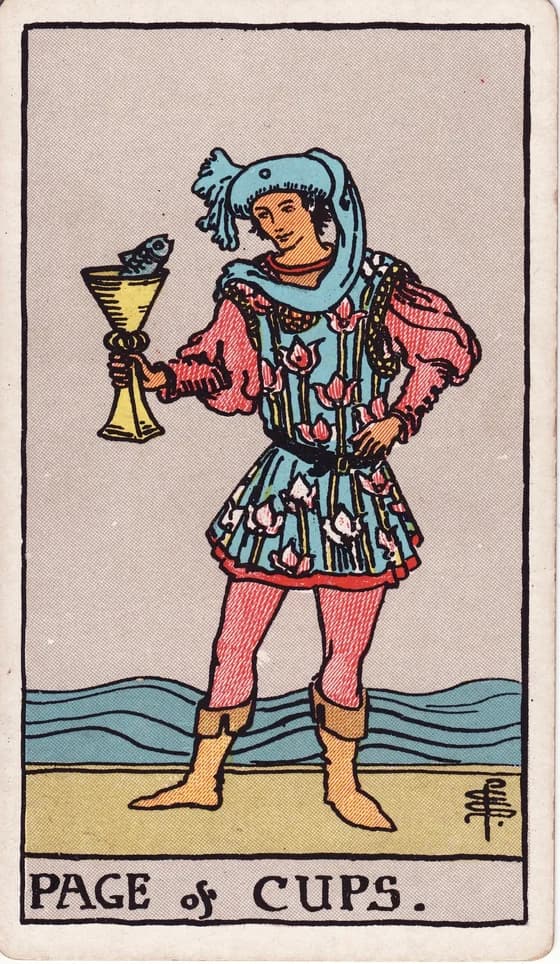
A fish appears from the cup
A figure stands beside water, wearing a blue cap with a long trailing fold. Pink-and-white flowers and green stems decorate a blue tunic, with reddish sleeves and leggings and yellow boots. One hand holds a golden cup; the other rests at the waist. The face turns towards a small blue fish emerging from the rim.
Rolling lines mark the blue water behind a narrow pale-yellow shore. The figure has neither thrown away the cup in alarm nor immediately grabbed the fish. Attention rests on this unusual visitor. Curiosity is one possible reading, but the fish alone cannot establish that a particular message will arrive. View the card image
From mental images to learning and messages
The 1911 English transcription of Waite’s The Pictorial Key to the Tarot connects the emerging fish with images of the mind taking form. Meanings concern study, messages, application and reflection, including practical affairs. Its descriptions of appearance, gender and youth belong to a historical framework; this article does not use them to identify real people. Waite’s entry for this card
The reversed entry includes inclination, attachment, seduction and deception. This site extends those varied terms into questions about unpractised expression and ideas needing verification. They do not authorise an accusation that someone is deceiving you because a card appeared.
Upright: Give something unfinished a chance
Upright, the card suits learning a form of expression: trying poetry, describing a feeling or offering an incomplete creative idea. You do not have to establish your talent before you may practise. Sharing on a small scale and receiving specific feedback can gradually turn inspiration into skill.
Honesty also means not pretending to understand already. When someone shares a feeling, ask whether they want listening or help finding a solution. Curiosity is not persistent probing into private matters; it is willingness to admit what you do not yet know.
Reversed: Separate a feeling from confirmed news
A short reply can prompt many stories in your mind, but those stories still need checking. The reversal can remind you to separate “this is how it feels” from “this is what the person explicitly said”, so an assumption does not become a conclusion.
After an attempt to speak goes badly, you may withdraw it and act as if you do not care. Acknowledge that you are learning and make the expression smaller: I have an early idea and would like one concrete suggestion. Court cards describe approaches here; people of any age or gender may be at this learning stage.
Use curiosity in creative work and relationships
If a talking cup occurs to you while writing a story, begin with a hundred-word scene and see whether it can move the plot. Do not demand a complete work in its first minute.
To thank a friend, give one real detail rather than making a heavy statement about the whole relationship. With a new collaboration invitation, first check the sender’s identity, the actual proposal and timing. Novelty cannot replace basic verification.
Practice: Make a small shareable sample
Record today’s most unexpected observation and spend ten minutes turning it into a short passage, sketch or spoken exercise. Review it yourself and choose only one improvement. If you want to show someone, ask whether they are willing first and offer one small, answerable question.
A common misreading
The Page of Cups does not always mean a young man, and a fish or cup does not predict pregnancy. Messages, romance and creativity are possible themes for discussion. Start with curiosity, then return to what you have actually heard, seen and are willing to try.
Read alongside
Ace of Cups: Develop an initial feeling into expression; Knight of Cups: Move from trying to express something to making an active proposal.
Sources for this article
- Pamela Colman Smith: Page of Cups, Commons Pam-A scan
- A. E. Waite, The Pictorial Key to the Tarot, Part III §2, Page of Cups
Edition note: the text was checked against the English transcription at Sacred Texts labelled [1911]. The image is the scan currently labelled Pam-A on Commons. The modern situations, questions and exercises were written originally by DestinyPixel. Historical divinatory terms are learning material, not predictions or evidence about real events.