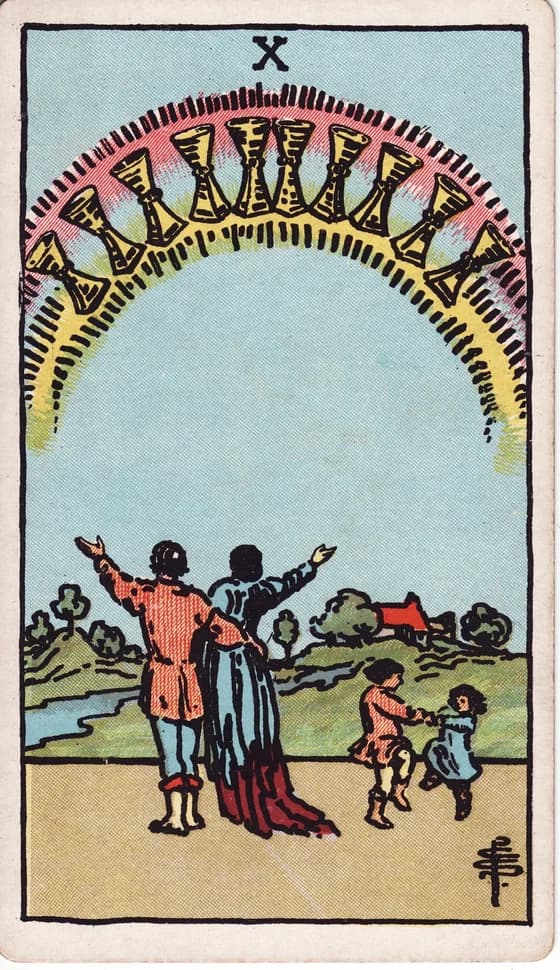
Some look at the rainbow while others play below
Ten golden cups form a broad arc within a rainbow high in the sky. Below, two adults stand side by side with their backs to the viewer. One has an arm around the other, and both raise their outside arms. On the right, two children hold hands in movement, one with a foot lifted.
Green land and trees surround a distant red-roofed house, while a blue watercourse bends to the left. Adults and children attend to different things: one pair looks upward, the other at each other. Different kinds of happiness share one place without requiring everybody to participate identically. View the card image
A historical family scene and belonging today
The 1911 English transcription of Waite’s The Pictorial Key to the Tarot identifies the adults as a married couple and describes the children as happy in their own way. Its meanings include repose of the heart, fulfilment in love and friendship, and the place one lives. Reversed terms include false repose, indignation and violence. Waite’s entry for this card
This site uses the family scene to explore different forms of belonging, including partners, friends, relatives and chosen family. A particular pattern of marriage and parenthood is not made the standard of happiness. Nor can Waite’s strong reversed terms predict a real violent event.
Upright: Notice what already supports life together
Upright, the card can draw attention to quiet sources of stability: people willing to discuss arrangements, room to speak when things are difficult, and respect for each other’s habits. Belonging means more than feeling liked; it includes having a voice when differences arise.
Lasting security needs maintenance. If housework, care and emotional labour always fall to one person, a warm appearance may hide an exhausted supporter. Appreciate existing happiness while sharing the work that sustains it, so a shared feeling rests on shared reality.
Reversed: Hear what the ideal leaves out
The reversal can help you check whether everyone means the same thing by happiness. One person wants more time together; another needs more solitude. One values rituals; another values practical help. Naming the differences makes arrangements that everyone can manage more possible.
If fear of disturbing the peace keeps you from expressing distress, find a safe way to speak. Real threats or harm call for practical protection and support. No card meaning requires you to keep up appearances or tolerate danger for the sake of being a complete family.
Turn being a family into practical care
Housemates planning regular shared meals can first ask who has the energy to cook, shop or clear up. Contributions may differ. For a holiday visit home, agree on the length of the stay and any need for private space in advance.
Long-term partners discussing the future can talk about housing, working rhythms and care responsibilities alongside ideal pictures. For someone living alone, friends, neighbours or an interest community with regular contact can also form a real support network.
Practice: Let each person name one need
With people who want to take part, each write down a recent moment of feeling supported and one small thing you would like adjusted. Listen to the end without immediately defending yourself. Agree on one change and a time to see whether it helps, rather than turning the conversation into a happiness test.
A common misreading
The Ten of Cups does not guarantee marriage, children or freedom from conflict, and it does not make one family form more complete than another. Treat the rainbow as an image of shared happiness, then return to actual interactions to ask whether everyone has dignity, choice and opportunities to receive care.
Read alongside
Three of Cups: Move from a short gathering to lasting support; Nine of Cups: Distinguish personal contentment from security everyone can share.
Sources for this article
- Pamela Colman Smith: Ten of Cups, Commons Pam-A scan
- A. E. Waite, The Pictorial Key to the Tarot, Part III §2, Ten of Cups
Edition note: the text was checked against the English transcription at Sacred Texts labelled [1911]. The image is the scan currently labelled Pam-A on Commons. The modern situations, questions and exercises were written originally by DestinyPixel. Historical divinatory terms are learning material, not predictions or evidence about real events.