Raised cups and the harvest underfoot
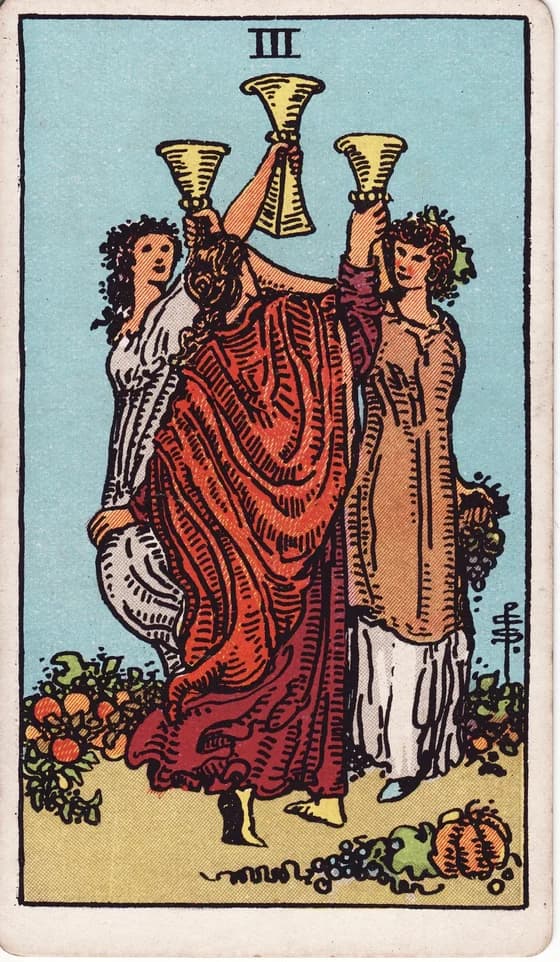
Three figures gather in long dresses of pale, red and warm yellow tones, raising golden cups overhead. The central figure has their back to the viewer, turns towards the others and lifts one foot. The figures to either side direct their eyes and arms towards the group. Flowing fabric and overlapping movements make the scene lively.
Grapes, leaves, orange gourds and other plants lie on the ground. The figure on the right holds a bunch of grapes in the other hand, against an open blue sky. Cups come together above a harvest at their feet. The picture shows shared celebration; it does not depict someone being excluded or a secret affair. View the card image
Historical meanings of fulfilment and excess
The 1911 English transcription of Waite’s The Pictorial Key to the Tarot describes figures raising cups in a garden. Upright meanings concern a plentiful conclusion, joy, fulfilment and consolation. Alongside completion and dispatch, the reversed entry explicitly includes excessive sensual enjoyment. Waite’s entry for this card
This site uses those themes to discuss celebration and social support. Extending the reversal to social exhaustion and group pressure is a modern line of inquiry. The historical language of healing is not a medical conclusion, and a gathering is not a remedy for every difficulty.
Upright: Let achievements be more than finished tasks
The card can remind you to recognise completion. A team delivers a project; a friend gets through a demanding period. Either can deserve a pause to celebrate. You do not have to wait until every problem disappears before allowing happiness.
Good support does not require constant agreement. It allows honest congratulations, practical help and people moving at different paces. Thank people for particular contributions so they know their effort has actually been seen.
Reversed: Notice when participation becomes a burden
Back-to-back engagements, spending beyond your budget to fit in, or leaving the same person to clean up every time can make enjoyable company feel heavy. The reversal invites a look at frequency, cost and shared labour; you may not need to leave the entire friendship group.
Another possibility is that celebration never happens because nothing feels good enough, or acknowledging success feels boastful. Keep it small: share an update with one or two trusted people instead of forcing yourself into a lively gathering.
Make support more specific
At the end of a project, hold a short review, thank those who actually carried the work and give quieter teammates a way to contribute in writing. A celebration should not replace unresolved discussion about responsibilities.
For a friend’s birthday meal, check the budget and dietary preferences in advance, and make room for people who do not drink or want to leave early. When joining an interest group, notice whether beginners are welcome, rather than judging only by cheerful photographs.
Practice: Plan a light-touch celebration
Write down one recent achievement and two people who supported it. Choose a low-pressure way to thank them: a specific message, a walk together or sharing the finished work. Check whether it suits them first, so gratitude does not turn into compulsory attendance.
A common misreading
Three figures in a picture do not imply a third party in a real relationship, and a reversal cannot prove betrayal. If exclusivity concerns you, discuss agreed boundaries and actual behaviour. Turning the number of figures directly into an accusation skips the evidence that matters.
Read alongside
Two of Cups: Compare a two-person exchange with being part of a group; Ten of Cups: Move from a single celebration to maintaining lasting belonging.
Sources for this article
- Pamela Colman Smith: Three of Cups, Commons Pam-A scan
- A. E. Waite, The Pictorial Key to the Tarot, Part III §2, Three of Cups
Edition note: the text was checked against the English transcription at Sacred Texts labelled [1911]. The image is the scan currently labelled Pam-A on Commons. The modern situations, questions and exercises were written originally by DestinyPixel. Historical divinatory terms are learning material, not predictions or evidence about real events.