Each person still holds a separate cup
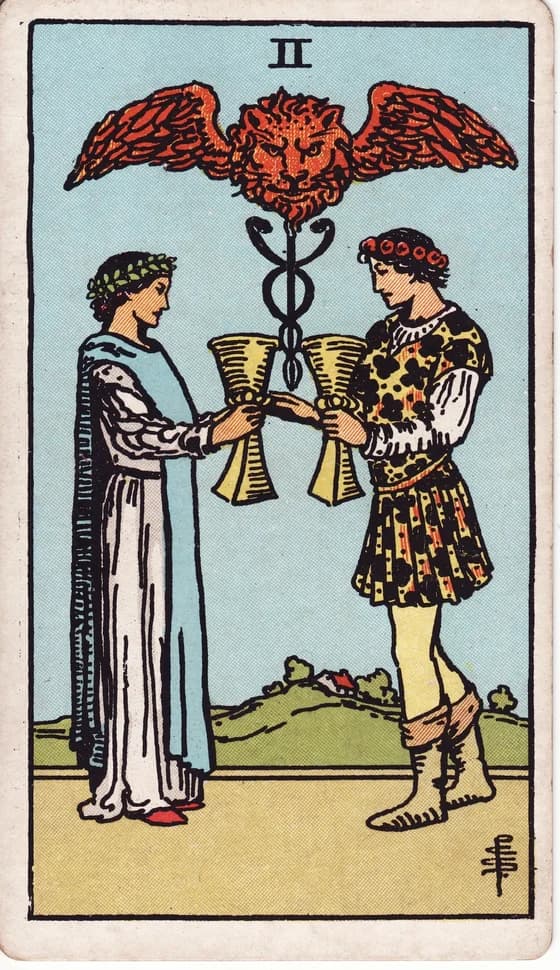
Two people face each other beneath a blue sky, each holding a golden cup. The figure on the left wears a pale robe, a blue outer garment and a wreath of green leaves. The figure on the right wears a short patterned outfit and a red floral wreath, extending one hand towards the other. A staff with two entwined snakes rises between the cups, topped by a red lion’s head and outspread wings.
A small house stands on a green hill in the distance. The figures and their cups are at similar heights: neither person kneels before the other, and they are not drinking from one shared cup. This symmetry can suggest meeting and exchange. The image gives no factual evidence that an engagement, reconciliation or contract has already taken place. View the card image
Waite’s union extends beyond romance
In the 1911 English transcription of The Pictorial Key to the Tarot, Waite describes the pair pledging to each other and names the central emblem the caduceus of Hermes. Historical meanings include love, friendship, affinity and concord. This site keeps the idea of mutual response without carrying forward the text’s restrictions around gender roles. Waite’s entry for this card
This card’s entry in Part III, Section 2 has no separate reversed meaning. Passion appears as a reversed meaning only in the additional meanings in Section 4. The imbalance and communication gaps discussed below are therefore this site’s modern reading, not Waite’s own words for the reversal. Waite’s additional meanings
Upright: Turn rapport into an agreement
Upright, the card may point to useful common ground: listening to the end, expressing disagreement and responding to things already agreed. You can suggest a next step while leaving the other person room to choose or adjust it.
Reciprocity need not be exactly equal on every occasion. One person may be better at planning, another at carrying things out. What matters is that the division is discussed and contributions are recognised, rather than one person doing everything out of fear of losing the relationship.
Reversed: Check whether you mean the same thing
One person may see a conversation as casual discussion while the other treats it as a firm promise. That mismatch is more useful to address than an abstract question of compatibility. Check expectations, pace and boundaries, then see whether a new agreement is possible.
If the other person has clearly declined, respecting that refusal is the response required now. Assuming from a card that they secretly still love you lets imagination override their words. A card cannot express consent for another person.
Three checks when doing something together
When you begin dating, ask how you each prefer to stay in touch rather than using reply speed as the only measure. After a misunderstanding, restate what matters to the other person before explaining your own needs, and check that you understood.
When choosing a collaborator, write down deliverables, timing and responsibilities. Getting along makes communication easier, but ability and follow-through still need separate checking. When asking a friend for help, first ask whether now is a convenient time.
Practice: Confirm both sides
Choose one small task you will do together. Each person states what they hope to receive, what they are willing to contribute and what they cannot currently do. Restate the other person’s answer in your own words. Once they confirm it, agree on one concrete arrangement and a time to revisit it.
A common misreading
The Two of Cups does not certify a soulmate or guarantee reconciliation. Conflict does not automatically make a relationship worthless, and apparent harmony does not prove equality or freedom. Real interactions and clearly expressed wishes are the basis for judging whether to continue a connection.
Read alongside
Ace of Cups: Distinguish a personal beginning from a two-way relationship; Three of Cups: Extend reciprocity between two people into group support.
Sources for this article
- Pamela Colman Smith: Two of Cups, Commons Pam-A scan
- A. E. Waite, The Pictorial Key to the Tarot, Part III §2, Two of Cups
- A. E. Waite, Part III §4, Cups Two
Edition note: the text was checked against the English transcription at Sacred Texts labelled [1911]. The image is the scan currently labelled Pam-A on Commons. The modern situations, questions and exercises were written originally by DestinyPixel. Historical divinatory terms are learning material, not predictions or evidence about real events.