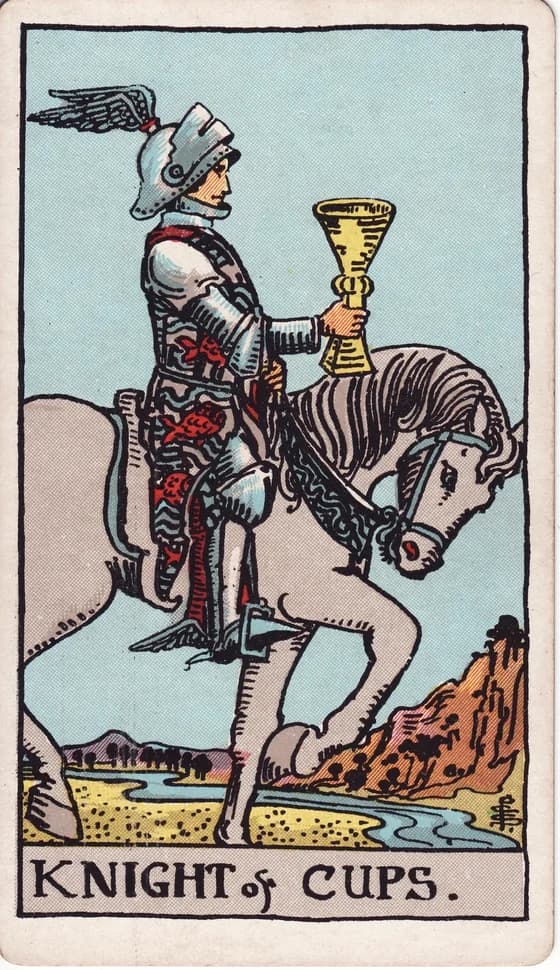
The knight extends a cup
An armoured rider on a pale horse faces right, holding a golden cup at chest height. Wing-shaped ornaments appear on the helmet and boots, while red fish and blue wave patterns decorate the surcoat. The horse lowers its head and raises one foreleg without the appearance of a forceful charge.
Below, a river curves across pale-yellow land, with hills, a few trees and orange-brown rock in the distance. Carrying a cup rather than brandishing a sword emphasises approach and presentation. The picture does not identify the intended recipient or prove that a promise has been fulfilled. View the card image
Waite emphasises arrival and proposals
The 1911 English transcription of Waite’s The Pictorial Key to the Tarot describes grace and quiet riding rather than combat, also connecting the figure with imagination and dreaming. Upright terms include arrival, approach, proposition and invitation. Reversed, strong historical terms cluster around trickery, fraud and duplicity. Waite’s entry for this card
This site turns those terms into a reflective check on expression and follow-through, rather than labels for real people. The figure can represent an approach to action, without a fixed gender or age and without automatically indicating a romantic partner.
Upright: Make the invitation clear and leave room to choose
Upright, the card suits an active proposal: an invitation to meet, a creative presentation, expressed appreciation or a collaboration idea. A good invitation makes its content, timing and expectations clear, and allows the other person to decline.
Feeling gives action direction; practical arrangements show someone how to participate. You can make a proposal appealing while naming what is still uncertain. An honest uncertainty protects trust better than a promise made beyond your capacity simply to win someone over.
Reversed: Check whether action has caught up with words
The reversal can draw attention to visions without practical detail: always saying soon without a date, or agreeing in the excitement of a moment and later finding the commitment impossible. Ask about progress and conditions first, rather than automatically reading a missed promise as calculated deception.
You may also be absorbed in pursuit but unwilling to handle ordinary life once closeness develops. Separating the wish to be liked from willingness to take relational responsibility makes adjustments clearer. If fraud is a real concern, check identities and records instead of repeatedly drawing cards.
Three invitations that need a next step
When asking someone to meet, offer two times that work for you and accept a lack of interest. Romantic expression loses respect when it ignores a clear refusal.
When presenting a creative idea to a client, explain deliverables, timing and limitations alongside the mood. After agreeing to a friend’s event, confirm travel and arrival arrangements. Good intentions are less likely to remain mere words once they enter the calendar.
Practice: Turn a vision into an invitation someone can answer
Choose a plan you have wanted to propose. In four sentences, explain what you would like to do together, why you thought of this person, how much involvement it needs and how they can reply. Remove outcomes you cannot guarantee, allow room to decline or adjust, and check that you can actually carry it out.
A common misreading
The Knight of Cups is not Prince Charming’s identity card, and its reversal is not evidence of promiscuity or infidelity. Observe attraction and reliability separately: one may arise in a moment, while the other takes time, action and respect for boundaries.
Read alongside
Page of Cups: Compare an early attempt at expression with active pursuit; King of Cups: See how expression develops into sustained responsibility.
Sources for this article
- Pamela Colman Smith: Knight of Cups, Commons Pam-A scan
- A. E. Waite, The Pictorial Key to the Tarot, Part III §2, Knight of Cups
Edition note: the text was checked against the English transcription at Sacred Texts labelled [1911]. The image is the scan currently labelled Pam-A on Commons. The modern situations, questions and exercises were written originally by DestinyPixel. Historical divinatory terms are learning material, not predictions or evidence about real events.