The water around the throne has not stopped
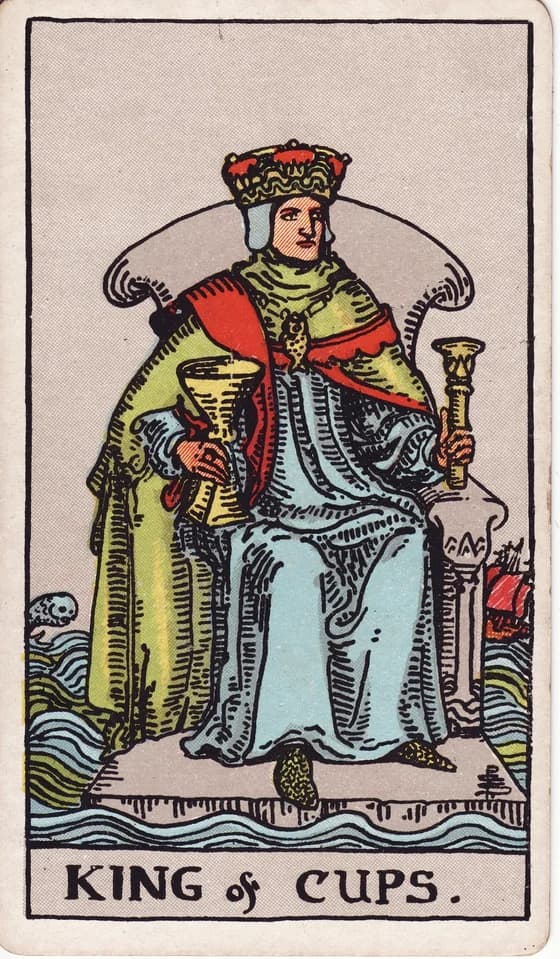
A crowned figure sits upright on a high-backed grey throne, wearing a blue robe beneath a yellow-green cloak. Red fabric crosses the chest, and a fish-shaped pendant hangs at the neck. The right hand holds a golden cup and the left a short sceptre, with the feet resting on a grey platform. The two objects occupy opposite sides of the body in a steady pose.
Layers of blue-green waves surround the platform. A red-sailed ship appears in the distance on the viewer’s right; a fish-shaped sea creature leaps from the water on the left. The figure is not in perfectly calm water. Stability comes from the seated posture and its support within the composition, not evidence that feelings or outside difficulties have disappeared. View the card image
Historical duties and modern emotional regulation
The 1911 English transcription of Waite’s The Pictorial Key to the Tarot sets the throne on the sea and explicitly names the objects to either side as a ship and a leaping dolphin. Its older meanings concern responsibility, willingness to help, fairness, art and creative intelligence, with associations to professional roles of the period. Waite’s entry for this card
Describing the King as emotionally mature is this site’s modern extension from the image and its themes of responsibility, not the text’s only meaning. Strong reversed terms concerning dishonesty, injustice and pillage are background for examining behavioural risks, not grounds for accusing a real person on the basis of a card.
Upright: Hear the feelings and explain the decision
Upright, the card can remind you to steady your response in a conflict, understand what each person is trying to protect, then explain the basis and limits of a decision. Calm does not mean having no feelings, and responsibility does not require absorbing all pressure alone.
An experienced person can still say they do not know yet or seek better-qualified help. Listening to views, applying consistent rules and following up demonstrate reliability more than a permanently composed expression. The court title describes an approach here; age and gender do not determine who can practise it.
Reversed: Notice how feeling enters the use of power
The reversal can examine whether an apparently calm exterior hides keeping people waiting through silence, favouring close associates, or requiring others to soothe you before practical issues can be addressed. It may also concern suppressing pressure and refusing help to preserve a reliable image.
Bring the question back to verifiable behaviour: which promise went unfulfilled, whether rules are consistent, and who can raise a concern. Adjustments might include clearer procedures, recorded decisions or third-party help, rather than an argument about whether someone is mature enough.
Be both kind and clear when responsible
If a team argues over scheduling, let both sides finish, then set priorities based on dependencies and capacity, explaining when the plan will be reviewed. Calming feelings cannot replace resource planning.
If relatives disagree about a trip, ask separately about budget and energy concerns before offering workable choices. If a friend makes you their only source of emotional support, state how much time you can talk and encourage a wider support network. Companionship with limits can still be warm.
Practice: Leave a clear account of a decision
Revisit a small decision you were responsible for. Write down what you felt, the facts you could verify and the standard you applied. Ask whether you would have handled the same request differently from someone else. If you find inconsistency, choose one part you can openly explain and adjust.
A common misreading
The King of Cups is not a fixed code for an older man, and suppressing feelings is not proof of maturity. Its reversal cannot diagnose personality or prove manipulation. The useful lesson is to acknowledge feelings, place limits on power and make commitments open to checking.
Read alongside
Queen of Cups: Compare close listening with public responsibility; Knight of Cups: Move from an appealing proposal to sustained follow-through.
Sources for this article
- Pamela Colman Smith: King of Cups, Commons Pam-A scan standard thumbnail
- A. E. Waite, The Pictorial Key to the Tarot, Part III §2, King of Cups
- Pamela Colman Smith: King of Cups, Commons Pam-A scan standard thumbnail
Edition note: the text was checked against the English transcription at Sacred Texts labelled [1911]. The image is the scan currently labelled Pam-A on Commons. This article inspected its standard 500px thumbnail and cross-checked the repository WebP at a fixed commit; the full-resolution JPEG could not be obtained because of rate limiting. The modern situations, questions and exercises were written originally by DestinyPixel. Historical divinatory terms are learning material, not predictions or evidence about real events.