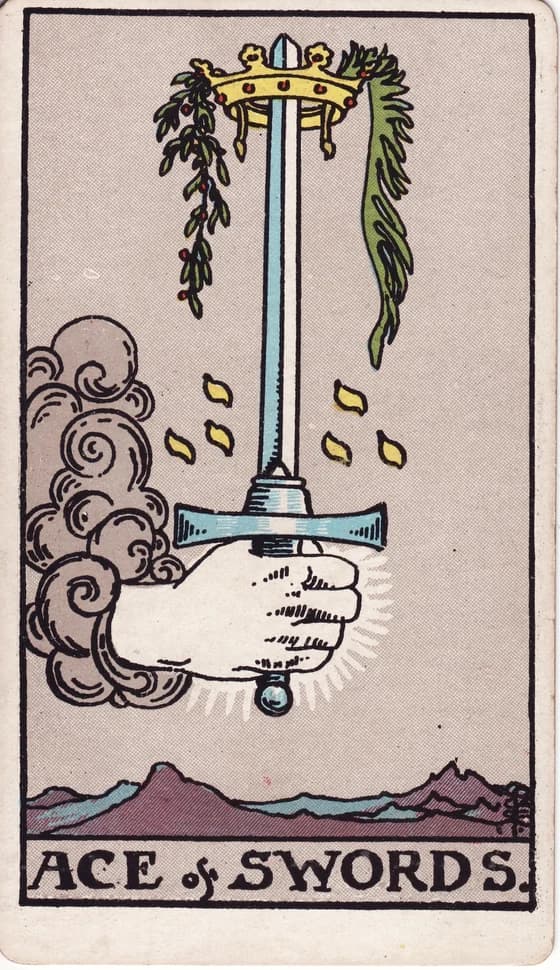
A crown at the point of the sword
A hand emerges from a cloud on the left, holding a long sword upright. Its point passes through a golden crown. Two differently shaped green branches hang from the crown, one with small red dots among its leaves. Six small yellow, leaf-shaped marks float beside the blade, and short rays surround the hand. Below are only undulating mountain ridges, with no crowd awaiting a verdict.
The composition leads your eye up the blade to the crown. A sharp edge can separate things that have become mixed together, while the crown gives that power weight. These are associations prompted by the composition. The image does not spell out your answer or establish that whoever holds the sword must be right. View the image examined for this article
Waite puts force first
In the English transcription of The Pictorial Key to the Tarot labelled 1911, Waite connects the Ace of Swords with triumph, conquest and the full expression of force, while allowing that such intensity can have different results. Reversal involves more than a lack of inspiration: it also concerns harmful consequences of using that force.
Using the card to clarify language and evaluate evidence is this article’s modern reflective extension. Clarity can help you act, but it cannot remove your responsibility for the action. That is very different from treating the card as a guarantee of victory. Check Waite’s original entry
Upright: Find a claim you can test
Upright, the card can help you find a main thread among tangled ideas. You may need to define a problem, propose a solution or put a vague need into words. Sound judgment does more than sound confident: it explains its grounds and allows facts to test it.
An Ace marks a beginning, not a completed plan. Once the goal is clear, specify who or what it concerns, its scope and the next step. Even a sharp insight needs follow-through before it becomes useful.
Reversed: Notice where the sharpness is directed
The reversed card invites you to check two possibilities: rushing to a verdict without enough evidence, or endlessly rewriting your thoughts while refusing even a provisional decision. Your words may also be so sharp that others hear an attack rather than the problem you want to solve. Check the facts and your wording before deciding how to proceed.
In meetings, relationships and writing
When a meeting drifts, ask, “Are we deciding the launch date today, or the scope of the first version?” Separating those questions may help more than adding another complicated chart.
If someone’s slow replies unsettle you, describe what you have observed, then ask, “When you’re busy, could you tell me roughly when you’ll be free?” Avoid treating a delayed reply as proof that they do not care. When writing, state in one sentence what you want the reader to understand, then remove paragraphs that do not support it.
Practice: Give a conclusion some evidence
Choose a question you keep returning to. Write three lines: the facts I know; the judgment I draw from them; the new information that would change my mind. If you cannot write the third line, try replacing “definitely” with a condition you can check.
Clarity does not make you infallible
Do not read the Ace of Swords as “I’m right, so I can say whatever I like.” Nor does it demand an irreversible decision on the spot. Accurate words and room for information you do not yet have are what make clarity useful.
Read next
King of Swords: Move from forming judgments to taking responsibility for them; Two of Swords: Compare defining the question with temporarily keeping your options open.
Sources for this article
- Pamela Colman Smith: Ace of Swords, actual RWS image at the fixed repository commit
- A. E. Waite, The Pictorial Key to the Tarot, Part III, Section 2, Ace of Swords
- Commons Swords01.jpg file page and upload history
Version note: The actual RWS WebP assets from a fixed repository commit were inspected individually. The Commons Pam-A file pages were used to check provenance and versions; no claim of pixel-for-pixel identity between the files is made. Waite is cited from an English transcription labelled 1911. The modern situations, questions and exercises were written originally for DestinyPixel, without borrowing paid card-meaning content.