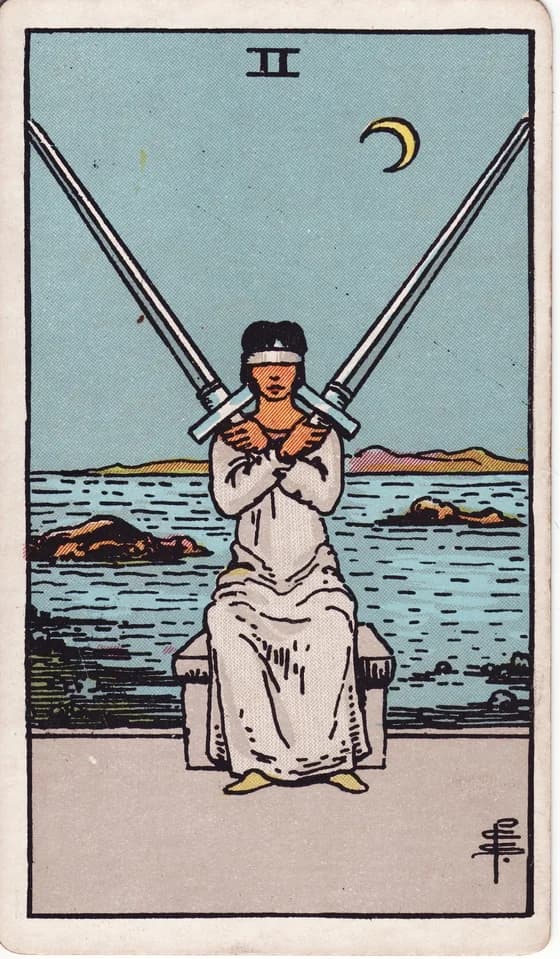
A balanced posture with covered eyes
A white-robed figure sits facing us on a stone bench. Their arms cross over the chest, each hand holding a sword that extends diagonally upward. The blades create an almost symmetrical tension. A pale band covers the eyes, and both feet rest on level ground. Behind are water, exposed rocks and a low distant shore. A crescent moon hangs in the upper right.
The swords touch no opponent, and the figure remains seated. The pose can suggest holding a position for now, though supporting both swords would take effort. Water and rocks lie behind someone whose sight is covered. Reading this as “some realities have not yet entered the calculation” is this article’s extension of what is visible. View the image examined for this article
The original meaning goes beyond indecision
In the transcription labelled 1911, Waite includes balance, courage, friendship and harmony in a state of arms, while qualifying how favourably that harmony should be understood. His reversed list concerns falsehood and unreliable dealings.
The familiar modern reading of difficulty choosing develops from the crossed swords and blindfold. It should not be presented as the original text’s only meaning. Here, the question is whether a pause helps you gather facts, not whether one card can establish that someone is hiding something. Check Waite’s original entry
Upright: Give the pause a purpose
Upright, this card can support briefly containing your emotions rather than letting either side force an immediate position. You can acknowledge the costs of both options and state that you cannot decide yet, provided you know what you are waiting for.
A useful delay has boundaries: a quotation to obtain, a time to confirm or a proper conversation to arrange. Without missing information to gather or a time to revisit the decision, caution may turn into exhausting immobility.
Reversed: The balance may be loosening
Reversed, the card can prompt you to notice a shelved conflict surfacing, or so much information that priorities become unclear. You need not force an instant choice, but identify which facts are already clear enough. If someone’s account seems inconsistent, check the record directly rather than substituting suspicion for evidence.
Two possibilities need not both become commitments
If you want to accept two projects, list the time and delivery requirements of each. When they overlap, the question is not how to please everyone, but whether you can negotiate priorities and trade-offs.
If your family disagrees about weekend plans, pause the argument, ask what each person cannot change and agree when you will respond. When choosing a course after endless comparisons, set two essential criteria. If an option meets them, you need not keep searching for a perfect choice that may not exist.
Practice: Set a condition for ending the pause
Complete this sentence: “Once I have ___ information, I will decide by ___.” Would that information genuinely change your choice? If not, name the cost you are most reluctant to bear and consider how to reduce it.
A blindfold does not prove intuition is always right
The Two of Swords does not automatically mean two people, two relationships or a fixed either-or dilemma. Remaining neutral for now is not necessarily fair. Some facts need acknowledging, and someone still needs to carry the responsibility.
Read next
Ace of Swords: Practise stating the unresolved question clearly; Eight of Swords: Distinguish postponing a choice from having your actions restricted.
Sources for this article
- Pamela Colman Smith: Two of Swords, actual RWS image at the fixed repository commit
- A. E. Waite, The Pictorial Key to the Tarot, Part III, Section 2, Two of Swords
- Commons Swords02.jpg file page and upload history
Version note: The actual RWS WebP assets from a fixed repository commit were inspected individually. The Commons Pam-A file pages were used to check provenance and versions; no claim of pixel-for-pixel identity between the files is made. Waite is cited from an English transcription labelled 1911. The modern situations, questions and exercises were written originally for DestinyPixel, without borrowing paid card-meaning content.