The picture assigns no owner to this heart
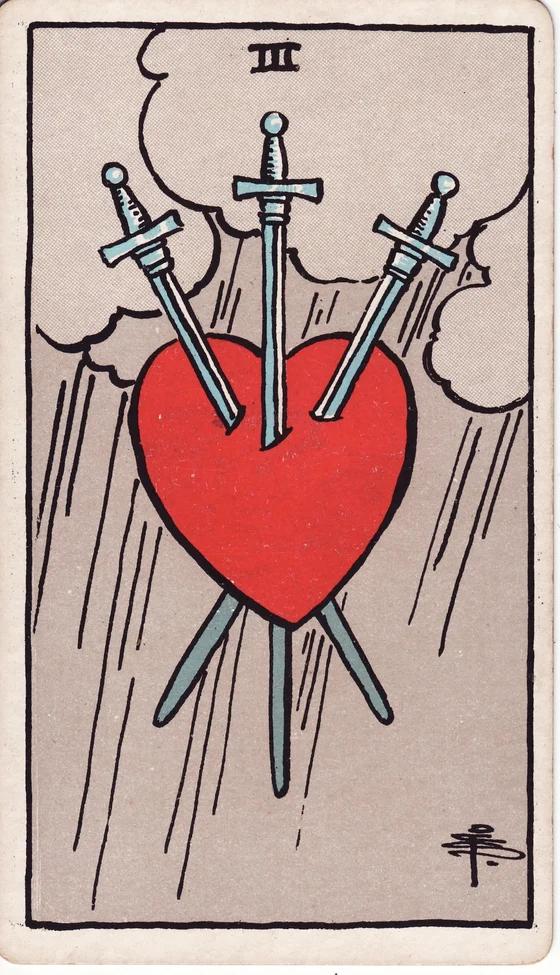
A red heart shape hangs in a gray background, pierced by three swords: the central one nearly vertical, the others crossing diagonally. Low clouds surround it above and on both sides, with thin rain lines falling. There are no people, buildings, or ongoing conversations, and nothing identifies whose heart it is.
The red heart sharply contrasts with the cool blades, leaving the eye little place to escape. Hurt is depicted directly, but its cause is not. Three swords can remind us to examine several factors; they cannot establish that a “third person” must exist. View the card image examined for this article
Waite writes of separation and rupture
Waite’s transcription labeled 1911 lists departure, absence, delay, division, and rupture, and treats the image as fairly direct. The reversed list also includes error, loss, and confusion, so uniformly reading reversal as a healed wound does not fit this text.
This article studies the card through acknowledging disappointment and identifying needs, a modern reflective use. It retains the image’s gravity without applying pathologizing language from the historical list to anyone’s mental state. Check Waite’s original card entry
From image to question: what still needs checking?
The card provides neither an identifiable face nor a sequence of events before and after. Readers can easily put their own story into it, which is precisely why “What has already happened?” should precede discussing feelings. You can acknowledge that a comment hurt while not yet knowing whether the speaker intended offense.
Both the Three of Swords and Five of Cups can discuss loss. The former focuses on pain and separation; the latter’s picture also shows remaining cups. That difference can guide question order: hear where it hurts first, then discuss what remains possible. Skipping the first step can make even positive advice feel premature.
Upright: connect feelings with a specific event
Upright may describe a disappointed expectation or finally admitting that an arrangement differs from your needs. Make “It’s awful” more specific: were you not informed, misunderstood, or affected by a changed agreement? Accurate naming helps you choose the next step.
Acknowledging hurt requires neither immediate forgiveness nor an immediate end to a relationship. Facts, effects, and needs can be handled separately. Some matters can be renegotiated; some losses take time to accept.
Reversed: observe how sadness is handled
Reversal may mean willingness to discuss pain, or repeatedly recalling one sentence without an opportunity to clarify it. Notice whether you are gradually regaining choice or forcing yourself to move on quickly. It cannot establish another person’s remorse; repair still depends on actual responses and changes.
Case one: continuing to create after a rejection
Original fictional case, current-situation position, upright. Ahe submits an essay to a community publication. The editor replies that its topic does not suit the issue and the middle is narratively unclear. She is disappointed and has reread the reply several times. She asks, “How should I understand this rejection?” The publication evaluated this manuscript alone, not her whole person, and did not tell her to stop writing.
The pierced heart first gives her disappointment a place. She can admit that she hoped to be selected without immediately calling rejection a good thing. But no people appear in the picture, so it cannot establish malicious targeting by the editor. Nor should three swords become three invented failures. They can instead prompt separating three levels: the issue’s theme, narrative structure, and personal expectations.
She saves the original draft and, after a night, divides the comments into actionable revisions and subject mismatch. She asks a friend to test-read the middle’s chronology and leaves the topic for a more suitable publication, rather than changing everything that interested her to fit this issue.
If the editor’s response were merely automatic, there would not be enough evidence of a problem in the middle, and specific feedback would be needed elsewhere. If two independent readers identify the same jump, revision has a stronger basis. Upright supports honestly facing one disappointment without turning one rejection into a final verdict on creative ability.
Case two: what if you said it was fine but still mind?
Original fictional case, advice position, reversed. Songyao and a friend planned to visit an exhibition together. The friend canceled at the last minute, later explaining a schedule clash. Songyao replied “It’s fine,” but her subsequent messages became increasingly brief. She asks, “How can I let this go?” The friend has explained the cause, but they have not discussed advance notice or rescheduled.
Reversal offers two routes: willingness to voice disappointment, or rushing to deny it so discomfort moves elsewhere. Here, brief replies do not match the spoken reassurance, supporting first clarifying what bothers her. The heart and rain can guide expression of real feelings. With no conversation depicted, the three swords cannot establish someone else behind the friend or announce the friend’s regret.
She realizes what matters most is that she kept an entire day free. She says, “I understand plans change, but I had set aside the time. Once you know there’s a conflict, could you tell me earlier?” She then decides whether to reschedule, rather than treat immediate warmth as proof of repair.
If this was an isolated cancellation communicated promptly, she may also need to accept unavoidable disappointment. If last-minute changes are frequent, reducing reserved time may be more suitable. Their history and subsequent response are the evidence. Reversal offers an opening for renewed expression without promising feelings will disappear by a deadline.
Disappointment is not confined to romance
When a proposal fails, distinguish feedback on the work from judgment on your entire person. Ask whether the rejected element was budget, direction, or expression, turning vague frustration into parts that can be handled.
If a friend cancels a long-awaited meeting, state your disappointment and check whether to rearrange. Hurtful relationship remarks need specific discussion of their impact, not a drawn card used as an accusation. When leaving a familiar city, reluctance to leave can coexist with wanting a new life.
Exercise: write a message you will not send yet
Write three sentences to the person or event that disappointed you: “What happened,” “What this cost me,” and “What I need now.” Put it aside briefly, then check whether unverified motives have been written as facts. Deciding whether to communicate can wait.
Three swords are not evidence of a love triangle
The Three of Swords cannot prove betrayal or guarantee a breakup. Pain deserves a serious hearing, but the image cannot replace the people’s own accounts, reliable evidence, or actual negotiation.
Sources and version for this article
- Pamela Colman Smith: Three of Swords, the actual on-site RWS image at a fixed commit
- A. E. Waite, The Pictorial Key to the Tarot, Part III, Section 2, Three of Swords
Version note: This article uses the existing RWS WebP card image at a fixed commit. It makes no claim of pixel-for-pixel identity with the Commons scan. Historical interpretations were checked against Waite’s English transcription; the modern questions, exercises, and fictional cases above are original applications.