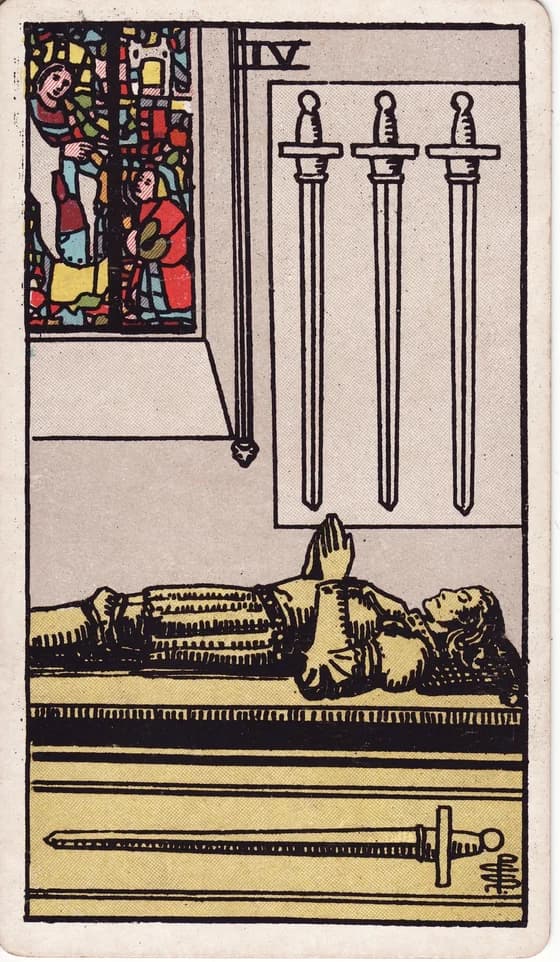
The reclining figure is a tomb effigy
A golden figure lies on a rectangular platform, head to the right and hands joined at the chest. Three swords hang point-down on the wall above. A fourth runs horizontally along the platform’s front, parallel to the body. In the stained-glass window at the upper left, one person stands and another kneels. Its colours contrast with the room’s grey walls.
The image shows armour-like clothing and very little movement; Waite explicitly identifies a knight’s effigy on a tomb. Do not turn this stillness directly into news of sleep, hospitalisation or death. What the composition offers here is a way to study quiet, withdrawal and a temporary halt to confrontation. View the image examined for this article
Rest and vigilance coexist in the original
Waite’s text labelled 1911 includes vigilance, retreat, solitude and a hermit’s repose, and says that funerary imagery informed the design. His reversed meanings include prudent management, economy and precaution. They do not precisely match the common modern interpretation of insufficient rest.
Using the card to discuss recovery arrangements is an extension into contemporary life. It provides no health assessment and does not promise that rest will solve every problem. Check Waite’s original entry
Upright: A pause needs to be arranged
Upright, the card invites you to lower external demands so your thinking can reorganise. Stop an argument, postpone a non-urgent reply or leave a period free of tasks. These are concrete ways to pause.
Quiet does not have to mean carrying everything alone. A proper handover and a clear time for resuming contact can make rest easier. If you lie down with your work phone and keep checking every alert, your body may be still while your attention remains on duty.
Reversed: Distinguish readiness from pressure to return
The reversal can be approached from two sides: you have recovered some capacity and are ready to return gradually, or you remain exhausted but feel undeserving of more time off. Do not let orientation alone decide whether to move or rest. Consider actual energy, workload and available support, then adjust your pace.
Leave an interval in work and conversation
After a run of writing deadlines, clear nonessential meetings from the next day and focus first on handovers and one crucial task. Recovery is not a reward you qualify for only after clearing the backlog.
During a relationship argument, agree to talk later and say which question you need to think through in the meantime. That differs from disappearing without explanation. When study stalls, stepping away briefly and then checking the faulty steps may help more than repeating the same attempt in exhaustion.
Practice: Design a genuine empty interval
Choose a manageable short period. Write down its start and end, what you will not handle during it, and who can take over if necessary. Afterwards, ask only: which reduction in stimulation made it easier for my attention to return? Keep the arrangements that helped.
Rest is not escape from every responsibility
The Four of Swords does not demand permanent withdrawal, and its effigy cannot establish anyone’s physical condition. It is better used to clarify a pause: what you step away from, what you retain and when you will reassess.
Read next
The Hermit: Compare active inquiry with temporary rest; Six of Swords: Move from stillness and recovery toward a supported transition.
Sources for this article
- Pamela Colman Smith: Four of Swords, actual RWS image at the fixed repository commit
- A. E. Waite, The Pictorial Key to the Tarot, Part III, Section 2, Four of Swords
- Commons Swords04.jpg file page and upload history
Version note: The actual RWS WebP assets from a fixed repository commit were inspected individually. The Commons Pam-A file pages were used to check provenance and versions; no claim of pixel-for-pixel identity between the files is made. Waite is cited from an English transcription labelled 1911. The modern situations, questions and exercises were written originally for DestinyPixel, without borrowing paid card-meaning content.