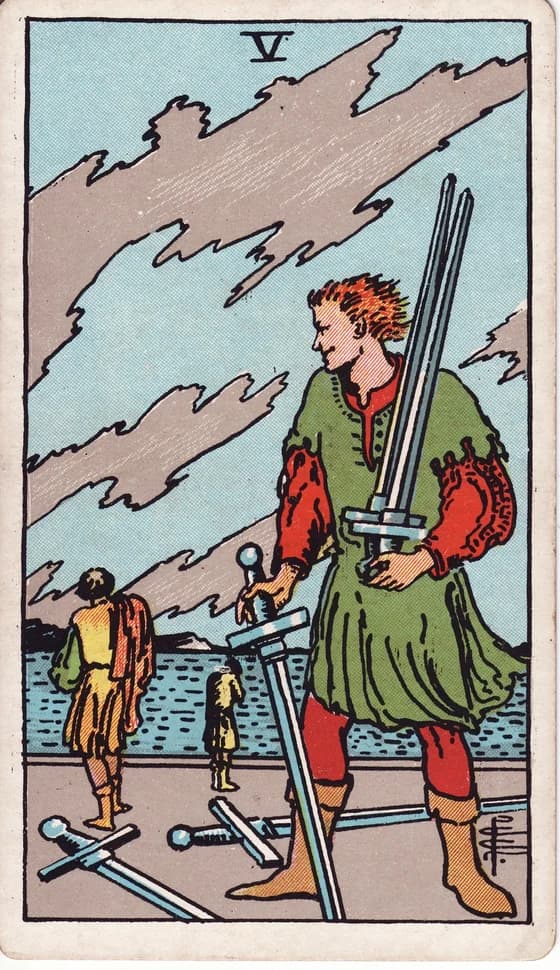
The person holding the swords stays in the foreground
The foreground figure wears a green top with red sleeves and leggings, turns toward the left and has an upturned mouth. One hand holds two swords pointing upward; the other holds a sword pointing down. Two more lie near the feet. Two people walk away toward the water with their backs to us. The farther figure raises a hand near the head.
Long diagonal clouds cross the sky, and the water and distant shore make a bleak backdrop. The image gathers the swords into one person’s possession while others leave. Gaining objects while losing companions is a more useful contrast to examine than simply assigning the roles of good person and bad person. View the image examined for this article
Waite does not describe a happy victory
In the transcription labelled 1911, Waite says the foreground person holds the field and the departing figures are dejected, yet his meanings concentrate on loss, revocation and damage to reputation. He does not define reversal as automatic reconciliation; similarly heavy meanings remain.
Examining the cost of winning and attempting repair are modern reflective approaches in this article, not a claim that the original predicts successful repair. The image supports a discussion of conflict, not a verdict on an absent person’s character. Check Waite’s original entry
Upright: Count the cost of how you win
Upright, the card can prompt you to notice when an argument has drifted from its purpose. You want cooperation, yet humiliation, fault-finding or interruption may be silencing others. A short-term advantage can cost information, trust and willingness to continue working together.
If you are in a weaker position, leaving an unproductive argument can protect a boundary. You do not have to prove that you can argue better before you are entitled to stop. Ask whether more effort would actually improve the situation.
Reversed: There is work after the ceasefire
Reversed, the card can help you examine lingering anger, revived grievances or willingness to acknowledge harm you also caused. An apology needs to address specific behaviour, and repair needs the other person’s response. If conversations keep causing harm, less contact or clear written agreements may be more appropriate.
Replace winning the debate with handling the problem
You publicly point out a colleague’s mistake, then find the project no longer receives timely feedback. Acknowledge the effect of how you spoke before moving the technical issue into a discussion where evidence can be checked.
Bringing up someone’s past failures during a family argument often makes the present issue harder to solve. Before replying again in an online dispute, ask whether it will add facts or only attract more spectators. Leaving an escalating comment thread does not mean accepting the other person’s view.
Practice: Pause for one line before replying
Write, “What I want from this conversation is ___.” Compare your planned reply with that goal. Remove sentences that would embarrass the other person without advancing it. If the goal is no longer achievable, consider a clear way to end the exchange.
This card does not label people as bad
The Five of Swords cannot prove malicious intent, and it does not encourage winning at any cost. Nor should real disagreement be erased for the sake of superficial peace. Examine how the disagreement is handled and the consequences that approach is creating.
Read next
Seven of Swords: Continue examining the relationship between strategy and responsibility; Five of Wands: Distinguish constructive competition from the damage left by a contest for victory.
Sources for this article
- Pamela Colman Smith: Five of Swords, actual RWS image at the fixed repository commit
- A. E. Waite, The Pictorial Key to the Tarot, Part III, Section 2, Five of Swords
- Commons Swords05.jpg file page and upload history
Version note: The actual RWS WebP assets from a fixed repository commit were inspected individually. The Commons Pam-A file pages were used to check provenance and versions; no claim of pixel-for-pixel identity between the files is made. Waite is cited from an English transcription labelled 1911. The modern situations, questions and exercises were written originally for DestinyPixel, without borrowing paid card-meaning content.