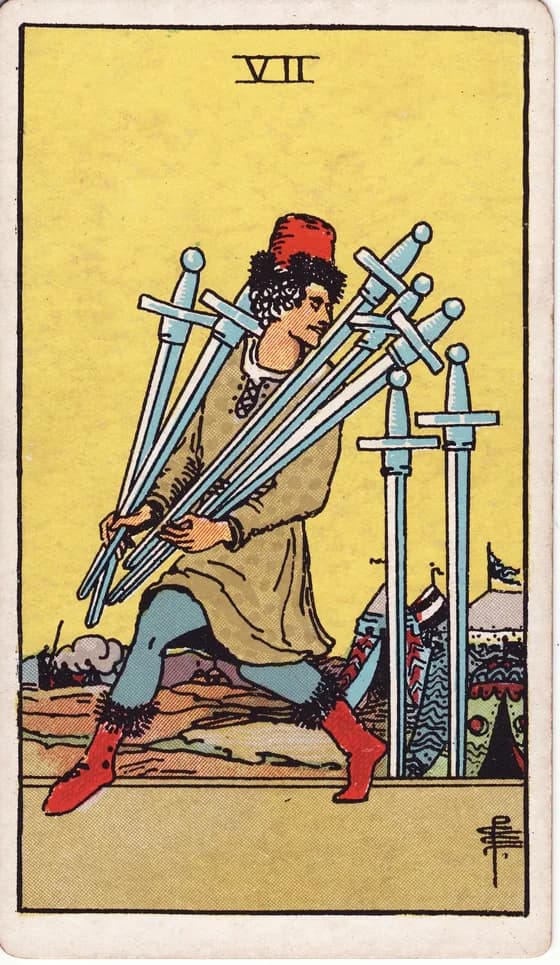
Five swords are carried away and two remain
A figure in a red cap and red boots steps left while looking back to the right. Both hands carry five long swords, gripping near the blades; two other swords remain upright in the ground. Patterned tents and flags stand behind to the right, while a small, indistinct group appears in the far left distance. The sky is a broad field of yellow.
The stride, backward glance and two remaining swords create tension. Permission, a transaction and a pursuit are not shown. “Carrying away” is a visible action; “stealing” adds a judgment about the story. That distinction is useful practice in not treating a first impression as the whole account. View the image examined for this article
Waite himself acknowledges conflicting meanings
In the transcription labelled 1911, Waite lists plans, attempts, wishes and hope alongside quarrelling and a plan that may fail. He explicitly notes how widely these meanings differ. Reversal includes advice and instruction as well as idle or false talk.
Reducing the card to “someone is deceiving you” narrows the original and turns speculation into accusation. This article extends it through strategy, informed participation and responsibility, to examine how things are done rather than detect other people’s secrets. Check Waite’s original entry
Upright: Check boundaries before changing routes
Upright, the card can suggest a flexible approach when a head-on confrontation would not help. Flexibility still needs explanation: whose resources are being used, which agreement is being bypassed, and who cannot protect their interests because they do not know?
Privacy and concealment also need distinguishing. Keeping personal details to yourself can be a reasonable boundary. Hiding a crucial condition in a shared decision can undermine cooperation. Specific agreements and real consequences matter more than a blanket demand to disclose everything.
Reversed: Let someone check the plan
Reversed, the card can invite you to show a privately developed plan to someone trustworthy or supply an explanation you left out. You may discover that the strategy cannot last. Revising it may take less effort than inventing excuses, but the card cannot prove a secret will be exposed or require someone to surrender all privacy.
Shortcuts and privacy have different boundaries
Reusing an old proposal can save time, but check its data, attribution and permission to use it. Do not present research you never conducted as something you verified.
Quietly altering a shared plan to avoid discussion may work briefly but leave partners unable to prepare. Explain the reason first and seek agreement. In study, memorising answers can look like rapid progress until a different question reveals gaps. You then need a better way to test understanding.
Practice: Put a shortcut through the explanation test
Write down one time-saving method you are considering, followed by: “If I explained this to the people affected, the sentence I would most want to skip is ___.” That sentence usually deserves checking. Add the missing facts, obtain agreement or choose a method that does not depend on concealment.
A backward glance is not evidence in a relationship case
The Seven of Swords cannot prove infidelity, theft or deliberate deception. If there are specific concerns, communicate and investigate on the basis of facts. Drawing a card adds no evidence to suspicion and gives no permission to invade someone’s privacy.
Read next
Five of Swords: Compare the costs of winning and the costs of a strategy; Page of Swords: Turn suspicion into questions that can be checked.
Sources for this article
- Pamela Colman Smith: Seven of Swords, actual RWS image at the fixed repository commit
- A. E. Waite, The Pictorial Key to the Tarot, Part III, Section 2, Seven of Swords
- Commons Swords07.jpg file page and upload history
Version note: The actual RWS WebP assets from a fixed repository commit were inspected individually. The Commons Pam-A file pages were used to check provenance and versions; no claim of pixel-for-pixel identity between the files is made. Waite is cited from an English transcription labelled 1911. The modern situations, questions and exercises were written originally for DestinyPixel, without borrowing paid card-meaning content.